


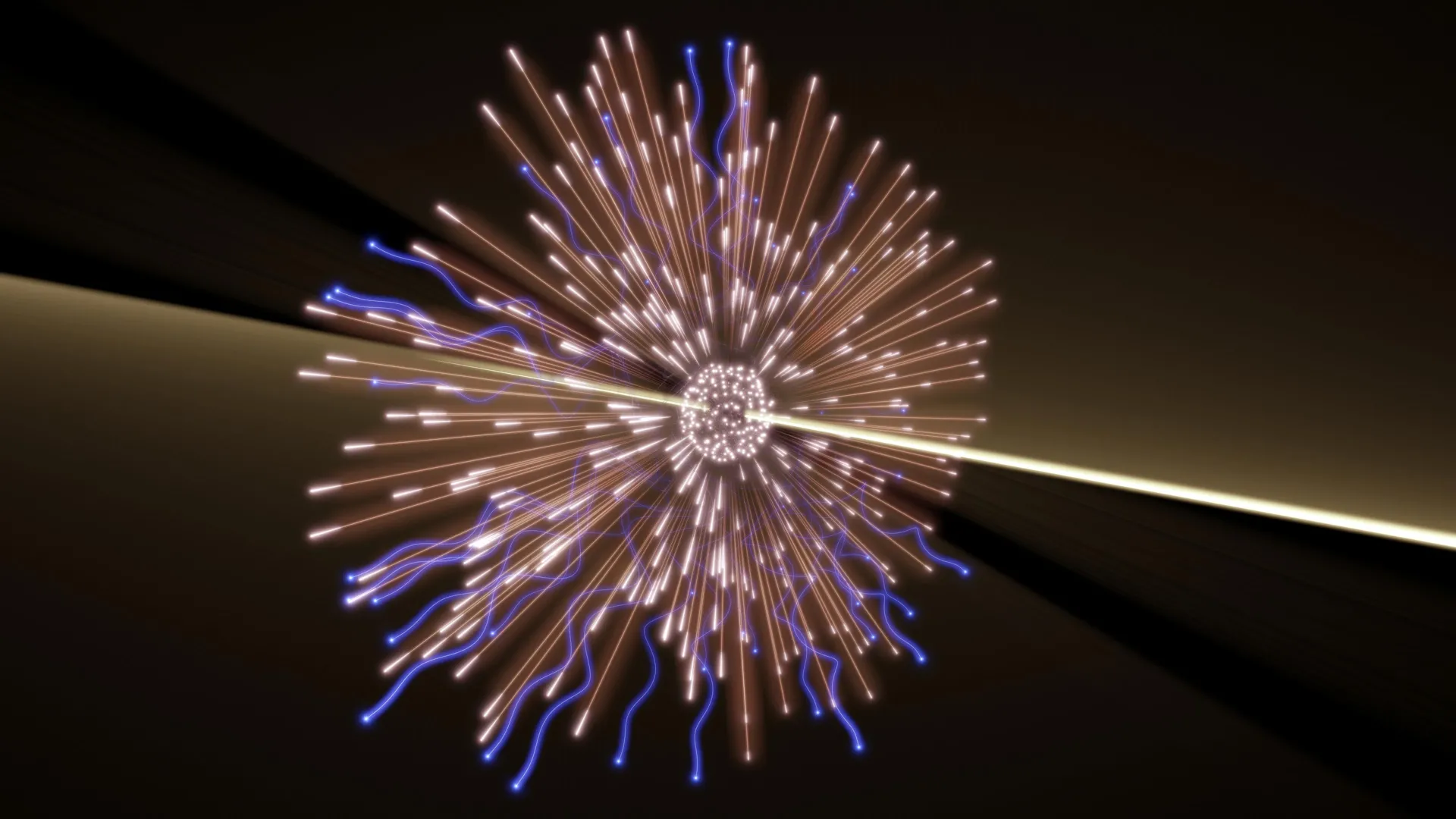
Even after a nuclear reactor is shut down, its core continues to produce a small amount of radioactive heat and radiation. Long-lived fission products decay for months or even years, releasing a steady stream of elusive particles known as antineutrinos. These nearly massless particles can pass through reactor structures, containment systems, and surrounding shielding with very little interference, making them valuable tools for nuclear monitoring.
Scientists with the Double Chooz experiment have measured residual antineutrino emissions from a nuclear reactor after shutdown for the first time. The study, recently published in Physical Review Letters, was led by Anthony O’Nilon and Thierry Lasserre of the Max Planck Institute for Physics (MPIK). The results demonstrate that antineutrino detectors can continue gathering information about nuclear facilities even when their reactors are offline, creating potential applications in reactor monitoring, nuclear safety, and nuclear safeguards.
Detecting antineutrinos from a shut-down nuclear reactor
The measurements were conducted at the Chooz nuclear power plant in northern France. The Double Chooz detector is located approximately 400 meters from the facility’s two reactor cores. Its detection system contains more than 30 cubic meters of liquid scintillator, a material that produces tiny flashes of light when antineutrinos interact with it.
“Antineutrinos interact with matter extremely rarely. However, when an interaction occurs inside the Double Chooz detector, it produces a distinctive double-light signal that can be separated from background events,” explains Thierry Lasserre of the independent OMINA research group, also based at MPIK. This signature enables researchers to identify antineutrinos associated with nuclear reactor activity.
The research team analyzed 17.2 days of data collected while both reactor units were completely shut down. During this period, the detector recorded approximately 100 candidate antineutrino events linked to residual radioactivity in the reactor cores and the nearby spent fuel cooling pool.
Results agree with nuclear fuel simulations
The observed antineutrino signals closely matched detailed computer simulations based on the remaining nuclear fuel inventory and the decay of long-lived fission products. These findings provide the first direct experimental confirmation of models predicting antineutrino emissions from shut-down reactors and spent nuclear fuel.
“Until now, reactor antineutrino experiments have mainly focused on operating reactors, which produce much stronger antineutrino fluxes. Measuring the much weaker residual signal after shutdown required exceptionally low background levels and advanced analysis methods developed over many years by the Double Chooz collaboration,” Dr. O’Nilon said.
Other experiments are now investigating this emerging research area. Initial results from JUNO-TAO, presented at Neutrino 2026, indicate that scientists are also analyzing reactor outage data to study the faint antineutrino emissions produced by spent nuclear fuel. The Double Chooz study provides an important published benchmark for future research into residual antineutrino signals from shut-down reactors and spent fuel pools.
Antineutrinos could improve nuclear reactor monitoring
The findings suggest that antineutrino detectors may eventually provide information about nuclear facilities during reactor operation, maintenance periods, and after shutdown. This capability could support the independent verification of reactor status and help monitor changes in spent fuel inventories.
Double Chooz was originally designed to study neutrino oscillations and played an important role in measuring the neutrino mixing angle θ13. This fundamental parameter describes how neutrinos change from one type to another as they travel and has helped advance research into matter-antimatter asymmetry in the neutrino sector.
With this latest result, the Double Chooz experiment has added another milestone to its scientific record: the first detection of a faint antineutrino signal that continues after a nuclear reactor has been shut down.
Source: www.sciencedaily.com