


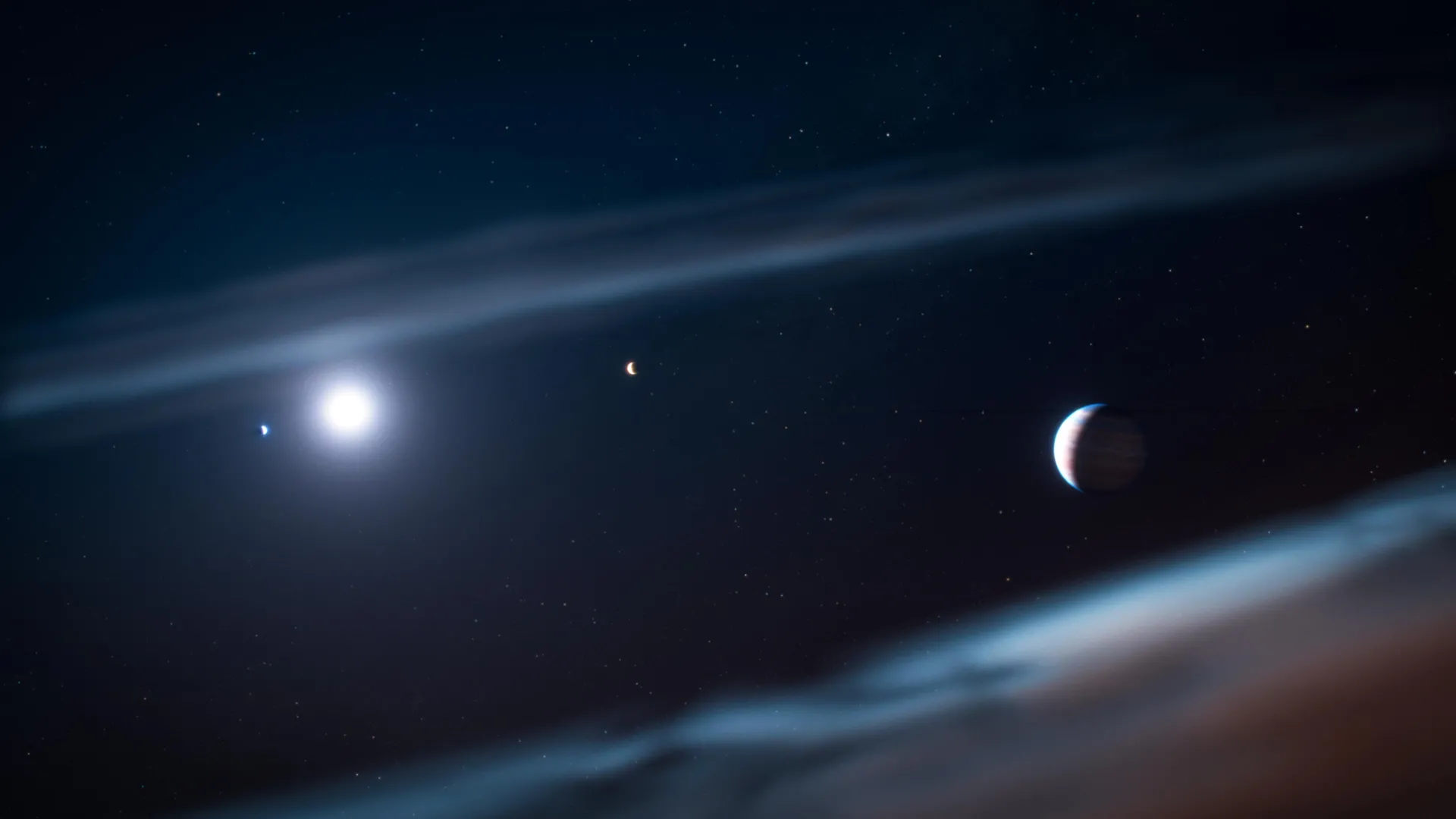
NASA’s James Webb Space Telescope has unveiled a remarkable discovery: a gigantic exoplanet nestled within one of the Milky Way’s most extensively studied planetary systems.
The nearby young star Beta Pictoris, already known to host two massive planets—Beta Pictoris b and Beta Pictoris c—has now added a third planet to its roster. Beta Pictoris b was among the first exoplanets to be directly imaged. The newly identified Beta Pictoris d means this system is only the second known to harbor at least three imaged planets, enriching the field of exoplanet research.
Astronomers did not originally recognize Beta Pictoris d as a bright light source. Instead, it was detected through distinctive chemical signatures in its atmosphere, showcasing how innovative approaches can enhance planet-finding endeavors in dusty environments where traditional imaging faces challenges.
“This breakthrough introduces a fresh layer to an already captivating planetary system,” says a Postdoctoral Fellow at the University of California, San Diego. “Beta Pictoris has long acted as a testing ground for understanding planetary system formation and evolution, and now we have an additional planet to enrich this narrative.”
Young and Proximity: A Unique Planetary System
Located approximately 63 light-years from Earth and estimated to be just 23 million years old, Beta Pictoris presents astronomers with a rare chance to observe the dynamics of newly formed planets amidst a disk of dust and debris from the system’s inception.
Researchers estimate Beta Pictoris d has at least twice the mass of Jupiter, making it the smallest of the three known gas giants orbiting this star.
Computer models suggest this planet orbits Beta Pictoris at around 30 astronomical units, a distance akin to Neptune’s position in our solar system. While it possesses the widest orbit of the three observed planets, it resides still within the inner boundary of the debris disk.
An Accidental Discovery
The research team did not initially set out to find new planets. The existence of Beta Pictoris d was an unexpected revelation during their study of its atmosphere using Webb’s NIRSpec.
Utilizing NIRSpec’s Integral Field Unit, which captures images and spectra at the pixel level, astronomers can dissect light into its component wavelengths, allowing for an in-depth analysis of chemical reactions and movements within distant celestial bodies.
“We weren’t searching for new planets,” said Gibbs. “We were investigating a signal we were already aware of, and unexpectedly, this distinct signal appeared in our data.”
Instead of a smooth spectrum anticipated from light reflecting off dust, they observed a pattern of peaks and valleys indicative of carbon monoxide absorption lines, a signature typically found in the atmospheres of giant planets.
Using spectroscopy, the research team also measured the object’s radial velocity, offering insights into its movement relative to the observer. The collected data concerning its speed, location, and relation to the debris disk aligned well with expectations for a planet in orbit around Beta Pictoris, effectively ruling out possibilities like distant background stars or brown dwarfs with carbon monoxide in their atmospheres.
Supporting Chemical Evidence for a Hidden World
“An unexpected bright source was revealed within the integral field unit’s image processing, yet we’ve learned to be cautious with bright clusters in images,” mentioned Jean-Baptiste Ruffio, a research scientist at the University of California, San Diego, and principal investigator for the initial Webb observation leading to this discovery. “Such clumps could be instrumental artifacts or other formations within the debris disk. By capturing spectra simultaneously with images, we quickly confirmed our suspicions.”
Following this, the astronomers conducted additional observations using Webb’s MIRI (Mid-Infrared Instrument) at the request of the director’s discretionary time. These follow-ups revealed the presence of water vapor and methane, further substantiating Beta Pictoris d as a planet and unveiling additional atmospheric details.
This methodology offered significant advantages over traditional imaging techniques. From initial observations, researchers not only validated that the object was a planet but also began investigating its atmospheric chemical and physical properties.
“The spectrum contains a wealth of information,” noted Rufio. “You don’t just establish the object as a planet; you start to understand its temperature, chemical processes, and movements.”
Furthermore, an independent imaging study corroborated this finding. Conducted by Ben Satriev from the University of Edinburgh and Markus Bonse from the European Southern Observatory, researchers verified the existence of Beta Pictoris d using the Very Large Telescope and Webb’s NIRCam.
Discovering Planets in Cosmic Fog
Beta Pictoris d had remained undetected for years due to its location within one of the brightest debris disks observed by astronomers. Dust in the disk scatters light from the central star, creating an effect akin to fog, complicating the task of distinguishing the planet from adjacent dust structures and other light sources.
Webb’s spectroscopic techniques allowed researchers to navigate around much of this confusion. By isolating a narrow molecular signal characteristic of the planet’s atmosphere, they could make a significant identification despite the glare.
The detection of Beta Pictoris d could also provide insights into the peculiar characteristics of the system’s debris disk, which features a well-defined internal boundary and several enigmatic structures. Astronomers had previously speculated that an undiscovered planet, similar to Beta Pictoris d, could be responsible for shaping the disk and creating some of its features.
A Groundbreaking Method to Uncover Exoplanets
This discovery does more than merely add a new entity to the Beta Pictoris system; it introduces a novel method for detecting exoplanets in intricate, dusty regions.
Beta Pictoris d is the first planet to be directly imaged and discovered primarily via moderate-resolution spectroscopy. This approach demonstrates that astronomers can identify worlds by recognizing the molecular fingerprints of their atmospheres, rather than relying wholly on traditional coronagraphic imagery.
This capability could prove invaluable for locating planets ensconced within dazzling debris disks or other structures that are challenging to discern in conventional telescopic images.
Researchers intend to continue examining Webb’s observations to refine their estimates of Beta Pictoris d’s temperature, atmospheric composition, and orbital parameters, potentially yielding a more comprehensive understanding of one of the most renowned planetary systems outside our own.
Expanding Horizons with Webb’s Vision
The James Webb Space Telescope stands as the premier space science observatory globally, unraveling the enigmas of our solar system, probing distant worlds around other stars, and delving into the intricate structure and origins of our universe. Webb represents an international partnership led by NASA, alongside the European Space Agency (ESA) and the Canadian Space Agency (CSA).
Source: www.sciencedaily.com