Sperm Whales Produce the Loudest Known Communication Sound in the Animal Kingdom
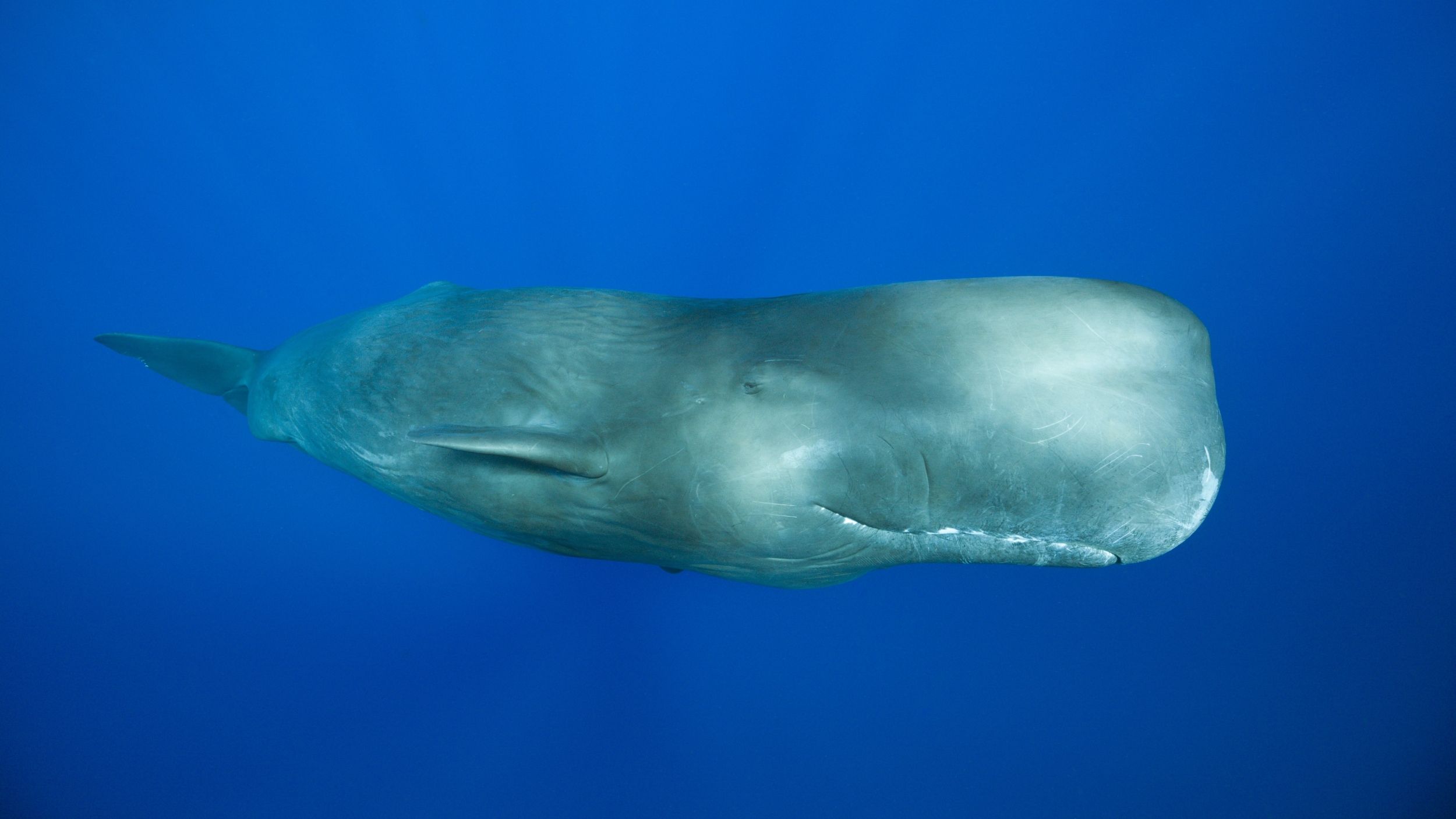
Sperm whales produce the loudest known communication sound made by any animal, according to new research. However, scientists still do not know exactly why male sperm whales make these powerful, metallic “clanging” sounds.
Researchers studying the mysterious low-frequency calls found that sperm whale clangs are louder than any previously recorded communication signal from the species. The sounds may be capable of traveling through the ocean and reaching other whales as far as 43 miles (70 kilometers) away.
The sounds are remarkably loud and metallic, resembling “a jail door slamming.” That distinctive quality is why scientists call them “clangs,” study first author Simone Videsen and co-author Peter Teglberg Madsen, biologists at Aarhus University’s Center for Active Sensing with Sound in Denmark, told Live Science. “You feel small as a human when you hear them, as they are clearly made by something bigger than you,” they said.
Sperm whales (Physeter macrocephalus) are the largest toothed predators on Earth. They can grow to approximately 59 feet (18 meters) long and dive nearly 1.9 miles (3 kilometers) below the ocean’s surface to hunt giant squid (Architeuthis dux) and other deep-sea prey.
Scientists first reported the distinctive clangs in the 1980s. Although sperm whales can produce even louder echolocation clicks while hunting, clangs are their loudest known communication signals. The calls are especially unusual because only males are known to produce them, and their purpose remains unclear.
For the new study, researchers used hydrophones, or underwater microphones, near the Seychelles to measure the volume and acoustic properties of sperm whale clangs. They also examined recordings from other regions, including waters near Sri Lanka, Norway and Scotland, to investigate the rhythm of the signals.
The recordings showed that male sperm whales produce the clangs in a slow, deliberate pattern. Unlike the rapid clicks used for echolocation and typical social communication, the whales left gaps of approximately five to 10 seconds between individual sounds. Scientists believe the whales may maintain this rhythm by using echoes that bounce off the seafloor, rather than by counting the seconds themselves.
Sperm whales are able to create such powerful underwater sounds because of their enormous noses—the largest of any animal. Their massive heads account for roughly one-third of their total body length and contain specialized structures known as “phonic lips.”
“They make these noises by forcing pressurized air through so-called phonic lips in their giant sound-producing noses,” Videsen and Madsen said.
The researchers suggest that male sperm whales could use the long-range clangs to attract mates, communicate across vast distances or warn rival males away. The sounds may also serve another function that scientists have not yet identified.
Future research could help solve the mystery by playing recordings of sperm whale clangs underwater and monitoring how nearby whales respond. These experiments may reveal whether the calls are linked to courtship, competition, social behavior or another form of deep-ocean communication.
Videsen, S. K. A., Raimondi, T., Sørensen, P. M., Pedersen, M. B., Zimmer, W. M. X., Van Geel, N. C. F., Risch, D., Cook, P., King, S. L., Ravignani, A., & Madsen, P. T. (2026). Extreme rhythm keeping in Long‐Range slow click communication of sperm whales. Annals of the New York Academy of Sciences, 1559(1), e70289.