


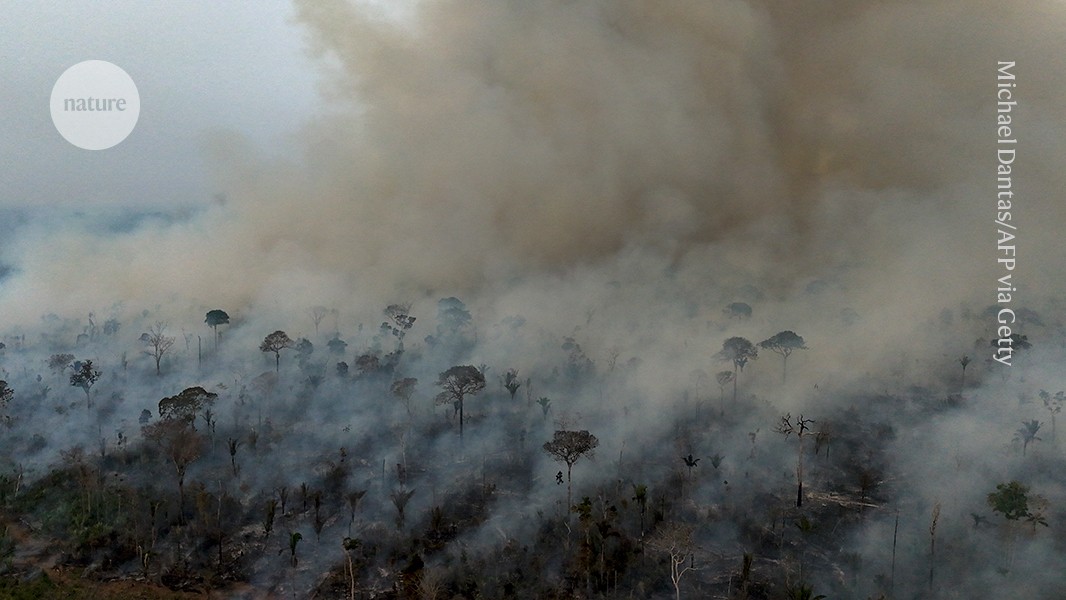
El Niño is returning with unusual strength. A vast area of warmer-than-average water is expanding across the equatorial Pacific Ocean, and the US National Oceanic and Atmospheric Administration estimates an 80% chance that the climate pattern will develop into a “very strong” event by the end of the year. Some forecasters believe this El Niño could become the most powerful in at least 150 years.
For the Amazon rainforest, the timing could not be more concerning.
Trouble in the Amazon
El Niño occurs approximately every two to seven years and disrupts weather patterns worldwide. In the Amazon basin, it usually brings intense drought. The most recent event, which began in June 2023 and ended by June 2024, severely affected the rainforest by drying extensive areas1, reducing major rivers to historically low levels2 and contributing to the worst Amazon fire season in more than 20 years3 (see ‘Tree troubles’).
Some scientists warn that the developing El Niño, combined with the warming and drying caused by climate change, could push the Amazon rainforest closer to a climate tipping point. This term describes a threshold beyond which a self-reinforcing cycle of drought, tree mortality and wildfires could spread irreversibly across the basin. If that occurs, rainforest could gradually be replaced by savannah and degraded woodland, potentially releasing several years’ worth of global carbon emissions and reducing rainfall across South America and other regions4.

Source: Ref. 3
The current El Niño might not produce the worst outcomes predicted by some forecasts. Its effects will depend largely on how strong the event becomes and how extensively the forest burns. However, the Amazon is entering this period in a weakened condition, raising concern among researchers who study the rainforest. “If this next El Niño really is as strong as we think it will be, it might result in things like huge wildfires in the Amazon, spreading across areas that were unimaginable before,” says Bernardo Flores, a specialist in Amazon resilience at the Juruá Institute in Manaus, Brazil. “We will see how much of the forest might die from it.”
Amazon rainforest still recovering from past drought
Researchers are particularly concerned that large parts of the Amazon may not yet have recovered from the severe droughts of 2023–24. Hao Bai, a forest ecologist at Peking University in Beijing, and his colleagues reached this conclusion after analysing 33 years of radar satellite data. The data tracked two measures of forest health across the Amazon basin: the amount of moisture stored in the forest and the quantity of living plant material.
During the 2023–24 drought, radar measurements for both indicators fell to their lowest levels since satellite observations began in 19925. The researchers estimate that fewer than half of the affected forests will return to their pre-drought condition within seven years, making this the slowest recovery from a major Amazon drought recorded by satellites.
For Bai and his colleagues, the results highlight the Amazon’s growing vulnerability to severe drought driven by El Niño and human-caused climate change. If major droughts occur before the forest has recovered from earlier events, repeated environmental stress could weaken the ecosystem and reduce its ability to withstand future climate extremes.
When will the Amazon hit a tipping point?
A study led by Nico Wunderling, an Earth-system modeller at Goethe University in Frankfurt, Germany, suggests that the Amazon could be closer to a tipping point than previously estimated6. The rainforest generates much of its own rainfall, so Wunderling and his colleagues, including Flores, modelled atmospheric moisture movement and assessed how warming and deforestation could alter this process.
Their model suggests that an Amazon without deforestation would remain relatively stable at global warming levels of up to 3.7–4 °C above pre-industrial temperatures. However, if deforestation removes 22–28% of the rainforest, warming of only 1.5–1.9 °C could trigger a collapse. Over time, as much as 80% of the forest could become degraded woodland or savannah-like ecosystems. The world is rapidly approaching 1.5 °C of warming, while approximately 17% of the Amazon has already been deforested, depending on how the loss is measured, says Wunderling.
“We’re not too far away,” he adds.
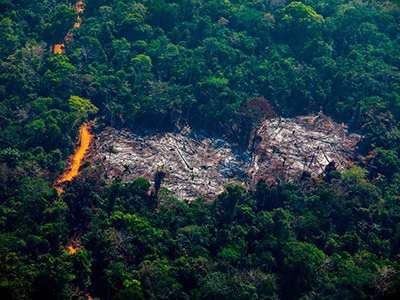
Flores says the Amazon could be even closer to a climate tipping point than the study indicates because the model did not fully account for other pressures4, particularly wildfires. Fires place severe stress on the rainforest and become more frequent and intense during El Niño events.
After a section of rainforest burns, Flores says, it can remain highly flammable for decades. “And then if we continue to have these escalating El Niños — these El Niños that get stronger and stronger — then it’s very concerning,” he says. “The area of flammable forest just increases and increases, and it can become exponential.” The amount of forest burned during the current El Niño could determine whether the Amazon crosses a tipping point, he adds.
“We may have already crossed the tipping point,” Flores says. “We don’t know. But the thing is, if we have crossed it, or we might cross it very soon, this is very concerning.”

Record low water levels were recorded in the Solimões River, one of the largest tributaries of the Amazon River, during a drought that followed the 2023–24 El Niño.Credit: Michael Dantas/AFP via Getty
Scientists have long debated where the Amazon’s tipping point lies and how close the rainforest is to reaching it. A further challenge is that the transition might not become apparent until after the threshold has already been crossed.
Some researchers, including Dolors Armenteras, a fire ecologist at the National University of Colombia in Bogotá, believe that parts of the Amazon may already have passed local tipping points. However, she says the entire basin has probably not yet reached a point of no return. “I think it’s a reasonable possibility for parts of the Amazon,” she says, “not for the whole basin.”
Carlos Nobre, an Earth-system scientist at the University of São Paulo in Brazil who helped propose the idea of an Amazon climate threshold in the 1990s, agrees with Armenteras. “The southern Amazon is close to a tipping point,” he says, but “not the northern Amazon or the northwestern Amazon”.

Climate tipping points — too risky to bet against
Luciana Gatti, an atmospheric scientist at Brazil’s National Institute for Space Research (INPE) in São José dos Campos, has monitored the Amazon’s carbon balance using small aircraft for more than 20 years. Her research shows that the southeastern Amazon has already changed from a carbon sink into a carbon source, releasing more carbon than it can absorb7.
Wildfires during the 2023–24 El Niño “produced the strongest emissions since 2010 in the Amazon”, Gatti says. She adds that she is “really afraid about the consequences” of another, potentially stronger El Niño arriving so soon.
Source: www.nature.com