


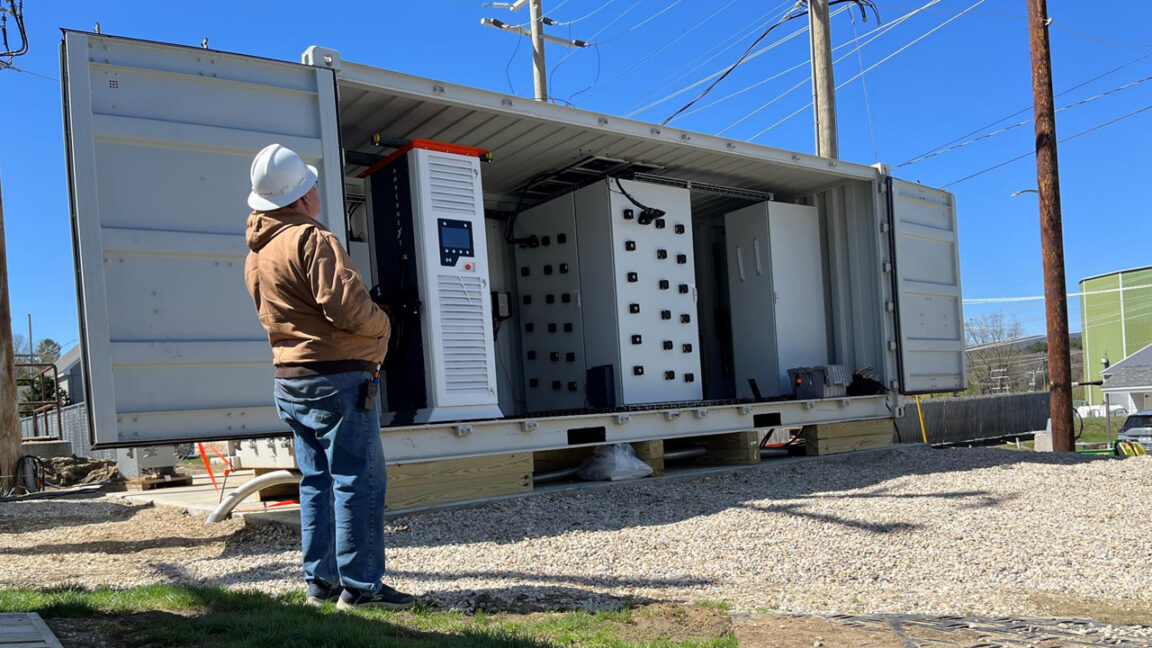
“It’s kind of a magic box that provides a single point of control, eliminating much of the infrastructure and many of the interoperability challenges found in traditional data centers, where different components are often trying to regulate the same systems,” said Srdjan Lukic, a professor of electrical and computer engineering at North Carolina State University. “Now, we have one power-conversion stage outside the data hall, and then we can connect directly to the rack.”
From “Killer Applications” to Mass Adoption
Data centers are currently the “killer application” for solid-state transformers, Lukic told Ars. Several US companies, including Amperesand, Heron Power, and DG Matrix, have raised more than $280 million in funding over the past year to commercialize solid-state transformer technology for AI infrastructure and other high-power applications.
Solid-state transformers can also reduce the amount of copper and other raw materials required for data center construction. Their compact footprint gives developers more usable space for computing equipment, cooling systems, and other critical infrastructure, Lukic explained.
Over the longer term, successful commercialization of solid-state transformers could help ease supply chain shortages affecting conventional power transformers. Increased production capacity could make transformers more readily available for power grid upgrades, industrial facilities, renewable energy projects, and data center expansions.
“There are relatively few companies that specialize in manufacturing conventional transformers. A conventional transformer is a transformer, but a solid-state transformer is more like an electronic device. That completely broadens who can participate in the transformer market and expands where these systems can be manufactured,” Lukic said.
The advantages of solid-state transformers also extend to electric vehicle charging, which relies on DC power. Lukic and his colleagues recently demonstrated that solid-state transformers connected to live power lines could handle up to 1 megawatt of power for EV battery charging. In addition to stepping down the voltage, the systems performed the required AC-to-DC power conversion, demonstrating their potential for high-power charging infrastructure.
Source: arstechnica.com