


A groundbreaking study reveals that Charon, Pluto’s largest moon, continues to experience a loss of rotational energy despite being tidally locked for years, offering scientists new insights into the enigmatic interior of this distant icy body.
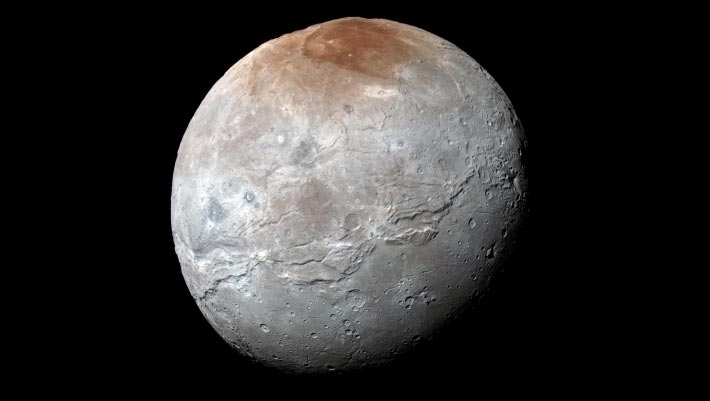
This striking view of Charon was captured on July 14, 2015. Unlike Pluto, Charon’s color palette is less diverse, with a prominent reddish northern polar region informally known as Mordor Macra. Image credit: NASA/Johns Hopkins University Applied Physics Laboratory/Southwest Research Institute.
The bodies in our solar system undergo a process known as despinning, where tidal forces gradually slow the rotation of celestial objects, altering their shape and thermal conditions.
While despinning has long been hypothesized for Charon, tangible geological evidence has been elusive.
Charon stands out as a potential candidate for this evidence, boasting a surface approximately 4 billion years old with minimal resurfacing compared to other icy moons.
“Charon displays a striking topographical contrast with rugged northern highlands and smooth southern plains,” explained Dr. Hanjiang Chen, a researcher from the University of California, Los Angeles and ETH Zurich.
“Prior research indicates that Charon has undergone global expansion accompanied by cryovolcanic activities.”
In their study, Dr. Chen and his team analyzed tectonic changes in a mountain range named Oz Terra located in Charon’s northern hemisphere.
These tectonic features extend over 200 km and exhibit asymmetric slopes indicative of compression rather than extension.
Modeling suggests that an ice shell at least 30-36 km thick existed during its formation, indicating that the equatorial crust contracted by around 1% during this period, with compression absorbed along pre-existing fault lines, resulting in the observed ridges.
The authors estimate that Charon’s initial rotation period was approximately 14.3 hours, significantly quicker than its current tidally locked rotation period of about 153.3 hours.
This evidence supports the theory that Charon’s rotation has been slowing over time.
These findings imply that Charon might have originated under relatively cold conditions, leading to the formation of a thick and robust ice shell early in its history.
“Our research suggests that Charon’s surface preserves a record of its planetary despinning history, predating the global expansion and cryovolcanic activity,” the researchers stated.
“The coevolution of despinning and global contraction points to a cold origin for Charon and enriches our understanding of the thermal evolution of icy moons in the outer Solar System.”
The complete study can be found in the published article dated July 14th in Nature Communications.
_____
H. Chen et al. 2026. Early tidal despinning history recorded in Charon, Oz Terra’s tectonics. Nat Commun 17, 5978; doi: 10.1038/s41467-026-75069-7
Source: www.sci.news