


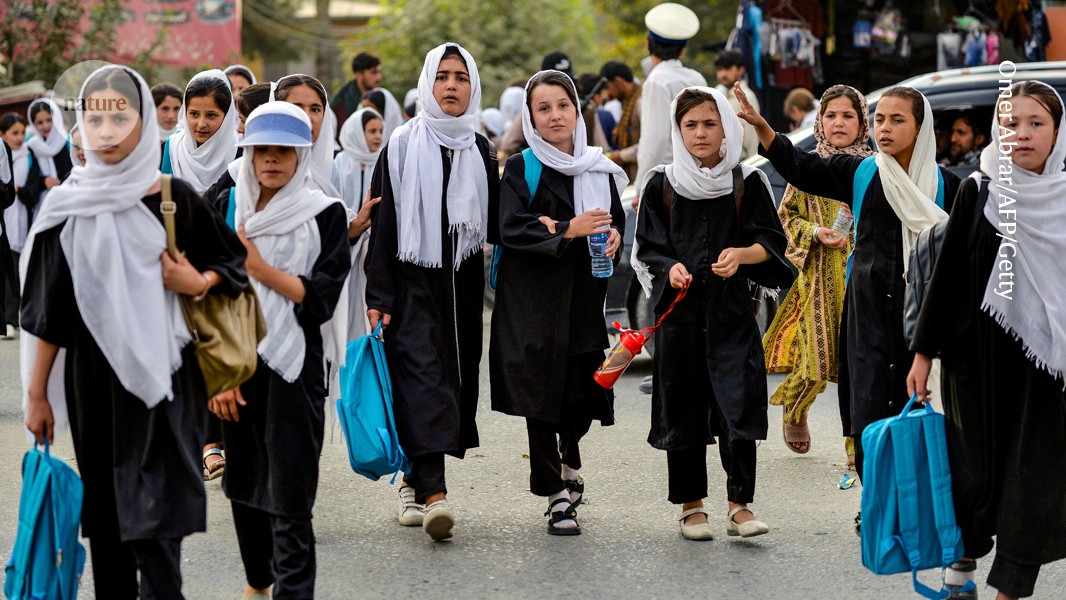
Girls return home from school in Fayzabad, Afghanistan. Girls may attend primary school until around age 11 or 12, but the Taliban prohibit them from attending secondary school and university.Credit: Omer Abrar/AFP/Getty
This week marks five years since the Taliban returned to Kabul and took control of Afghanistan. It has also been nearly four years since girls and women were barred from secondary schools, universities and most forms of employment. Women remain excluded from public-sector positions and, increasingly, from public life. As international governments establish relations with the Taliban, Afghan women and girls risk being forgotten.
Why aren’t there talks with the Taliban about getting women and girls back into education?
“It’s like we’re at a crossroads; all the paths are dark. One path is concrete, another is muddy, and one has pitfalls. We can’t discern the paths; all of them are dark and uncertain.” A female Afghan academic used these words to describe her situation to researchers (S. Shahir et al. Womens Stud. Int. Forum 113, 103193; 2025).
When the Taliban seized control of Afghanistan in August 2021, its leaders verbally promised that girls and women would retain access to education and employment. That commitment appeared intended to distinguish the movement’s current rule from its previous government between 1996 and 2001. However, evidence soon showed that the promises were not being honoured (Nature 633, 494; 2024).
Five years later, the deterioration is clear. Afghan girls and women face increasingly severe restrictions, while countries seeking diplomatic or practical ties with the Taliban are failing to make human rights a condition of engagement. More than 20 million women and girls — roughly half of Afghanistan’s population — are being denied education, employment and basic freedoms with limited international accountability.
Since 2021, approximately 2.4 million girls have been excluded from secondary education, while more than 100,000 young women have been denied access to higher education, according to UNESCO, the United Nations cultural organization. Educational opportunities for Afghan boys and men are also declining: higher-education enrolment fell by 40% between 2019 and 2024 (see go.nature.com/4hs2a3s).
Some Afghan women continue to work in restricted roles, including delivering health care to women and providing humanitarian assistance to some of the country’s 14 million people experiencing acute hunger. They do so under intense pressure and at considerable risk to themselves and their families.
The Taliban said women could study — three years on they still can’t
Restrictions on Afghan women and girls continue to expand. Last September, the Taliban prevented women from entering United Nations facilities. In May, the Baran Health Sciences Institute in Bamiyan — one of the final institutions where women could receive health-care training and education — was forced to close.
Afghan women are also being removed from the country’s academic record. Last August, the Ministry of Higher Education issued two directives. One prohibits universities from teaching 680 books written by women or by authors from Western countries and Iran. The other removes subjects including gender studies, women’s rights, religious history and democracy from university courses. A legal change in May also removed the statutory minimum age for marriage, effectively enabling child marriage.
These measures should prompt an urgent international response to protect the rights of Afghan women and girls. Instead, several influential countries are restricting their escape routes and educational opportunities. Pakistan and Iran were previously important destinations for Afghan women seeking safety, work and study. This year, however, both countries have returned a combined one million people to Afghanistan.
How the world should oppose the Taliban’s war on women and girls
The United States and several European countries are also limiting opportunities for Afghans. In the United States and the United Kingdom, it is now extremely difficult for people from Afghanistan to enter for work or study.
The UK government told Nature that it is applying a “visa brake” to applications from Afghanistan, Cameroon, Myanmar and Sudan. The government cited concerns that many students and skilled workers from these countries might later apply for asylum.
However, a policy briefing from a group that includes many of the UK’s leading universities challenges that approach. It states that “the vast majority of international study applicants are genuine” (see go.nature.com/4z1me4c). The briefing also notes that students can have legitimate reasons to seek asylum when conditions in their home countries change during their studies. For Afghan women researchers and students, the danger of returning home is precisely why international protection and study opportunities are so important.
Afghanistan’s terrified scientists predict huge research losses
There are still limited sources of hope. UNESCO is supporting community literacy programmes, while the American University of Afghanistan — now based in Doha, Qatar — is offering women and girls access to online education. More than 21,000 students applied for its undergraduate courses in 2025, but only 281 places were available. The overwhelming demand highlights the scale of Afghanistan’s unmet need for higher education.
Afghan academics living in exile are also developing the Afghanistan Online University to provide education for Afghan women. Yet internet access remains vulnerable. A nationwide 48-hour internet blackout last September demonstrated how quickly the Taliban can disrupt online learning and communication.
Olga Cherevko, a representative of the United Nations Office for the Coordination of Humanitarian Affairs in Kabul, told Nature that some people assume conditions for Afghan women have improved because the crisis receives less media attention or because the country is experiencing less civil conflict. That assumption is wrong. The international community must continue to highlight the Taliban’s restrictions and defend the rights of more than 20 million Afghan women and girls before they are erased from public view.
Source: www.nature.com