


Tesla Semi Enters Mass Production as Musk Bets on a $20 Trillion Future
Tesla CEO Elon Musk says investors increasingly view the electric carmaker as a robotics and self-driving company. On that premise, he is targeting a valuation of $20 trillion—nearly four times the current value of market leader Nvidia.
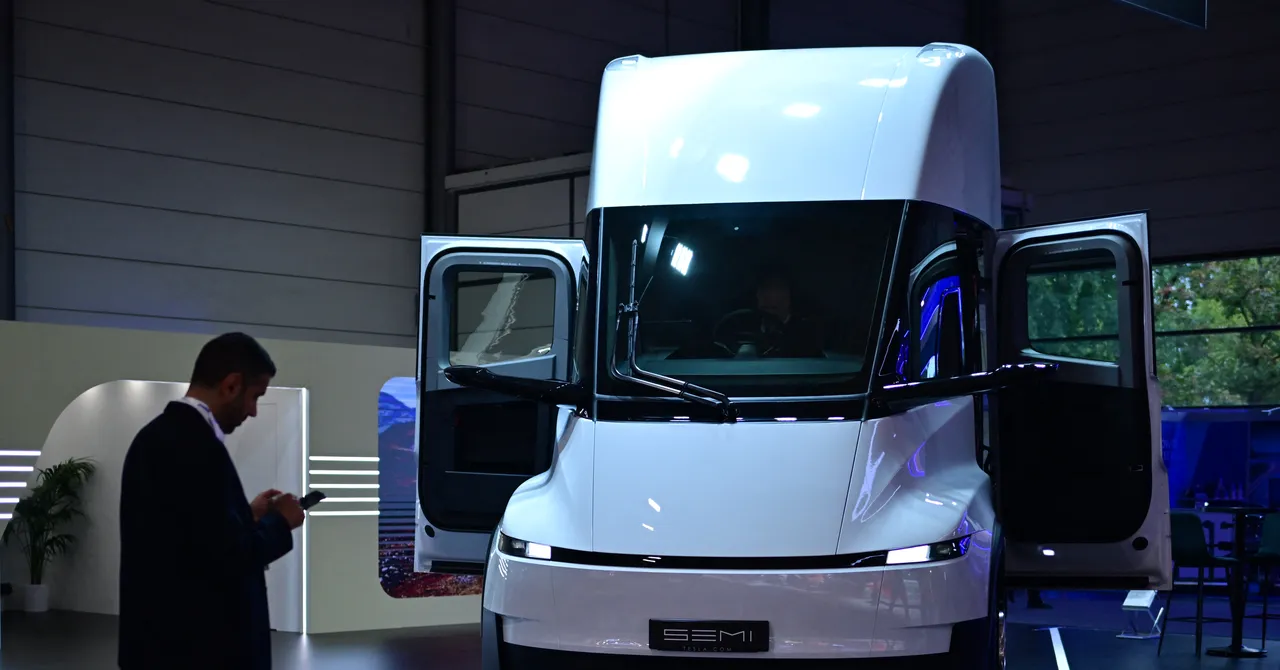
Yet Tesla’s team was in Sparks, Nevada, on Thursday focused on a more immediate product: the long-awaited Tesla Semi electric truck.
Tesla first unveiled the Semi concept onstage in late 2017. Nearly a decade later, the company officially began mass production at a livestreamed, invite-only event at its factory. The event targeted a niche audience: cost-conscious managers of large trucking fleets. Several attendees, all men, crossed the stage to a pulsating techno beat to express their gratitude for the order.
“It’s really going to be a driver’s truck. It’s like a sports car in the shape of a truck,” Musk said in a prerecorded video played during the event.
Musk, Tesla’s longtime ringleader at its circus-like product events, was absent from the Semi’s debut for the second time in a row. He was attending the China State Dinner at the White House with President Xi Jinping.
Tesla Semi range: Up to 500 miles on a charge
Lars Moravy, Tesla’s vice president of vehicle engineering, confirmed that the long-range version of the Tesla Semi is expected to travel 500 miles on a single charge. He said that is close to the average daily mileage of long-haul truckers in the United States.
The standard version is expected to travel 325 miles on a single charge. By comparison, competing electric trucks advertise ranges of 155 miles to 430 miles.
The biggest challenges for electric trucks
The Tesla Semi has features designed to address the demands of long-haul trucking, but major challenges remain for electric truck adoption.
Almost 30 percent of heavy-duty truck sales in China are electric, according to state media. However, manufacturers have struggled to make electric trucks more competitive with traditional diesel-powered vehicles. The initial cost of an electric semi can be two to three times higher than a conventional truck.
Charging infrastructure is another obstacle. Electric trucking requires a nationwide network of dedicated megawatt chargers capable of charging large batteries within hours. Tesla’s website lists two such public chargers operating in the Los Angeles area. Dan Priestley, head of Tesla’s Semi program, said the company plans to open 30 units by the end of the year.
The Trump administration and Republicans—the same group that spent millions of dollars helping Musk enter the White House—cut federal support for electric vehicles by billions of dollars last year. The administration is also working to lower fuel economy standards for truck engines, which would require manufacturers to meet aggressive climate goals. Heavy trucks alone account for about 7 percent of U.S. greenhouse gas emissions.
High diesel prices could boost Tesla Semi demand
Despite the political and infrastructure challenges, conditions may be favorable for electric truck makers. U.S. diesel prices reached record highs this month as the Iran war continued to disrupt oil production and transportation in the Middle East. Prices have nearly doubled from the same period last year.
“Especially in these crazy times, this truck makes a lot of economic sense because the cost of electricity is so much cheaper than the cost of diesel,” Musk said in a prerecorded speech, referring to the conflict sparked by the administration he once worked for.
Microsoft and PepsiCo among buyers of 2,500 Tesla Semis
This week, a consortium of shippers that includes Microsoft and PepsiCo placed an order for 2,500 Tesla Semis. The trucks are scheduled to be delivered over the next 18 months, starting this year.
Once delivered, the order will represent almost twice the number of large electric trucks currently on U.S. roads.
Meena Bibra, a spokeswoman for the nonprofit Smart Freight Center, which was involved in the deal, told WIRED that the group selected Tesla trucks after evaluating “price, performance, production capacity, and service support.”
Carriers that are more comfortable with another manufacturer’s fleet, or that find another electric truck better suited to their needs, may also consider models from Kenworth, RIDE, and Volvo.
By combining demand from multiple carriers, electric truck manufacturers were able to lower prices for new trucks, the group said.
Tesla Semi self-driving technology is still pending
Tesla’s Full Self-Driving feature, which operates with supervision, is not yet available in the Semi. Musk said in his speech that it would debut in the “very near future.”
The technology’s predecessor, Enhanced Autopilot, was promised during its initial rollout in 2017.
Source: www.wired.com