


Hubble Discovers a Rapidly Developing Decagon Around Saturn’s South Pole
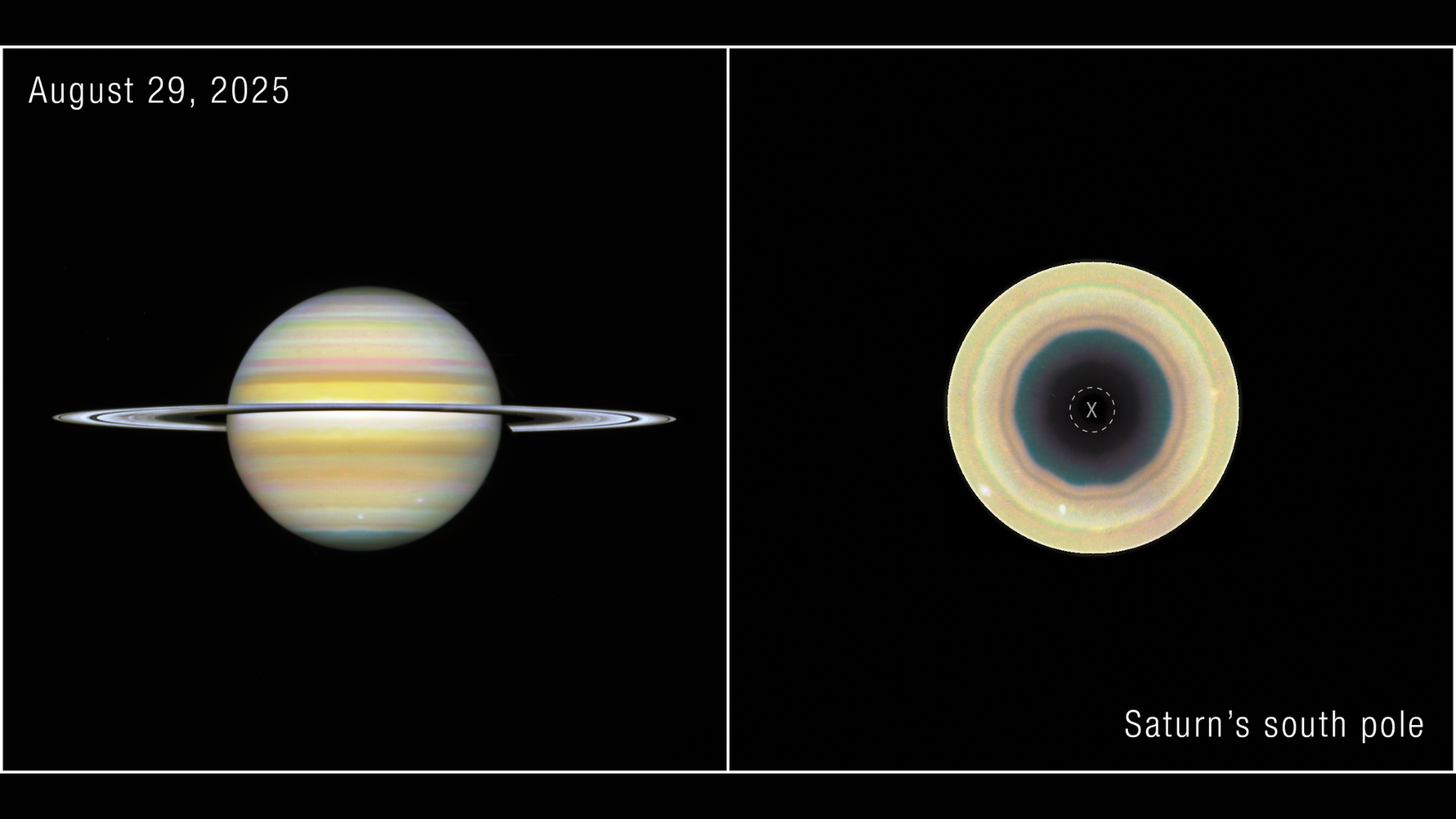
New observations from the Hubble Space Telescope have revealed a dramatic, 10-sided atmospheric wave forming around Saturn’s south pole. The unusual feature appears to have developed since 2023, offering scientists a rare opportunity to watch a large-scale weather pattern evolve on a gas giant.
The discovery is particularly intriguing because Saturn is already famous for its long-lasting north polar hexagon—a six-sided jet stream observed for more than 40 years. However, the newly detected southern feature is different: It appears to be changing and intensifying over time.
“The question is, we’ve never seen it before, so why is it suddenly forming now?” Amy Simon, a senior scientist at NASA’s Goddard Space Flight Center and co-author of a new study, said in a statement.
From the latest videosLive Science
“The north hexagon has been there every time we’ve looked for it for over 40 years,” Simon added. “This feature is different. It appears to be intensifying and gives us a rare opportunity to observe the development of large atmospheric patterns.”
Saturn’s famous six-sided jet stream at its north pole.
Image credit: NASA/JPL-Caltech/Space Science Institute
How Saturn’s southern decagon is changing
Hubble images show the atmospheric waves extending through multiple layers of Saturn’s atmosphere, beyond the tops of the visible clouds. The feature also appears within one of Saturn’s powerful polar jet streams, suggesting that the decagon is linked to complex atmospheric circulation deep within the planet.
Further observations with Hubble and the James Webb Space Telescope (JWST) could help researchers determine how the waves formed and what Saturn’s developing decagon reveals about weather on gas giant planets.
Hubble’s long-term view of the outer planets
The images were collected through Hubble’s Outer Planet Atmospheres Legacy program, which uses part of the telescope’s observing time to monitor Jupiter, Saturn, Uranus and Neptune approximately once a year. These long-term observations complement data gathered by spacecraft and allow scientists to track changes in the atmospheres of the solar system’s giant planets.
As Saturn travels around the Sun during its roughly 29-year orbit, the planet’s south pole becomes visible from Earth at different angles. This allows astronomers to study the changing polar weather patterns, including the newly forming decagon.
Hubble was not the first observatory to detect signs of the feature. In 2024, a ground-based observatory recorded a mysterious wavy band circling Saturn’s south pole.
Ground-based astronomers helped identify the feature
Agustín Sánchez-Lavega, along with study authors Trevor Barry and Jean-Paul Auger, used observations from the University of the Basque Country’s Planetary Virtual Observatory Laboratory to investigate Saturn’s changing atmosphere. The platform combines observations from astronomers around the world.
Images captured in 2025 showed that the waves were beginning to organize into a decagonal pattern. Hubble’s high-resolution observations provided a clearer view of the structure without the blurring effects caused by Earth’s atmosphere.
NASA noted that the Cassini spacecraft, which orbited Saturn from 2004 to 2017, did not observe the feature. This suggests that the southern decagon either had not formed or was not yet detectable during Cassini’s mission.
“Given the symmetry of Saturn’s north-south jet stream system, we have been looking since 1990 for an equivalent of Saturn’s north hexagon at the south pole in Hubble images,” Sánchez-Lavega said.
Saturn’s decagon compared with other planetary weather systems
Hubble and JWST are expected to provide more opportunities to monitor the developing atmospheric wave in the years ahead. Saturn is not the only planet with striking polar weather. Images captured by NASA’s Juno spacecraft in 2017 showed that Jupiter’s south pole is covered by enormous oval cyclones.
By comparing Saturn’s decagon, its persistent northern hexagon and Jupiter’s polar cyclones, planetary scientists can better understand how powerful jet streams and atmospheric waves shape weather on worlds beyond Earth.
Sánchez-La Vega, A., Simon, A.A., Wong, M.H., Fletcher, L.N., Antugnano, A., Hueso, R., Inurigaro, P., Flix-Vermund, A., Miro, A., García-Melendo, E., Barry, T., Auger, J., Orton, G.S., and Galate-López, I. (2026). A decagonal wave around Saturn’s south pole. Scientific Progress, 12(36).
Source: www.livescience.com