


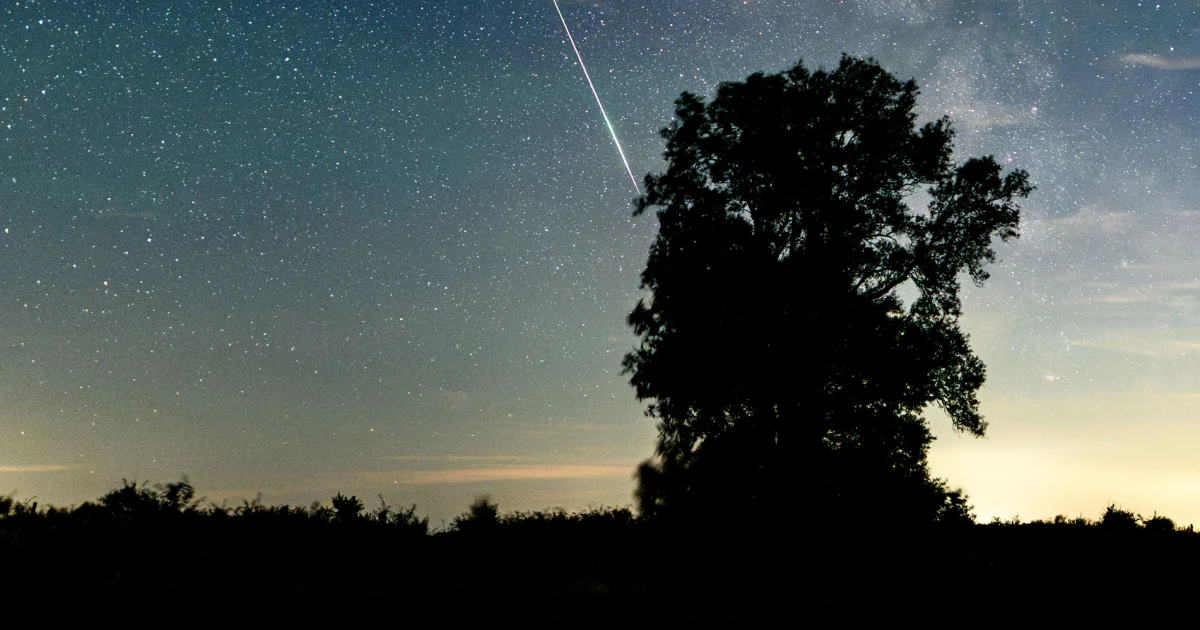
The annual Perseid meteor shower, one of the brightest and most popular meteor showers of the year, reaches its peak this week. Skywatchers could have an especially good chance of seeing shooting stars because the peak coincides with a new moon, creating darker nighttime skies.
The Perseid meteor shower has been active since mid-July and is expected to reach peak activity overnight Wednesday into Thursday.
With the moon’s illuminated side facing the sun and its dark side facing Earth, moonlight should not significantly interfere with this highly anticipated summer skywatching event.
The Perseid meteor shower peak also coincides with another major astronomical event: a total solar eclipse visible from Spain, parts of Portugal, Greenland, Iceland and northern Russia on Wednesday.
A total solar eclipse occurs when the sun, moon and Earth align, allowing the moon to pass directly in front of the sun and completely block its light.
In areas where the eclipse takes place near sunset, observers may even spot Perseid meteors during totality — the brief period when the moon fully covers the sun, darkening the sky and revealing the sun’s glowing outer atmosphere.
The Perseids are among the most popular meteor showers because they occur during the warm summer months in the Northern Hemisphere, typically from mid-July through late August. Under ideal conditions, including clear weather and dark skies, the shower can produce up to 100 meteors per hour.
Although the greatest number of meteors will be visible during the peak, Perseid shooting stars should remain observable for roughly two more weeks.
The Perseid meteor shower occurs as Earth travels through dust and debris left behind by Comet 109P/Swift-Tuttle, which was discovered in 1862. When these particles enter Earth’s atmosphere, they heat up and create bright streaks of light. The Perseids are also known for producing fireballs — exceptionally bright meteors that can leave glowing trails as they break apart.
For the best chance to see the Perseids from the Northern Hemisphere, watch during the early morning hours before dawn. Find a location with a wide, unobstructed view and as little light pollution as possible, preferably far from cities and artificial lights.
NASA recommends allowing your eyes 20 to 30 minutes to adjust to the darkness. Once your vision adapts, sit back, look toward the sky and wait patiently for meteors to appear.
In much of the Southern Hemisphere, the Perseid radiant — the region of the sky where the meteors appear to originate — remains below the horizon. As a result, the meteor shower can be difficult or impossible to see from many southern locations.
NASA plans to host a virtual Perseid meteor shower watch party on YouTube beginning at midnight ET on Thursday. The livestream will feature views from sky cameras at NASA’s Marshall Space Flight Center in Huntsville, Alabama.
Source: www.nbcnews.com