


Every summer, lawns come alive with vibrant “silly sprinklers,” featuring looped and twisted tubes that spray water in whimsical patterns. While their designs may appear playful, researchers are leveraging these backyard devices to explore significant, long-standing questions in physics.
This fascinating puzzle is known as the Feynman’s sprinkler problem. What happens when a sprinkler operates in reverse, drawing water into its arms instead of pushing it out? A dedicated team of mathematicians has provided a clear experimental answer by building and testing various sprinkler shapes. Their findings yield broader insights into how moving fluids can push, twist, and rotate physical structures.
“This study presents an experimental resolution to Feynman’s sprinkler problem, illustrating how the angular momentum of water flow drives sprinkler rotation across multiple designs,” states Leif Listlov, an associate professor at the New York University Courant Institute’s Department of Mathematics, Computing, and Data Science and senior author of the paper published in Proceedings of the National Academy of Sciences.
Why is the sprinkler question important?
Researchers affirm that this discovery extends beyond solving a famous scientific enigma. Understanding how objects interact with moving fluids can aid engineers in enhancing machines that capture or convert energy from flowing fluids.
“Our results contribute to a more comprehensive understanding of how components react to fluid flows, providing guidance for future engineering and technological advancements in devices such as turbines that harness these flows for energy,” says Brennan Sprinkle, assistant professor at the Colorado School of Mines and co-author of the paper.
The research team began exploring Feynman’s sprinkler problem in a study published in 2024. This problem gained prominence in the 1980s after physicist Richard Feynman detailed his unsuccessful attempts to investigate it experimentally.
Initial research indicates that reverse sprinklers rotate nearly 50 times more slowly than standard ones, despite both relying on closely related physical mechanisms.
Traditional sprinklers function like rotating rockets, ejecting water from their arms, which generates a force that rotates the device. In contrast, reverse sprinklers act like “inverted rockets,” as the water jet moves inward toward the central chamber where the arms connect.
Within that chamber, the two incoming jets collide. However, they do not collide fully head-on; this slight misalignment creates a force that rotates the sprinkler in the opposite direction.
Ristroph, Sprinkle, and their colleagues describe this phenomenon as momentum flux theory, a focus on how swirling water transfers momentum through sprinklers.
Testing sprinklers with twists and loops
The 2024 experiment concentrated solely on standard sprinklers with S-shaped arms, leaving questions about how more complex shapes, such as the curved, looped tubes of silly sprinklers, may behave.
Previous studies also did not decisively rule out other significant explanations for sprinkler movement.
For this new study, the team crafted a variety of silly sprinklers with different contours, tested in two configurations: forward mode, where water sprays outward, and reverse mode, where water is drawn inward.
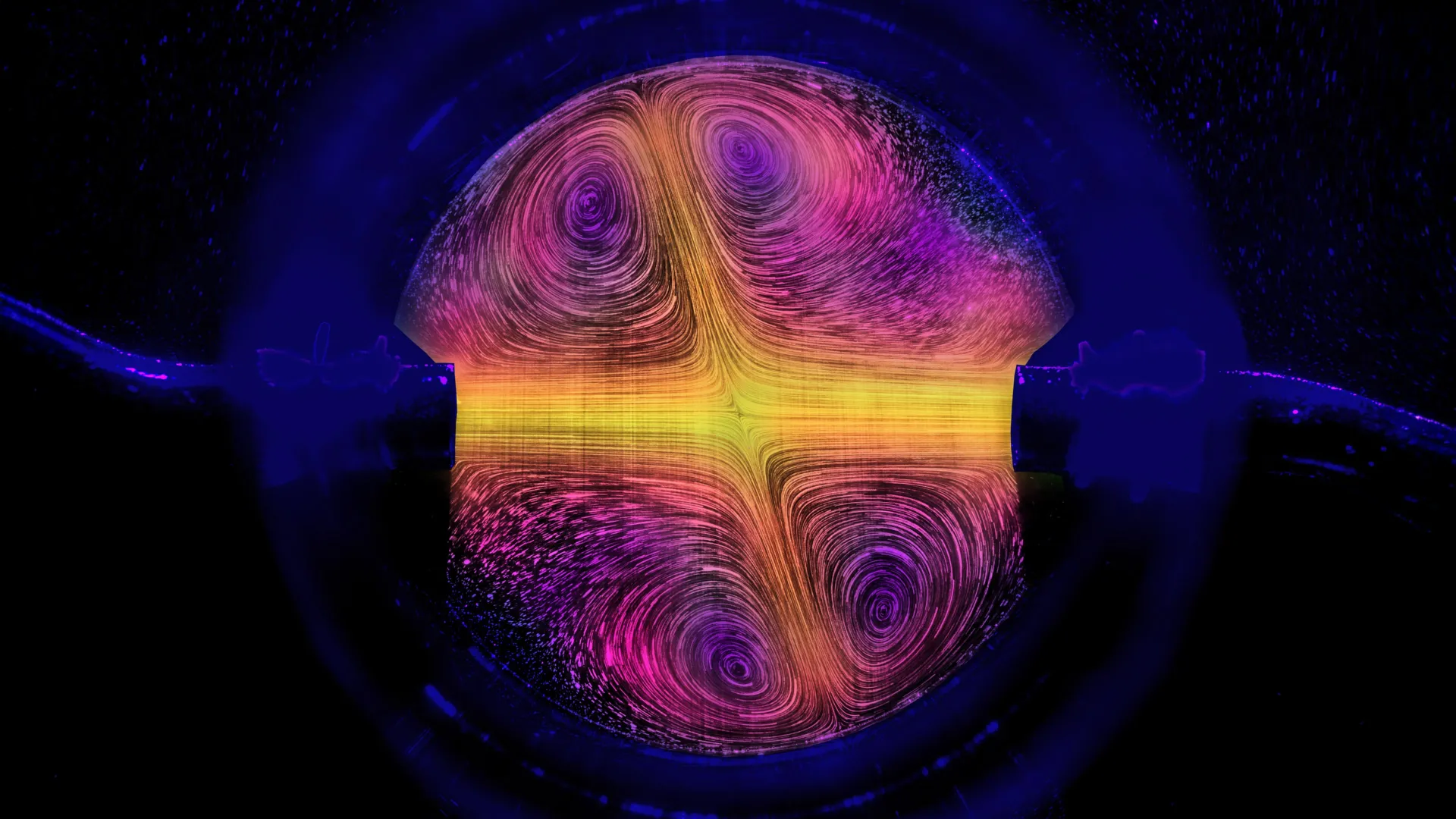
This unique shape allowed researchers to investigate various features simultaneously. They recorded the sprinklers’ rotation, observed water movement inside and outside the device, and measured the torque and twisting forces created when the sprinklers were restrained from rotating.
Competing physical theories put to the test
Scientists tested momentum flux theory against two other historical explanations of sprinkler movement.
The first dates back to the 1880s, proposed by physicist Ernst Mach, positing that the fluid rotates in one direction while the sprinkler rotates in the opposite direction. However, Mach’s theory fell short in accounting for the reverse rotation and torque observed in this new experiment.
The second theory, linked to Feynman and later researchers, centers on water flowing near the outer end of the sprinkler arm. Recent tests have indicated that neither the outer portion of the arm nor the water moving around it influences sprinkler movement or torque.
Instead, the results strongly support momentum flux theory. Researchers expanded this theory, demonstrating it accurately describes the behavior of both forward and reverse operations across all tested sprinkler shapes.
This experiment also unveiled that altering the sprinkler arm’s shape can change and control the water jet, a finding that could be valuable in designing real fluid-based devices.
“By confirming that momentum flux is the key to solving Feynman’s sprinkler problem, our findings address a long-standing question in flow physics and provide valuable insights into how these devices function and their effectiveness,” Ristroph concluded.
Additional authors of the paper included New York University graduate students Jesse Smith and Mingxuan Zuo, and undergraduate Will Kuhlke.
This research received support through grants from the National Science Foundation (DMS-2407787 and DMS-2407788).
Source: www.sciencedaily.com