


Could Earth’s Water Have Formed Inside the Planet? The Z Machine May Hold Clues
Albuquerque, New Mexico
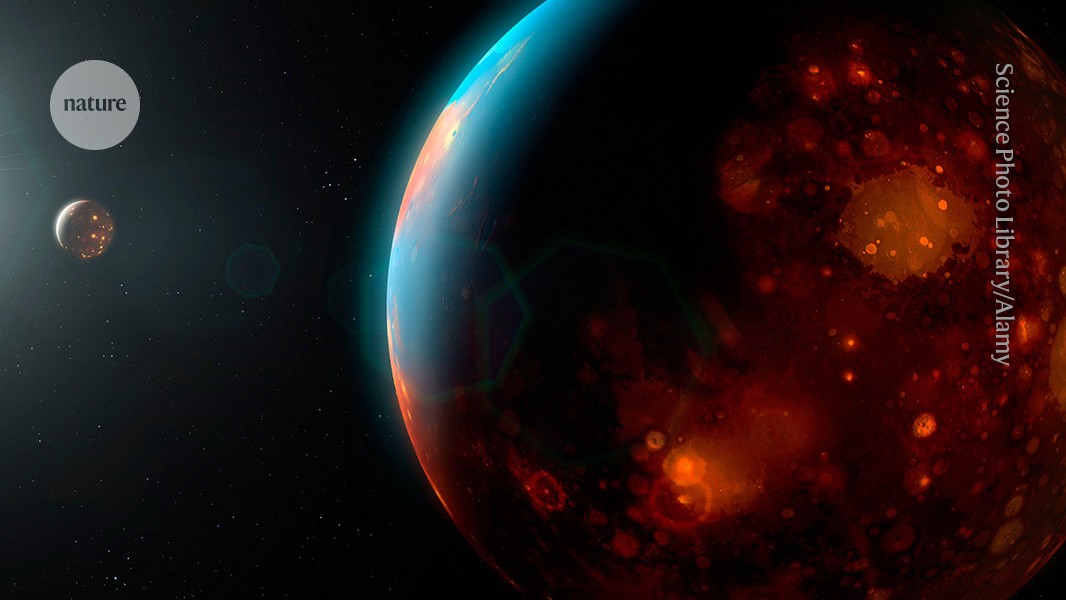
Earth scientists debate whether water was trapped inside Earth when it formed about 4.5 billion years ago.
Credit: SPL/Alamy
Sandia National Laboratories’ Z machine is an extreme device. Its ring of capacitors fills a room the size of two basketball courts. When ignited, it releases a pulse of electricity that, for billionths of a second, provides more power than all the power plants in the world produce at that moment. The pulse generates a shock wave that subjects the machine’s core to pressures comparable to those found deep inside a gas giant or during a nuclear explosion.
Earth’s oldest crystals suggest early start of plate tectonics
Late last month, Alisha Clark, a mineral physicist at the University of Colorado in Boulder, harnessed the Z machine’s power to study Earth’s interior. She is using the final shot in a multiyear project investigating the origins of water on Earth.
The focus on Earth is unusual for the Z machine. Located at Kirtland Air Force Base in Albuquerque, New Mexico, the device was originally created to test materials for the reliability of the US nuclear-weapons stockpile without detonating a bomb. It is still used mainly for that purpose, although about 10% of the shots taken with the instrument each year are devoted to basic research.
It took months of preparation and input from more than 100 people to launch the machine. Each shot takes a full day to set up and costs approximately US$250,000. As a result, applications from researchers studying the planet—and especially Earth—are rarely approved.

Mineral physicist Alisha Clark inspects a target containing a sample of water-infused glass before it is loaded into the Z machine.
Credit: James Dineen/nature
But the Z machine is important to Clark’s work. She suggests that during the early, chaotic stages of Earth’s formation, molten rock may have trapped and retained water inside the planet. That idea challenges the origin story usually told by Earth scientists. “The Earth is a sponge,” she says.
To test this possibility, Clark needed to simulate how molten rock behaves under pressures close to those found near Earth’s core. That is where the Z machine comes in.
Earth’s early magma ocean
About 4.5 billion years ago, Earth formed from cosmic dust and gas. Collisions with radioactive elements and debris from other planets would have heated the young planet until it melted completely, geoscientists say.
One long-standing theory holds that water molecules accumulated inside the newly formed Earth would have become vapour or escaped into space. If so, the water now found on Earth’s surface would have arrived later, carried by icy comets and asteroids after the crust cooled. Water currently inside the planet is thought to have been transported there by tectonic plates sinking into Earth’s mantle.
But there is another possibility. While Earth was molten, it may have retained some of the water molecules originally incorporated from cosmic dust and gas. If that happened, much of the water on Earth’s surface today could have been released over geological time through volcanic activity. An amount of water equivalent to an ocean might also have remained inside the planet.
Diamonds bring long-sought minerals from deep within the Earth
The idea was inspired by several geophysical and geochemical discoveries.1 Research over the past decade suggests that Earth’s interior contains a larger reservoir of water than plate tectonics alone could have supplied.2
For example, scientists studying diamonds from deep within Earth’s mantle have found mineral impurities containing surprisingly large amounts of dissolved water within their crystal structures.
Researchers are still trying to explain how so much water could have become trapped inside molten Earth. Clark’s work with the Z machine tests one possible explanation.3
She is investigating how water affects the compressibility of molten glass, which serves as a substitute for molten silicate rock, under extreme pressure. The experiment sends shock waves through a water-filled glass sample, briefly recreating conditions near the centre of Earth.
In earlier experiments, Clark found that adding large amounts of water made the glass appear harder. As pressure increased, however, it became more compressible. “The more you crush it, the squishier it gets, which is not normal behaviour,” she says.
Clark thinks this unusual response could mean that molten rock is better at trapping water under the pressures found in Earth’s mantle. That would suggest the planet may have retained water even during its early “magma ocean” phase, when Earth was largely molten.

Technicians placed a target holding Clark’s glass sample in the centre of the Z machine.
Credit: James Dineen/nature
Source: www.nature.com