


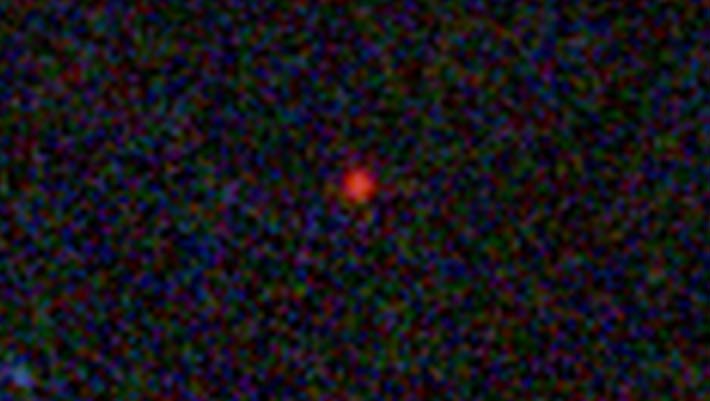
About 660 million years after the Big Bang, a mysterious bright-red object has been detected in one of the deepest regions ever observed by NASA, ESA, and CSA’s James Webb Space Telescope. MIT astronomers say the object could represent the first confirmed example of a previously unknown class of black holes in the early universe.
This James Webb Space Telescope image shows MoM-BH*-1, a possible early-universe black hole surrounded by dense gas. Image credit: NASA / ESA / CSA / Webb / Naidu et al., doi: 10.1038/s41586-026-10846-4.
MIT astronomer Rohan Naidu and his colleagues discovered MoM-BH*-1 while searching for some of the earliest galaxies in the universe as part of Webb’s investigation of distant cosmic “mirages” and other unusual sources.
The object was almost invisible through Webb’s blue filter but became exceptionally bright in the red filter. This extreme color makes MoM-BH*-1 one of the reddest distant objects ever observed.
Follow-up spectroscopy revealed the likely cause: MoM-BH*-1 has the strongest Balmer break ever measured at such a high redshift. The Balmer break is a sharp reduction in brightness at wavelengths linked to hydrogen absorption and can provide important clues about the physical conditions surrounding distant cosmic objects.
According to the researchers, ordinary starlight cannot produce such a dramatic spectral interruption. Even the reddest known stellar populations are less than one-third as intense as the signal detected from MoM-BH*-1.
The object’s spectrum also contains unusually broad hydrogen emission lines and deep absorption features that significantly reduce the strength of that emission. Together, these characteristics point to an exceptionally dense and turbulent envelope of gas—far denser than the atmospheres of typical stars.
“The cracks observed in this object are the deepest cracks ever observed in any celestial body, ruling out ‘ordinary’ stars as their source,” Dr. Naidu said.
“But we wondered if we were seeing a ‘great atmosphere’ of a kind never seen before, and on a grander scale.”
“Furthermore, the red dot’s light contained almost no traces of metals or elements other than hydrogen and helium. It was truly unique in many ways.”
To explain these unusual observations, the researchers modeled MoM-BH*-1 as a massive black hole with a mass between 100,000 and 10 million times that of the Sun. The black hole would be surrounded by an extremely dense, turbulent envelope of hydrogen gas measuring approximately 10 to 100 astronomical units (AU) across—roughly comparable to the size of our Solar System.
Radiation from the black hole’s accretion disk would pass through this dense gas cocoon. The hydrogen envelope could absorb and scatter the light, creating MoM-BH*-1’s distinctive red color and unusual spectral signature without requiring large amounts of cosmic dust.
Remarkably, the object’s luminosity appears to exceed what nuclear fusion could produce in a body of its estimated size. This effectively rules out a normal star as the source and instead points to an actively feeding black hole. The black hole may even be growing faster than the Eddington limit—the theoretical maximum rate at which a black hole can accrete matter before radiation pressure pushes surrounding material away.
Astronomers also found preliminary evidence that MoM-BH*-1 brightened by approximately 30% over a period of about two months. Such rapid variability is another characteristic associated with active black-hole accretion.
“The whole picture of this object is evolving very rapidly,” Dr. Naidu said.
“It is believed that there is a central black hole with a mass 100,000 times that of the Sun.”
“And around this black hole there will be a very extended envelope of gas that looks like a star the size of our Solar System. It’s huge.”
“These little red dots were apparently everywhere in the early universe, but have essentially disappeared by now.”
“What exactly these objects are is one of the most debated topics of the Webb era.”
The discovery is described in a paper published in the journal Nature.
_____
RP Naidu et al. 2026. A black hole covered in gas at the dawn of the universe and turned red by gas. Nature 656, 329-333; doi: 10.1038/s41586-026-10846-4
Source: www.sci.news