


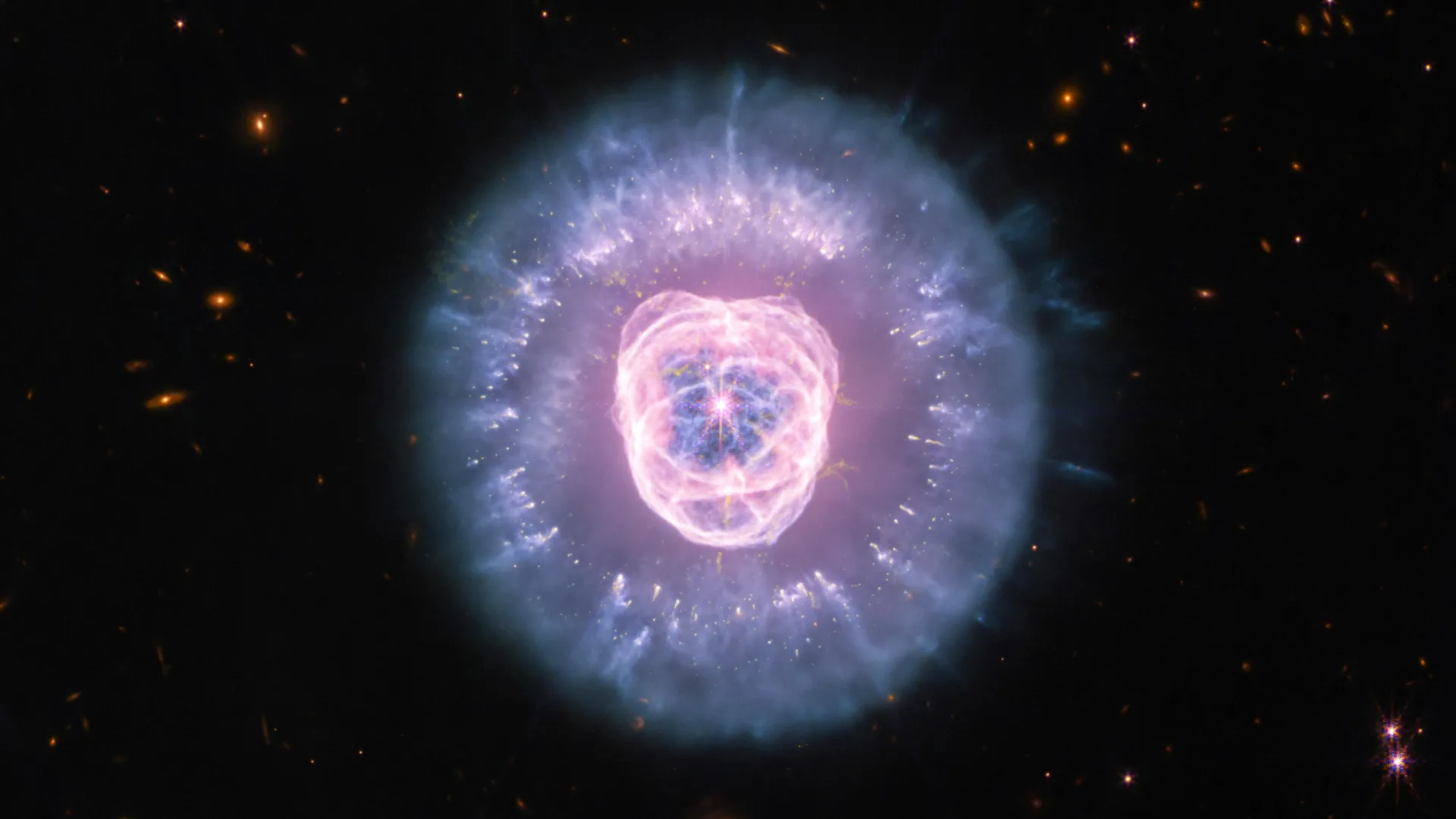
The James Webb Space Telescope has captured spectacular infrared images of NGC 2392, a planetary nebula commonly known as the Lion Nebula. The new observations reveal intricate layers of glowing gas, dust, and stellar debris in remarkable detail.
The Hubble Space Telescope observed NGC 2392 in 2000, imaging the lion-shaped nebula in visible light. Those observations highlighted the nebula’s distinctive appearance, including a hazy “mane” made of structures that resemble comet tails. Webb’s powerful infrared instruments now provide an even clearer view of these features.
James Webb reveals hidden details of the Lion Nebula
In infrared images from the James Webb Space Telescope, the Lion Nebula retains the structure previously seen by Hubble while revealing many previously hidden details. Webb observed NGC 2392 using both NIRCam, its near-infrared camera, and MIRI, its mid-infrared instrument.
Infrared light allows astronomers to study dense clouds of dust and faint regions of ionized gas that are difficult to detect in visible-light images. These observations offer new insight into how planetary nebulae form and evolve.
The gas and dust that make up the nebula have been expanding and changing for thousands of years. Even today, material continues to move away from the central stellar remnant, gradually reshaping the cosmic object.
At the heart of the Lion Nebula is the remnant of a dying star. In the nebula’s lion-like appearance, this compact stellar remnant resembles a small button or snout. Although it appears tiny, its intense radiation and stellar wind power the complex structures surrounding it.
How a dying star created a cosmic lion
Very massive stars can end their lives in dramatic supernova explosions, but such events are relatively uncommon. Most stars, including the one that created NGC 2392, are lower-mass stars that follow a different path at the end of their lives.
When a low-mass star can no longer sustain the nuclear reactions needed to support its core, it becomes unstable and begins to pulsate. The star then sheds its outer layers into space. These expelled layers form expanding shells of gas and dust known as a planetary nebula. Stars in this stage also contribute significantly to the dust found throughout the universe.
Radiation and stellar winds from the exposed core push the surrounding material outward. The remaining core eventually becomes an extremely hot white dwarf.
In the Lion Nebula, the hot central white dwarf illuminates and energizes the surrounding gas. Its intense radiation creates expanding bubbles of ionized material that help produce the nebula’s recognizable lion-like face.
As these bubbles expand, they push through and destroy dust in their path. Astronomers are still working to understand how the star’s outflow creates the intricate rings, shells, and other structures commonly seen in planetary nebulae.
A glowing mane of dust and gas
The Lion Nebula’s mane corresponds to an inner region of the dusty shell illuminated by the central white dwarf. Within this area are structures that resemble tufts of hair or elongated comet-like tails.
These features are compact clumps of dust that have survived the intense radiation from the stellar core. Because the dense clumps block some of the radiation, they also shield the material behind them.
Webb’s observations capture a brief moment in the long evolution of NGC 2392. The nebula will continue to change as gas and dust expand away from the central white dwarf, gradually transforming its appearance.
Astronomers estimate that the Lion Nebula may dissipate in approximately 10,000 years. On the timescale of the universe, that is a remarkably short period.
James Webb Space Telescope mission details
The James Webb Space Telescope is the largest and most powerful space telescope ever launched. Under an international cooperation agreement, the European Space Agency provided launch services for Webb using an Ariane 5 rocket.
ESA, working with its partners, developed and qualified the Ariane 5 modifications required for the Webb mission and procured launch services from Arianespace. ESA also contributed 50% of Webb’s NIRSpec instrument and helped develop MIRI, the telescope’s mid-infrared instrument. MIRI was designed and built by a consortium of European research institutes in partnership with NASA’s Jet Propulsion Laboratory and the University of Arizona.
Webb is an international partnership between NASA, ESA, and the Canadian Space Agency (CSA).
Source: www.sciencedaily.com