


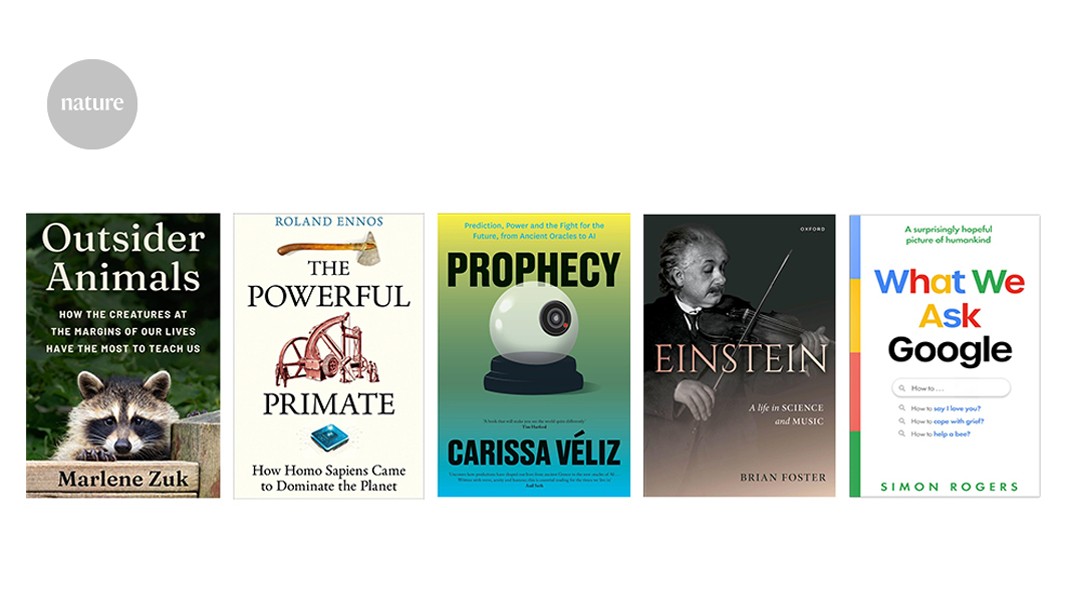
Outsider Animal
Marlene Zuk Princeton University Press (2026)
In Outsider Animal, evolutionary biologist Marlene Zuk explores the fascinating animals that live alongside humans but remain outside our closest relationships with nature. The book opens with a nighttime encounter between Zuk and a young raccoon (Procyon lotor) on the deck outside her California bedroom. As the animals noisily played with a garden hose, one stood up and raised its paw as if inviting her to join in.
Zuk describes these species as “outsider animals”: creatures with the potential to enter and disrupt our daily lives, even though humans do not depend on them for survival. The book examines raccoons, seagulls, cockroaches and coyotes (Canis latrans), giving each species its own chapter and revealing how urban wildlife adapts to life around people.

Prophecy
Carissa Velis Quickly (2026)
Carissa Velis traces the history of prophecy from fortune-telling in ancient Mesopotamia during the third millennium BC to the predictive technologies used by artificial intelligence today. In this compelling and often unsettling analysis, the philosopher examines how AI predictions are influencing politics, business and everyday decision-making.
Velis highlights the close relationship between technology leaders and political figures, comparing it with the bond between the mystic Rasputin and Russia’s Tsar Nicholas II. She argues that unquestioning faith in AI forecasts can weaken personal freedom and democratic choice. “Democracies need uncertainty to thrive,” she writes, presenting philosophy as an “antidote to prophecy.”

Powerful Primate
Roland Ennos Scrivener (2026)
In Powerful Primate, comparative biomechanics scholar Roland Ennos examines how humans learned to generate ever-greater levels of power and energy. Drawing on the design and function of animals and plants, Ennos offers a dramatic history of human technological development, from early innovations to the industrial age.
He argues that industrialization shaped modern history by driving urbanization, transforming rural landscapes and accelerating globalization. Although Ennos celebrates the extraordinary achievements made possible by human ingenuity, he also recognizes their environmental cost. By harnessing unprecedented power, he suggests, humans have become “nature’s bullies.”

Einstein
Brian Foster Oxford University Press (2026)
Source: www.nature.com