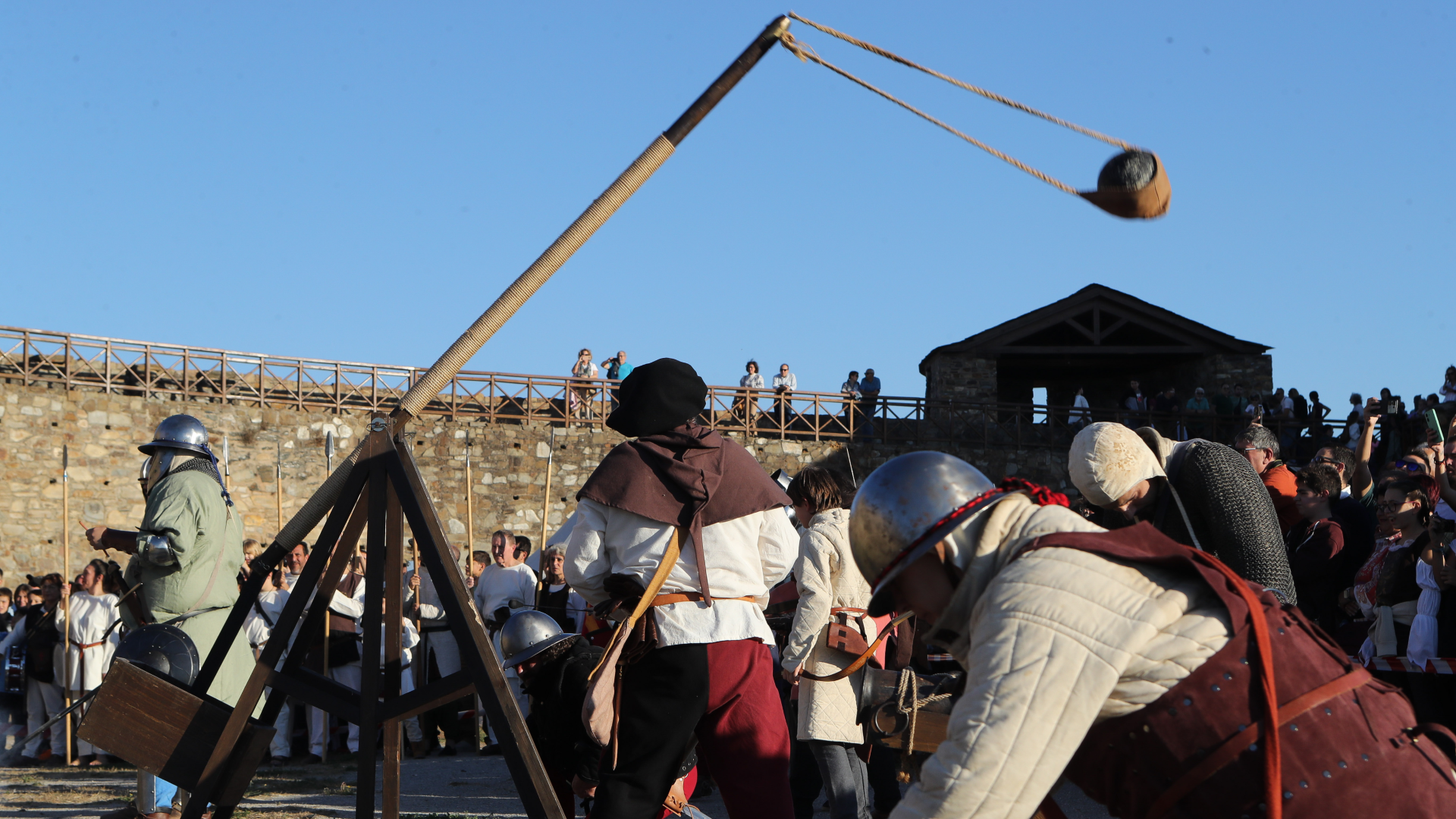
Medieval Skeleton at Stirling Castle May Reveal the Earliest Known Trebuchet Death
BERLIN — A 14th-century skeleton discovered at Stirling Castle in Scotland may represent the earliest known archaeological evidence of a person killed by a trebuchet or another medieval siege weapon. The remains, identified as “Skeleton 150,” belong to a young man who suffered extensive fractures during the siege of Stirling Castle.
Researchers believe the man may have been struck by a high-velocity projectile launched during the 1304 English siege. The weapon could have been similar to the legendary Warwolf, a massive trebuchet commissioned by King Edward I of England.
The findings were presented by biological anthropologist Jo Buckberry of the University of Bradford at the 25th European Paleopathology Society Conference.
Stirling Castle was a strategically important stronghold during the Scottish Wars of Independence, which lasted from 1296 to 1357. Built on a steep, defensible site, the castle became a major target as England attempted to control Scotland.
Latest videos fromLive Science
Skeleton 150 Suffered Extensive Trauma
The remains of eight medieval individuals were discovered beneath Stirling Castle Chapel in 1997. Their burial location was unusual because most people during the Middle Ages were buried in parish churchyards rather than inside royal chapels.
All eight skeletons showed evidence of injuries sustained before or around the time of death, including damage consistent with blunt-force trauma, projectiles and sharp-edged weapons. Skeleton 150, however, displayed an exceptional number of fractures.
Buckberry and her colleagues examined 167 fractures across the skeleton’s bones. The injuries included damage to the spine, arm and right shoulder, along with 61 skull fractures and 57 broken ribs. Most of the trauma was concentrated in the upper body.
The fractures also displayed an unusual zigzag pattern. Similar injuries have been documented in modern forensic cases involving high-speed vehicle collisions, but a road accident would not explain the damage in medieval Scotland.
Could the Warwolf Have Killed Him?
Radiocarbon analysis indicates that Skeleton 150 dates to around A.D. 1300, a period that coincides with the First War of Scottish Independence. At the time, Edward I was developing and deploying increasingly powerful siege engines.
Historical records state that Edward I used as many as 12 siege engines during the 1304 siege of Stirling Castle. Among them was the Warwolf, believed to have been the largest trebuchet ever constructed. Medieval accounts claim that the weapon could launch projectiles capable of breaking through castle defenses.
Researchers cannot determine whether the Warwolf itself struck Skeleton 150. However, the pattern and severity of the injuries are consistent with a high-speed impact from a large projectile launched by a trebuchet or a comparable siege weapon.
“It is difficult to say whether the Warwolf was the weapon that caused the man’s death,” Buckberry said. “But it is likely that a similar siege engine was responsible. A trebuchet is the most probable explanation.”
Signs of an Instant Death
The distribution of the fractures suggests that the young man was standing when the impact occurred. Researchers believe he may have turned away from the incoming projectile before being struck.
Patrick Randolph-Quinney, a biological anthropologist at Uppsala University in Sweden and a co-investigator on the research, said the victim likely went from standing to the ground almost immediately. The impact may have caused instant death.
When the remains were excavated in the late 1990s, researchers initially believed that the fractures occurred after death, possibly when the burial was disturbed or the skeleton was accidentally stepped on. Newer analytical methods, including micro-CT imaging and 3D scanning, allowed the team to distinguish injuries sustained around the time of death from later damage.
The analysis offers a rare glimpse into the destructive power of medieval siege warfare and may provide the earliest known physical evidence of a person killed by a trebuchet. Further research will be needed to confirm the precise cause of death and determine whether the Warwolf was involved.
“If I see something that piques my interest, I keep pursuing the question,” Buckberry said, “because there is almost certainly a larger story that we do not fully understand yet.”
Can you identify these historical weapons? Test your knowledge with our World Weapons Quiz!