


The 2026 Doomsday Equation: Why a 1960 Science Paper Predicted Population Infinity
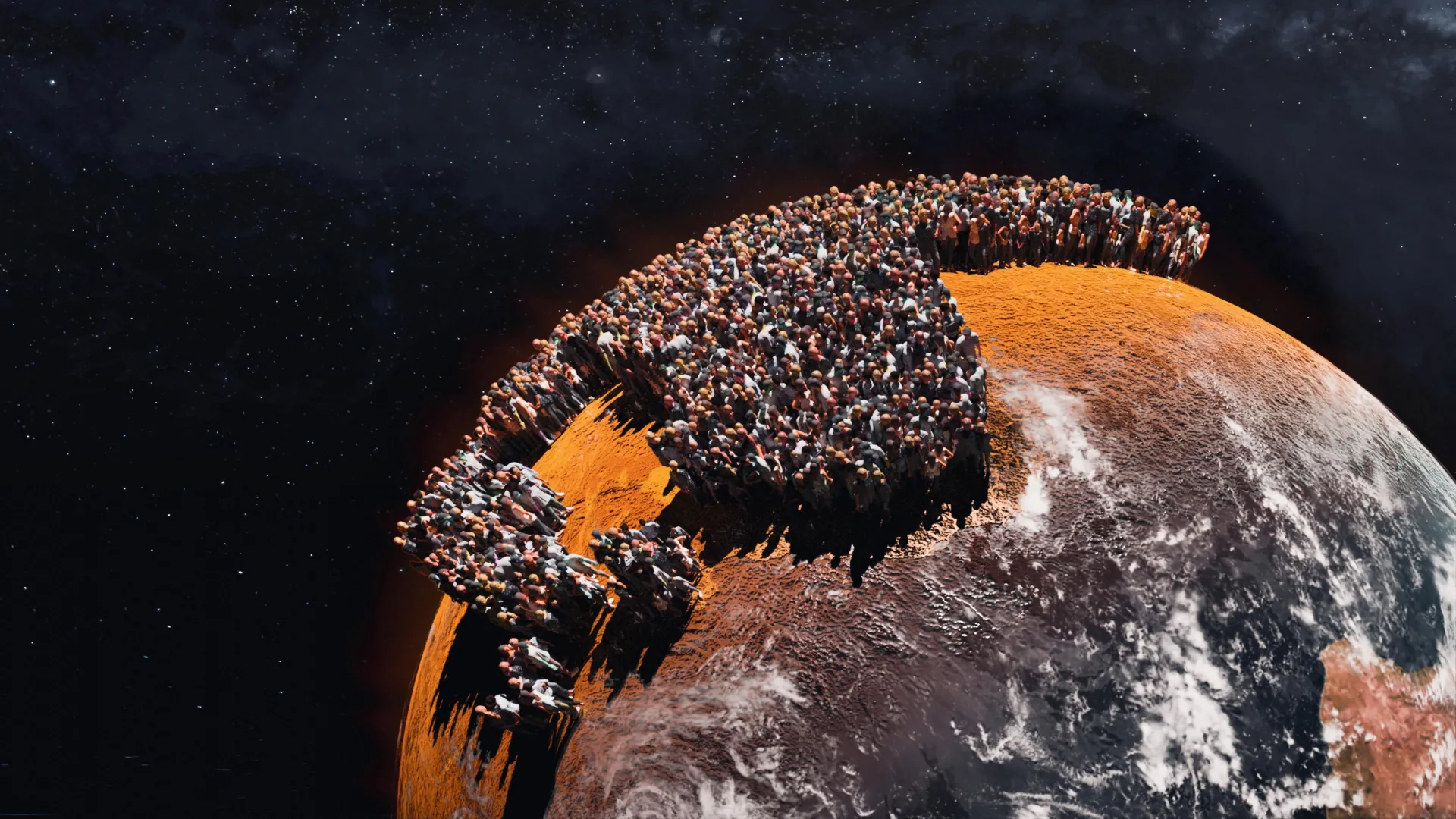
In 1960, Science, one of the world’s leading scientific journals, published an article with the alarming title “Doomsday: Friday, November 13, A.D. 2026”. The paper predicted that, on that date, the human population would approach infinity and that humanity could become virtually extinct.
The unusual claim attracted widespread public attention, as Time reported. More surprisingly, it also received sustained scientific scrutiny because the research and mathematics behind it appeared to be sound.
The paper was written by Austrian-American professor and cybernetics expert Heinz von Foerster, along with his students Patricia M. Mora and Lawrence W. Amiot. They argued that human beings were exceptional among populations and that our numbers could continue to grow faster than exponentially.
“Our great-great-grandchildren will not go hungry,” they insisted. “They will be strangled.”
Although the article was frequently cited and its population projections initially appeared astonishingly accurate, it was not until around 1993—roughly halfway through the predicted “apocalypse”—that the world’s population began to fall below the paper’s projections.
Today, the global birth rate is slightly less than half what it was in 1960. Hopefully, people will wake up on November 13, 2026, and find that ordinary life continues. Nevertheless, the paper remains a remarkable combination of rigorous science and theatrical presentation.
What made humans different?
The mid-20th century saw growing concern about global population growth and the possibility of resource scarcity and geopolitical conflict. Much of this concern rested on the ideas of Thomas Malthus: populations have the potential to grow exponentially but are ultimately limited by their ability to feed themselves.
Von Foerster and his co-authors argued that humans might be an anomaly. Because people can communicate and form “coalitions” to solve problems, increasing population density could create more opportunities for cooperation. As a result, human numbers might grow not only exponentially but at an accelerating rate.
Using 24 estimates of the world’s population over the previous 2,000 years, the authors argued that human numbers had consistently exceeded expectations. They supported the claim with precise mathematical formulas and expressed it in calm, scientific prose.
“Crushed to death”: The 2026 population prediction
By projecting historical population figures into the future, von Foerster and his colleagues calculated that continued growth would cause the world’s population to approach infinity in 2026.
They also argued that humanity’s cooperative abilities could help avert the catastrophe. Since people were unlikely to want to shorten their lifespans, the authors concluded that societies should work together to cut global birth rates in half.
The publication prompted an immediate response. It was covered by Time and the New York Times, and the prediction became the subject of a series of Pogo comics. Many commentators treated the paper as a joke built around public fears about overpopulation.
How the “Doomsday Equation” shaped population debates
Rather than ending the discussion, the controversy intensified. After Science published a letter from mathematicians and demographers calling von Foerster and his co-authors’ work “ridiculous” and “patently absurd,” the authors responded with a vigorous defense of both their mathematics and their conclusions.
From the 1960s through the 1980s, the “Doomsday Equation” was regularly cited—often at face value—in textbooks covering genetics, ecology and population dynamics.
The theory also appeared in unexpected political and policy debates. In 1963, witnesses from the chemical industry cited the coming population explosion during a Canadian Parliamentary Committee discussion about the need for chemical pesticides. In 1971, during the events leading up to the U.S. Supreme Court abortion case, population growth was cited as a reason there was no compelling argument for encouraging larger families.
One reason apocalyptic thinking persisted was that the paper’s population projections proved surprisingly accurate for decades. Predictions derived from its central equation were described as better than those of many demographers from the 1970s through the 1980s, according to research from that period.
It was not until around 1993, when the equation’s accuracy began to weaken, that the world’s population fell below its projections. By then, global birth rates were beginning to follow the recommendation made by von Foerster and his colleagues: the current global birth rate is now slightly less than half what it was in 1960.
Science, spectacle and the power of a dramatic prediction
Perhaps humanity will not wake up “strangled” on Friday, November 13, 2026. Before moving on to the next doomsday scenario, however, this prediction offers a useful lesson about how scientific ideas are presented.
Heinz von Foerster was a stage magician at one point in his life. In classical performance, an effective illusion often has three parts: a familiar setup, an unexpected turn and a final twist that returns the situation to normal.
Von Foerster’s paper attracted attention because it wrapped an ordinary scientific study in an extraordinary title and conclusion. It remained important because its dramatic presentation was supported by research, data and mathematical argument.
Sometimes, the most effective way to draw attention to a serious problem is to present it through an absurd and unforgettable idea.
Source: www.sciencedaily.com