


Close Menu
HitechubHitechub
    What's Hot
    Science

    FDA-Approved Epilepsy Drug May Help Reverse Osteoarthritis Damage, Study Finds

    Science

    Who Created Figure 3? Why Scientists Need to Visualize Experimental Contributions

    Technology

    Pentagon Faces Pressure to Find a Location for New Spaceport

    Important Pages:
    • About Us
    • Privacy Policy
    • Terms & Conditions
    Facebook X (Twitter) Instagram Pinterest
    Facebook X (Twitter) Instagram
    HitechubHitechub
    Friday, November 27
    • Shop
      • Fashion
        • Mens
        • Womens
        • Accessories
          • Handbags
          • Keychain
          • Masks
          • Money clicps
          • Neck Pillow
          • Rings
          • Towels
          • Wallets
        • Jewelry
        • Watches
        • T-shirts
        • Hawaiian shirts
        • Vests
        • Swim trunks
        • Swimsuits
      • Fun
        • Magic cubes
        • Magnifiers
        • Misc
        • Photo books
        • Puzzles
        • Toys
      • Home
        • Cleaning/Care
        • Mailbox covers
        • Mugs
        • Pot Holders
        • Spoon
      • Office and Electronics
        • Chairs
        • Office Supplies
        • IPad cases
        • Laptop stickers
        • Mouse pads
        • Notebooks
        • Pencil bags
        • Pens
        • Phone cases
      • Personalized
      • Pets
      • Sports
        • Cycling
          • Balaclava Mask
          • Bike Bell
          • Bike Computer
          • Bike Fender
          • Bike Grips
          • Bike Kickstand
          • Bike Light
          • Bike Locks
          • Bike Mitts
          • Bike Pumps
          • Bike Repair Stand
          • Bike Seat
          • Bike Trainer
          • Bike Wheels
          • BIKES
            • Folding Bikes
            • Road Bikes
          • Carbon Fiber Bike Products
          • Cycling Mask
          • Kid’ Bike Helmets
          • Inner Tube
          • Motorcycle Bag
          • Nylon Pedals
          • Adult Helmets
          • Photochromic Sunglasses
          • Soft Coolers
          • Suction Cup Bike Rack
          • Tool accessories
          • Winter Cloth
          • Heart Rate Monitor
        • Outdoors/Camping
          • Outdoor Bags
        • Sweatband
    • Technology
      1. AI
      2. Gadgets
      3. View All

      This is the most popular CEO in the world

      Sectors in which “Chat-GPT” is most often used

      Artificial intelligence has begun to “swallow” professions

      The unusual robot conductor of a concert in Seoul

      Here’s how you can tell if your phone is being tapped

      PlayStation 5 becomes a completely silent console and gets more space

      This is the first phone that can be used to park a car

      Best Gaming Laptops 2023: Powerful Portables for PC Games

      Etsy Clarifies AI Policy and Terms Following Seller Backlash

      Why Is There a Shortage of Elevator and Escalator Mechanics?

      NordVPN Black Friday 2026 Deal: Save 78% on VPN Plans

      OpenAI Warns GPT-6.2 Astra Will Hit Usage Limits 40% Faster After Bug Fix

    • Science
      1. Space
      2. Wheels
      3. View All

      Space Perspective: A Journey to the Edge of Space

      5 Fascinating Facts About Space

      Space Exploration: Unveiling the Wonders of the Universe

      Toyota wants to make a new generation battery with a range of up to 1,200 km

      Meet Toyota’s lunar “baby” that could make exploring the Moon easier

      What does a night drive look like with one of the most beautiful cars in the world: the Rolls-Royce Ghost

      Alpha-Gal Syndrome: Why Tick-Bite Red Meat Allergy Is Puzzling Scientists

      How to Overcome Sadness in Academia and Find Balance

      Stephen Colbert-Named Tiny Spider Has a Genome 50% Larger Than the Human Genome

      Oldest Male Killer Whale on Record May Have Been Identified Using Historic Atomic Bomb Test Data

    HitechubHitechub
    Home » James Webb Space Telescope Reveals Mysterious Bulge in Exoplanet Atmosphere
    Science

    James Webb Space Telescope Reveals Mysterious Bulge in Exoplanet Atmosphere

    Share Facebook Twitter Pinterest WhatsApp
    Share
    Facebook Twitter LinkedIn Pinterest WhatsApp

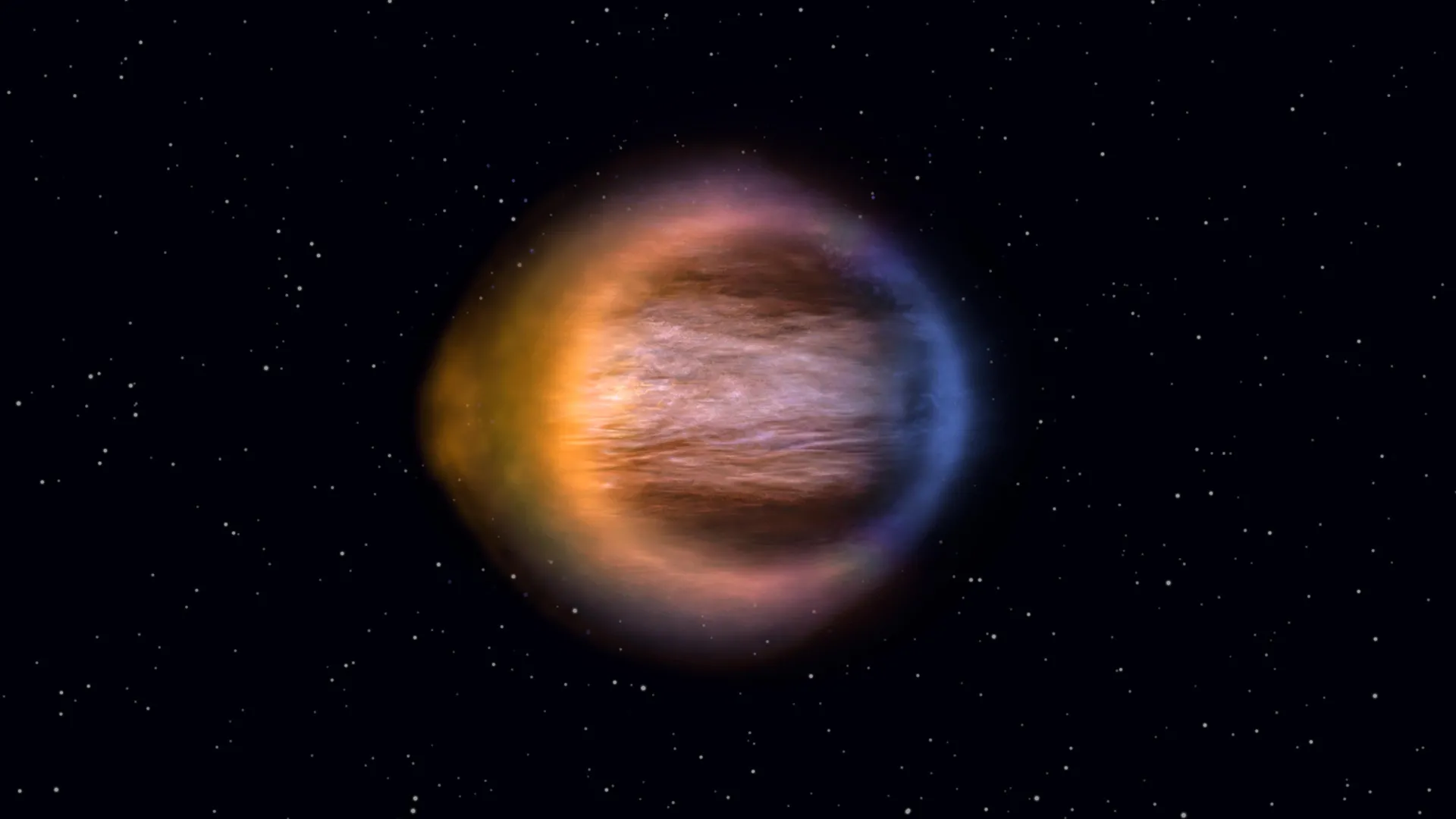
    James Webb Telescope Reveals a Lopsided Atmosphere on Alien Planet WASP-17b

    Astronomers have long depicted distant exoplanets as smooth, circular worlds. New observations from NASA’s James Webb Space Telescope (JWST), however, reveal that the atmospheres surrounding some scorching alien planets can be surprisingly uneven in shape.

    Researchers discovered that one side of the atmosphere surrounding WASP-17b, a giant planet about 1,300 light-years from Earth, extends farther outward than the other. Although the planet’s overall outline remains roughly circular, its atmosphere is noticeably asymmetrical.

    The finding provides new evidence of how extreme temperatures and powerful winds reshape the atmospheres of distant planets. The study was conducted jointly by Cornell University in the United States and the University of Bristol in the United Kingdom.

    The researchers investigated WASP-17b’s atmosphere in unprecedented detail using an innovative technique called a transmission string, developed by Bristol astrophysicists Dr. David Grant and Dr. Hannah Wakeford.

    James Webb reveals the 3D structure of an alien atmosphere

    WASP-17b belongs to a class of planets known as “hot Jupiters”—large gas giants that orbit close to their host stars and experience intense heating. Its unusual atmospheric shape offers new insight into how heat moves through these extreme worlds.

    Lead author Dr. Lili Alderson, a Claman postdoctoral fellow at Cornell University, began the research while attending the University of Bristol, where she earned a PhD in physics.

    “This is a proof of concept that planets are actually 3D objects, and as they orbit around stars, what we predict should happen is consistently happening. Beyond a computational exercise, actually seeing it is another matter.”

    The observations provide information about changes in the chemistry and temperature of WASP-17b’s atmosphere, differences between its equator and poles, and contrasts between its permanently illuminated and dark hemispheres.

    The results are broadly consistent with earlier theoretical predictions and computer models. Together, they provide one of the most detailed three-dimensional views of an exoplanet’s atmosphere ever created and establish a useful reference point for studying the more than 6,000 exoplanets identified to date.

    Co-author Dr. Hannah Wakeford, associate professor of astrophysics at the University of Bristol, said:

    “Planets are fickle and their atmospheres are complex and chaotic. The fact that all these numbers came together to show us a highly structured and dynamic picture of this huge world more than 1,000 light-years away was really exciting.”

    New JWST technique reveals hidden atmospheric features

    James Webb’s extraordinary sensitivity has already enabled scientists to study alien atmospheres using a method called eclipse mapping. This approach examines subtle changes in light as a planet moves behind its parent star, helping researchers determine how conditions vary across the planet.

    The new transmission string technique, also known as transit mapping, examines the opposite part of a planet’s orbit. When an exoplanet passes in front of its star, some of the star’s light travels through the outer edge of the planet’s atmosphere before reaching the telescope.

    By analyzing that light from different angles, scientists can study the atmosphere’s composition and determine how far it extends in different regions. This outer atmospheric boundary is known as the rim.

    Traditional methods typically combine light measurements from the entire limb of a planet into a single average spectrum. The new approach instead separates information from different regions, allowing researchers to identify atmospheric variations that would otherwise remain hidden.

    “Rather than assuming that the atmosphere is a circle with the same radius all around, our technique allows us to derive different distances from the center of the planet to the edge,” Alderson said. “We were able to get around the edges, so to speak. We were able to understand from the ring where the gemstone was in the ring.”

    Powerful winds create WASP-17b’s lopsided atmosphere

    The new measurements reveal a particularly interesting feature near WASP-17b’s equator, exactly where previous models predicted it would appear.

    The distortion occurs on the planet’s “evening” side. Powerful atmospheric winds permanently transport heat away from the hemisphere facing the star toward the hemisphere trapped in darkness.

    This movement of hot gases causes the atmosphere on the evening side to expand farther outward than the cooler “morning” side. As a result, the contours of WASP-17b’s atmosphere are not perfectly symmetrical.

    The finding supports predictions about temperature differences between the planet’s morning and evening regions. The transmission mapping measurements also support other previously identified properties of WASP-17b.

    Dr. Alderson added:

    “The theory is that there should be a large temperature difference between the morning and evening sides, and WASP-17b fits that trend very well, pretty much in line with what we expected.”

    JWST technology could map weather on distant planets

    The successful application of the transmission string technique to WASP-17b indicates that it could be used to study the atmospheres of many other exoplanets.

    Until recently, much of what astronomers could determine about distant atmospheres came from measurements averaged over large areas. This new method offers a way to distinguish conditions at different latitudes and between the day and night sides of a planet.

    Ultimately, the approach could help scientists probe smaller-scale atmospheric structures and bring them closer to mapping global weather patterns far beyond our solar system.

    Dr. Wakeford said:

    “It’s incredibly exciting to have such a robust mathematical model that can be applied to this cutting-edge data. The results really beautifully illustrate the dynamics that are happening in these multidimensional and multifaceted worlds.”

    This study used observations collected by JWST scientists through the Deep Reconnaissance of Exoplanet Atmospheres by Multi-Instrument Spectroscopy (TST DREAMS) Guaranteed Time Observation program.

    Funding was provided by NASA, the UK Research and Innovation (UKRI) Science and Technology Facilities Council (STFC), and a Klarman Fellowship.

    Source: www.sciencedaily.com

    Share. Facebook Twitter Pinterest LinkedIn WhatsApp
    Previous ArticleSpaceX Delivers Mysterious Cargo to the International Space Station
    Next Article Police Take No Further Action Against Government Adviser’s Wife Over Palestine Action Post

    Related Posts

    Science

    Alpha-Gal Syndrome: Why Tick-Bite Red Meat Allergy Is Puzzling Scientists

    Science

    How to Overcome Sadness in Academia and Find Balance

    Science

    Stephen Colbert-Named Tiny Spider Has a Genome 50% Larger Than the Human Genome

    Science

    Oldest Male Killer Whale on Record May Have Been Identified Using Historic Atomic Bomb Test Data

    Science

    345-Million-Year-Old Fossil Fooled Scientists for Decades

    Science

    Has AI Cracked Internet Encryption? Rumored Breakthrough Claim Surprises Scientists

    Science

    Indonesian Wildfires Threaten Orangutans and Their Future

    Science

    Hidden Underground Caves in Australia May Reveal Otherworldly Secrets

    Add A Comment
    Leave A Reply Cancel Reply

    Stay In Touch
    • Facebook
    • Twitter
    • Instagram
    • Pinterest
    Top Picks
    Technology

    Samsung Launches Galaxy Z8 Foldable Phone and Galaxy Watch – Pre-Order Starts August 7th!

    This year’s price increases for Samsung’s foldables may seem modest, but considering their already high…

    Man Attempts to Treat Urinary Incontinence by Plugging His Urethra With Glue, Creating a Diagnostic Dilemma

    NASA’s LRO Reveals New Details of Falcon 9 Crater on the Moon

    6-Million-Year-Old Whale May Have Had the Most Distorted Face in Mammal History

    50% of Long COVID Patients Improve Within Three Years, but Symptoms Persist in This Subtype

    Most Popular
    Science

    NASA Conducts Low-Altitude Research Flight Over Texas Farmland

    Technology

    New Dolphin X Malware Utilizes AI to Identify High-Value Targets

    Categories
    • AI (9)
    • Gadgets (6)
    • Science (3,601)
    • Space (3)
    • Technology (3,033)
    • Wheels (3)
    Our Picks
    Science

    Controversial Alzheimer’s Surgery May Reverse Symptoms: What Scientists Know

    Technology

    SAP Warns of Critical OAuth 2.0 SSRF Security Vulnerability

    © 2026 Hitechub.
    • Home
    • About Us
    • Privacy Policy
    • Terms & Conditions

    Type above and press Enter to search. Press Esc to cancel.

    GDPR Cookie Banner

    We are using cookies to give you the best experience on our website.

    You can find out more about which cookies we are using or switch them off in .

    Ad Blocker Enabled!
    Ad Blocker Enabled!
    Our website is made possible by displaying online advertisements to our visitors. Please support us by disabling your Ad Blocker.