


NASA’s Curiosity Rover Celebrates 14 Years Exploring Mars
Susanne P. Schwenzer, Professor of Planetary Mineralogy, Open University, UK
Earth date: Friday, August 7, 2026
This week was especially memorable for the Curiosity rover team as we celebrated 14 years since NASA’s Mars Science Laboratory successfully landed on the Red Planet. I still remember watching the entry, descent, and landing sequence unfold through NASA’s Eyes on the Solar System. I do not remember much after the landing began until I heard the words, “Mars is safe.” The tension was overwhelming, followed by an unforgettable celebration.
If you would like to relive Curiosity’s journey, visit NASA’s interactive Eyes on the Solar System tool. Use the menu to find the Mars Science Laboratory spacecraft. Curiosity launched from Earth on November 26, 2011, at 15:02 UTC. You can also rewind the mission to its launch and follow the spacecraft as it traveled toward Mars.
Curiosity landed in Gale Crater on August 6, 2012, at 05:17 UTC. For me, one of the most powerful moments was seeing the excitement in the mission control room after the landing. I have watched the “Curiosity Has Landed” video countless times, and it remains just as inspiring today.
Curiosity Continues Exploring Mount Sharp
So, how did the Curiosity team mark the transition from the rover’s 14th Earth year to its 15th? For the rover, it was business as usual. While many team members shared memories and reflected on Curiosity’s discoveries, the rover continued its scientific investigations on Mount Sharp.
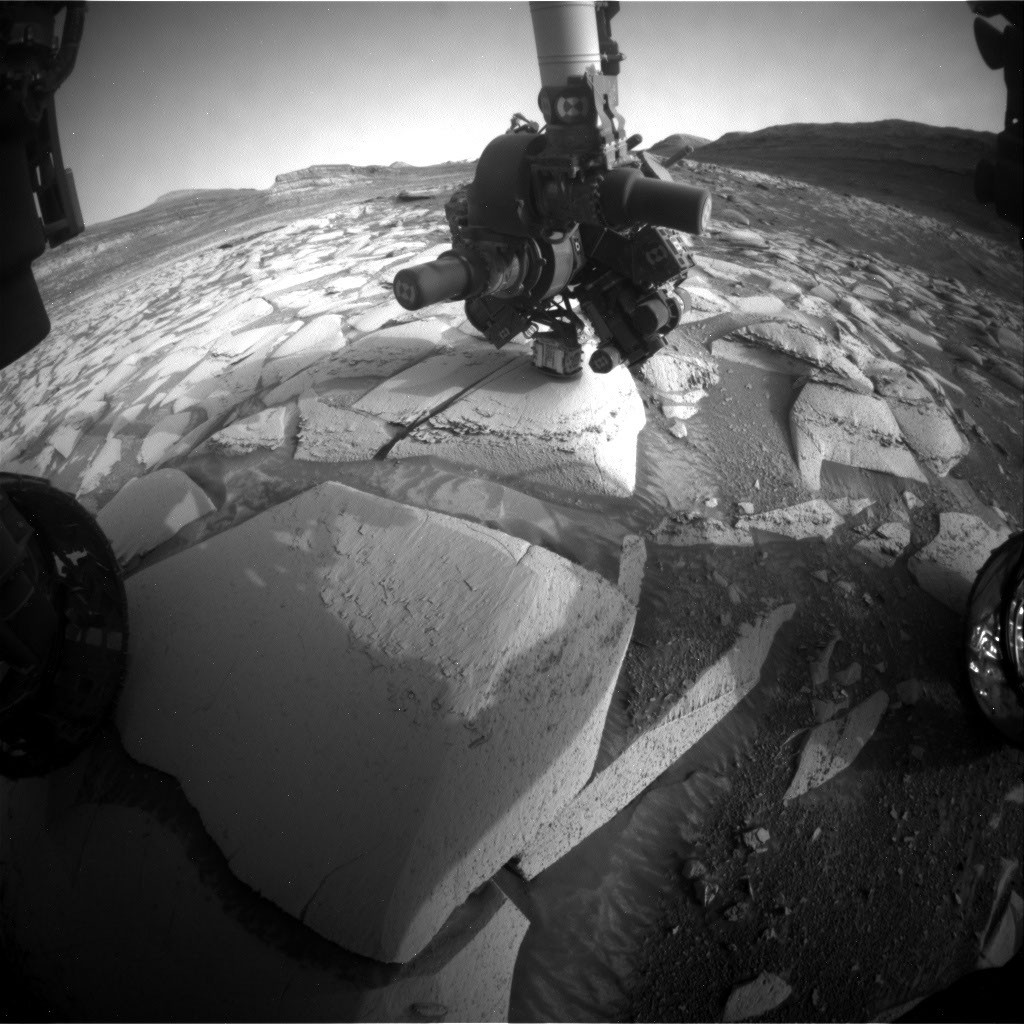
With support from NASA’s Jet Propulsion Laboratory science and engineering teams in Pasadena, Curiosity carried out activities on Sol 4976 at 19:47 local mean solar time. The rover’s robotic arm was deployed to the target “Tunas Casa” for an Alpha Particle X-ray Spectrometer, or APXS, measurement.
The rover continued climbing Mount Sharp while investigating a variety of rock formations. The terrain is steep, and Curiosity was tilted by as much as 24 degrees at one point last Friday. However, the engineering team understood the rover’s capabilities and successfully guided it to its planned location on Monday.
At the first stop of the week, the APXS examined the rock targets “Tunas Casa” and “Villarrica.” Both locations were also documented with the Mars Hand Lens Imager (MAHLI). ChemCam investigated the targets “Lago Rupanco” and “Chulipa Punta,” while its Remote Micro-Imager captured detailed, high-resolution views.
One focus of the investigation is cross-bedding—a geological feature in which layers of sediment slope across and intersect with one another. Studying these patterns helps scientists understand how ancient sediments were deposited and how the rock layers formed.
Mastcam also planned five mosaics to survey nearby rock surfaces and more distant formations. The targets included wall rocks forming the buttes around the rover as well as smaller rock surfaces close to Curiosity. “La Linea” shows evidence of erosion, while “Tilak” may reveal more about the region’s complex layering.
In addition to science observations, the plan included routine rover maintenance. These activities included washing the Sample Analysis at Mars (SAM) instrument’s column and taking MAHLI images of the rover’s REMS ultraviolet sensor. Although such tasks may seem routine, they are essential for keeping Curiosity’s instruments operating effectively.
Investigating Ancient Wind and Water on Mars
A 46-foot (14-meter) drive positioned Curiosity in front of a particularly interesting geological feature. Here, two distinct rock layers intersect, and additional layers cut across them. Sites like this allow scientists to reconstruct the environmental history of Gale Crater one piece at a time.
The rocks clearly record the effects of wind, but water also played an important role in shaping and depositing the sediments. Because this location is so scientifically valuable, the team plans to remain there through Monday and use two planning cycles to study it in detail.
New Curiosity Rover Targets and Observations
Friday’s plan included two APXS measurements on rock blocks located in front of the rover. Additional APXS observations were identified for planning on Monday, targeting “Gorbea Shiobara” and “Uriondo.” MAHLI will document both locations.
The science plan also includes one of the largest MAHLI mosaics I have seen. Centered on the target “Tres Moros,” the mosaic will provide a detailed view of how different rock formations meet. The team is eager to examine the high-resolution images and study the geological relationships visible in every detail.
Mastcam will survey representative outcrops both near and far from Curiosity. Important targets include “Laguna del Eulogio” and “Laguna de Pozuelo,” which are associated with changes in the local rock formations. The observations will also include the distant butte known as Miche Mokwa.
Miche Mokwa has appeared frequently in the mission’s science planning. Curiosity has driven around it and captured repeated images to create stereo views. These observations help scientists investigate the region’s stratigraphy—the way rock layers are arranged and related to one another.
ChemCam will study the hump-shaped target “Rio Tranquilo,” which may provide clues about the water-related conditions present when these rocks formed. Another ChemCam target, “Rio Juncalito,” contains cross-bedding. ChemCam’s Remote Micro-Imager will also observe two locations: one looking ahead toward Valle Grande and another focused on Miche Mokwa.
Monitoring the Martian Environment
Both planning cycles include extensive environmental monitoring. Curiosity will measure atmospheric opacity, monitor wind conditions, and survey the landscape for dust devils. The rover will also search for clouds while the Radiation Assessment Detector (RAD) continues monitoring the radiation environment at the surface.
RAD is rarely mentioned in daily mission updates because it operates quietly inside the rover, measuring radiation from its stationary position. However, it has been collecting valuable data for more than 14 years. In fact, RAD was among the first instruments switched on after launch and began monitoring the radiation environment during Curiosity’s cruise to Mars.
Happy 14th anniversary, Curiosity! After more than a decade on Mars, NASA’s rover continues climbing Mount Sharp, studying ancient rocks, and revealing the geological history of Gale Crater.
Source: science.nasa.gov