



Archaeopteryx may have taken flight through a series of powerful leaps rather than the single explosive launch used by many modern birds, according to new biomechanical research published in Developmental Biology. Read the study.
Archaeopteryx lived in what is now Germany during the Jurassic period, approximately 150 million years ago.
Often described as the earliest known bird, Archaeopteryx combined feathers and wings with several primitive dinosaur-like characteristics, including teeth, claws on its fingers, and a long, bony tail.
The animal also had limited shoulder mobility and lacked a keel-shaped sternum, a central structure that anchors the powerful flight muscles of modern birds. These features may have prevented it from using the rapid, forceful wingbeats associated with modern bird takeoffs.
How Archaeopteryx first became airborne has remained an important question in the evolution of bird flight.
“Archaeopteryx is the first real bird,” said Dr. Neil Gostling of the University of Southampton.
“It was feathered and had wings, but it also retained many typical dinosaur features, including a long bony tail, claws on separate fingers, and teeth in a beakless jaw.”
“It was not a particularly well-developed ‘bird’ compared with the birds we know today.”
Because Archaeopteryx lacked a keeled sternum and could not raise its wings fully above its back, researchers questioned whether its wings could generate enough force to launch the animal directly into flight.
“We know that Archaeopteryx could not rely entirely on its wings for takeoff, so we asked what role its legs may have played,” said Professor Marcus Heller of the University of Southampton.
“Our findings indicate that takeoff could have been a staged process. The legs generated the initial force, and the wings then took over.”
For the study, the researchers used data from living birds to create a detailed musculoskeletal computer model of the hind limbs of Archaeopteryx.
The scientists proposed that the animal’s wings may not have been capable of producing the powerful downstrokes modern birds use during takeoff. However, its relatively strong legs may have compensated for this limitation.
The legs of Archaeopteryx are estimated to have accounted for approximately 13% of its body weight, compared with around 9–10% in modern birds.
According to the computer model, a single leap could have propelled the animal to a speed of approximately 3 meters per second. That was not enough to reach the estimated 7 meters per second required for sustained flight.
However, two or three consecutive jumps, combined with limited wing flapping between leaps, could have enabled Archaeopteryx to reach flight speed.
In one modeled scenario, three unassisted jumps generated enough forward thrust, followed by a short final wing flap, to achieve takeoff. In another scenario, two jumps separated by a single wing downstroke produced the same result more quickly.
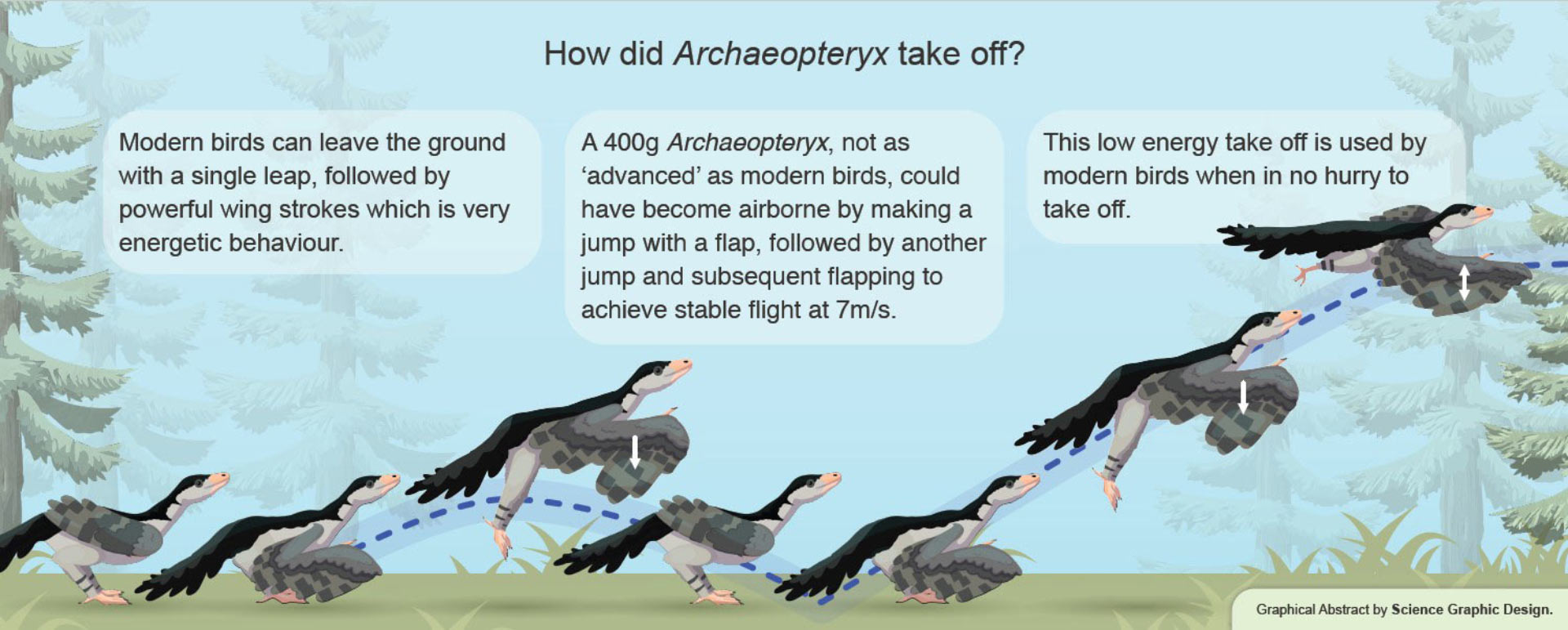
Illustration of how Archaeopteryx may have taken off. Image credit: Science Graphic Design.
The findings suggest that the origin of powered flight may have involved a gradual increase in speed through repeated leaps, rather than the single powerful launch seen in many modern birds.
This takeoff strategy could represent an evolutionary transition between ground-based jumping and the more advanced flight mechanisms used by living birds. Some modern land birds, including crows and magpies, still use repeated jumps when taking off.
“Our findings show that a medium-sized, 400-gram Archaeopteryx could have reached a sustainable flight speed of 7 meters per second through three bipedal jumps, or through two bipedal jumps separated by downward wingbeats,” said Dr. Eric Mailach of the University of Southampton.
“All birds use their feet to help generate force during takeoff,” Dr. Gostling said.
“In fact, as much as 90% of the force needed to leave the ground can come from the legs before the wings take over.”
“Archaeopteryx may have jumped repeatedly before flapping its wings and flying away. Alternatively, it may have combined a jump, a wingbeat, another jump, and additional wingbeats.”
“Modern birds can often take off with a single leap, but many species, including crows, magpies, and gulls, also use multiple-jump takeoffs. They may use a single jump when startled or threatened, while repeated leaps can help conserve energy.”
_____
Eric A. Mayr et al. 2026. Hop, Hop and Away: Taking Off in Archaeopteryx Using Multiple Jumping Mechanisms. Developmental Biology 539: 57–64; doi: 10.1016/j.ydbio.2026.07.018
Source: www.sci.news