


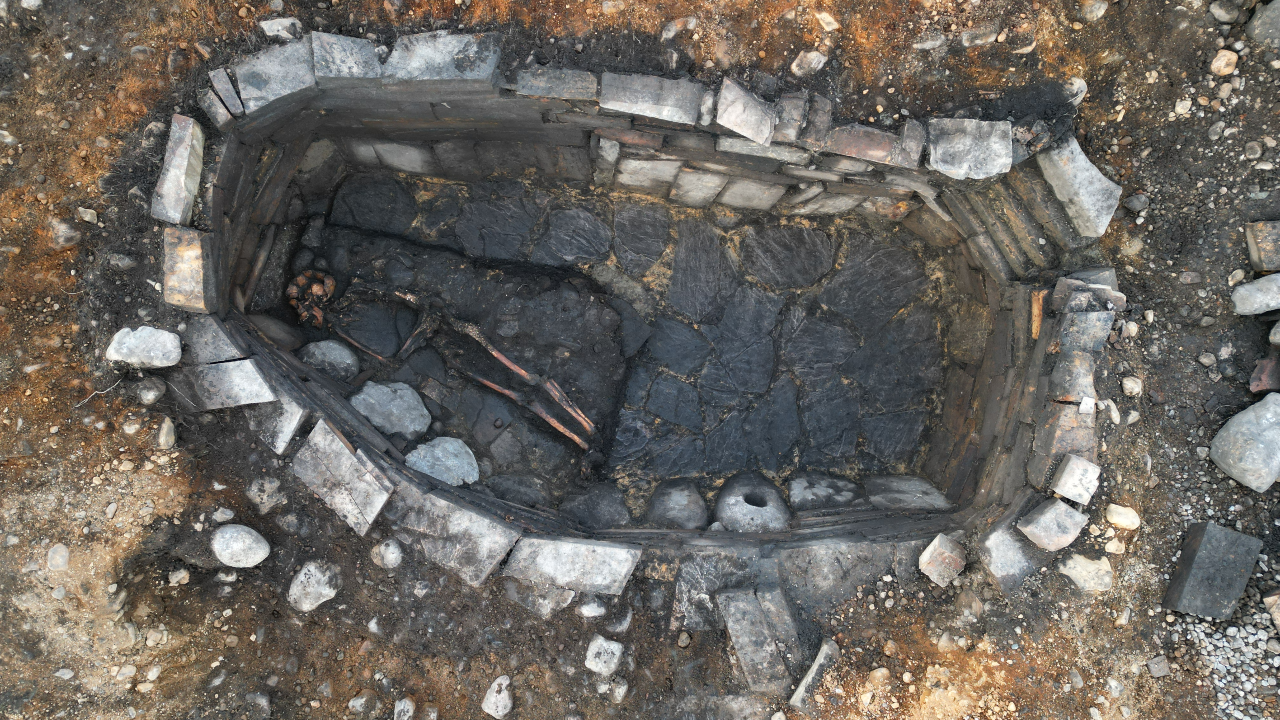
2,000-Year-Old Burial Discovered in Possible Iron Age Ceremonial Well in Scotland
Archaeologists excavating a quarry in the Scottish Highlands have discovered a 2,000-year-old burial inside what may have been a ceremonial well. Researchers believe the burial could have formed part of a closing ritual performed when the well was abandoned.
The unusual discovery was made in northern Scotland during an archaeological investigation linked to the expansion of a quarry, according to the Highland Archaeological Service.
Ancient Well May Have Held Ritual Significance
The well measures approximately 3 meters (10 feet) in length and 1 meter (3.3 feet) in depth. Its base was lined with clay pressed between stone slabs and gaps in the masonry, a construction technique that may have helped the structure retain water.
Archaeologists believe the burial dates to the Iron Age, a period spanning roughly 800 B.C. to A.D. 400 in northern Britain. Animal bones were placed over the human remains, but researchers have not identified any other grave goods.
Human Remains Could Reveal More About the Burial
The identity of the individual remains unknown. Further analysis is expected to determine the person’s age, biological sex, health and possible cause of death, as well as provide a more precise date for both the burial and the well.
“Iron Age burials in northern Scotland are generally quite rare finds,” Lachlan MacKeggie, co-director of the Highland Archaeological Service, told Live Science.
The discovery is particularly significant because burials from this period are uncommon in the region. The placement of animal bones above the remains may also provide clues about the rituals associated with the closure of the well.
Burial Found Near an Iron Age Settlement
The burial site lies near the remains of an Iron Age settlement in Camore Wood. Archaeologists have identified at least 20 hut circles in the area, along with the possible remains of a roundhouse near the well.
However, researchers have not yet established whether the burial was directly connected to the settlement, which is located approximately 1 mile (1.6 kilometers) away.
Possible Final Ceremony at the Well
One explanation is that the individual was buried as part of a final ceremony carried out when the well was deliberately closed. Archaeologists have found similar examples of burials associated with the abandonment or sealing of important prehistoric sites.
“There are other examples of burials as part of ‘final’ rites in important locations, such as High Pasture Cave on the Isle of Skye,” MacKeggie said. At that site, the burial of a woman and two infants took place near the entrance to a cave that was ceremonially closed during the Iron Age.
Analysis of the Scottish Highlands burial is ongoing. Researchers hope that laboratory studies and 3D scans of several artifacts will provide additional information about the individual, the well and the rituals practiced by the Iron Age community.
Additional findings and project updates may be available through the Highland Archaeological Service website.
What do you know about the human skeleton? Test your knowledge with our human bones quiz.
Source: www.livescience.com