


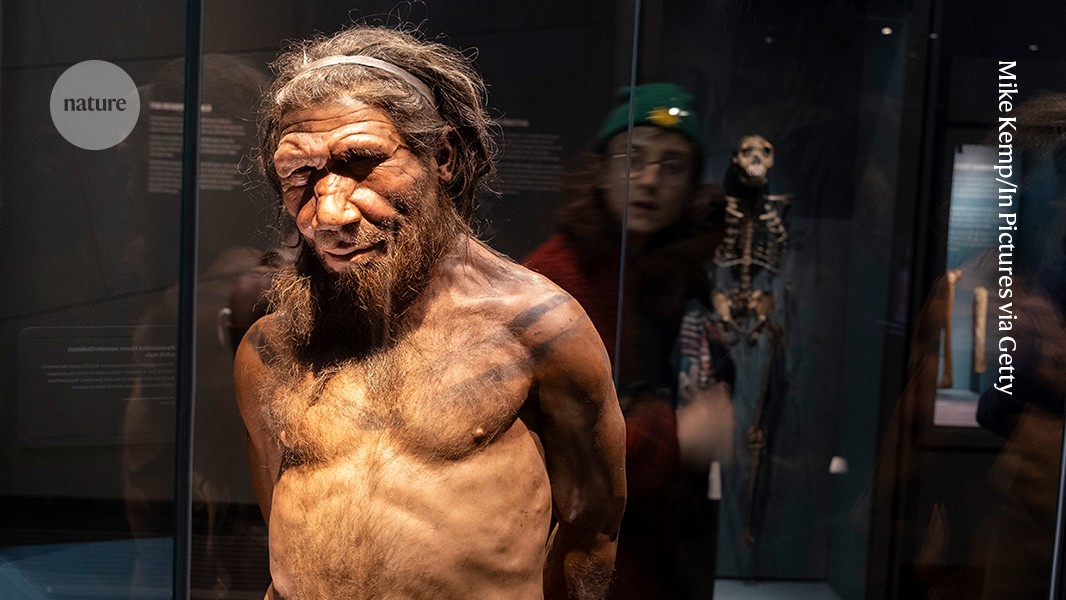
Neanderthals had physiological features that differed from those of Homo sapiens, including thicker bones and pronounced brow ridges, as shown in this model.Credit: Mike Kemp/In Pictures via Getty
Two genetic changes inherited from Neanderthals may have contributed to the extinct hominins’ characteristically robust physiques. The variants affect the growth hormone receptor and are linked to greater height and muscle mass in modern humans, according to a study1 published in Current Biology.
Neanderthals lived across Europe and western Asia from approximately 300,000 years ago until about 40,000 years ago. Before their extinction, they interbred with Homo sapiens. As a result, people with ancestry from outside Africa typically carry around 1–4% Neanderthal DNA2.
Fossil evidence indicates that Neanderthals had broader chests3, thicker bones4 and larger muscles than most modern humans. The new findings suggest a possible molecular mechanism behind these robust physical traits, says Bastien Llamas, a human geneticist at Adelaide University in Australia.
How Neanderthal DNA influences modern human traits
Well-preserved Neanderthal remains are exceptionally rare. Researchers have recovered only about five genetic samples of sufficient quality to reconstruct a complete or nearly complete Neanderthal genome. Most available Neanderthal DNA is fragmented and provides only partial genetic sequences.
The researchers examined the growth hormone receptor, a protein involved in regulating bone and muscle development. Using three high-coverage and two medium-coverage Neanderthal genomes, they identified two amino-acid changes in the receptor that were unique to these ancient hominins.
According to the study, the Neanderthal growth hormone receptor variant entered modern human populations through interbreeding roughly 47,000 years ago. Today, it is carried by about 20% of people in South Asia and 15% of people in East Asia. The variant occurs in approximately 0.5% of Europeans and is absent in people from sub-Saharan Africa.
To investigate whether the ancient genetic changes affected receptor activity, the researchers engineered mouse cells to produce either the Neanderthal or modern human version of the growth hormone receptor. After five days, cells carrying the Neanderthal receptor had proliferated about 39% more than cells carrying the variant dominant in modern humans.
The researchers then analysed health and genetic information from more than 1.1 million adults across five biobanks. On average, people carrying the Neanderthal-derived variant were approximately 0.3 centimetres taller than non-carriers.
Carriers also had an average of 0.25 kilograms more muscle mass, says study co-author Philipp Kanis, a genetics researcher at the Max Planck Institute for Evolutionary Anthropology in Leipzig, Germany.
The study’s key strength is its combination of ancient genomics, laboratory experiments and health data from modern biobanks, says Llamas. Together, the findings show how DNA inherited from Neanderthals can influence a specific molecular pathway and contribute to measurable physical differences in people today.
The Neanderthal-derived variant was also associated with several craniofacial characteristics. Modern humans carrying the variant tended to have a shorter ramus — the rear section of the lower jaw — along with a higher likelihood of an overbite and shorter tooth roots than non-carriers.
Source: www.nature.com