


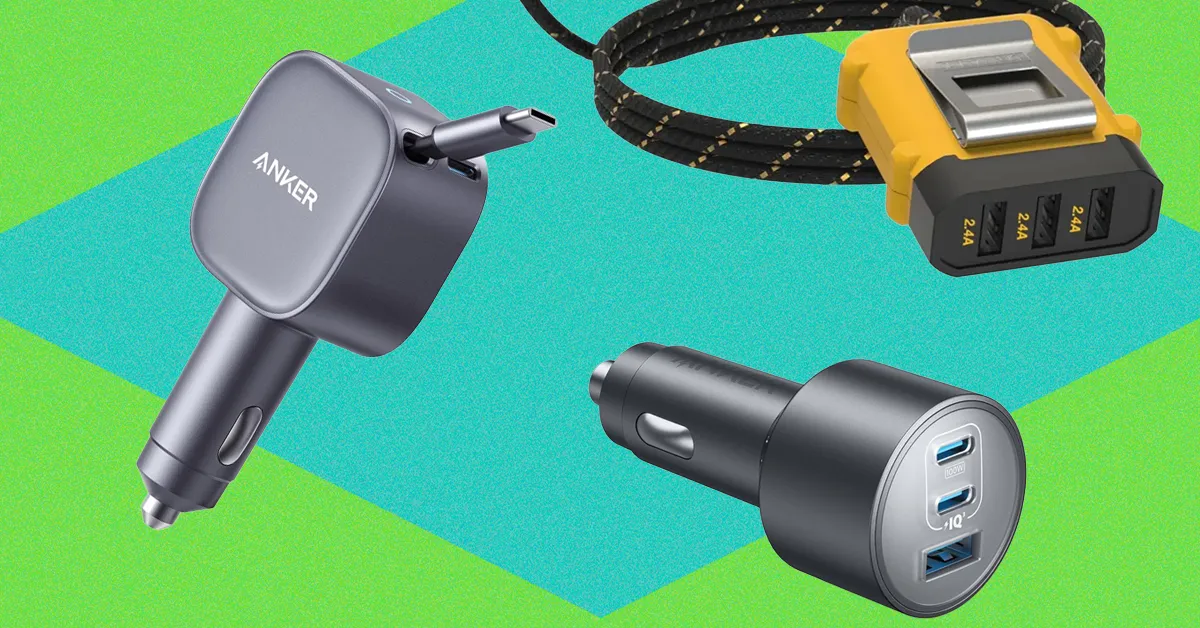
Anker is one of the most dependable brands in charging technology, but retractable charging cables have a few potential weak points. The cable can wear down over time, and the retraction mechanism may eventually fail. Because the built-in cables typically cannot be replaced, convenience and cable organization may come at the expense of long-term durability. Fortunately, most USB car chargers are affordable and usually cost around $20.
Best front- and rear-seat USB car charger
Today’s families often travel with several devices at once. Parents may need to charge their phones in the front seat while children use tablets or gaming devices in the back. A dead tablet battery can quickly disrupt an otherwise peaceful road trip—especially during another episode of Bluey.
The DeWalt 72W front- and rear-seat charger is a practical solution for keeping multiple devices powered. Its front USB-C port delivers up to 30 watts, providing useful charging performance for phones and other compatible devices. Additional USB-A ports help keep tablets, headphones, and portable electronics charged in the back seat.
Although DeWalt is best known for power tools, its rugged charger works well for family travel. The main compromise is that the rear-seat ports use USB-A rather than USB-C. Dedicated rear-seat USB-C car chargers remain difficult to find for vehicles without built-in rear charging ports, making this DeWalt model one of the most versatile options currently available.
USB Car Charger FAQ
How do you choose and test a USB car charger?
To evaluate the best USB car chargers, we began with established charging brands such as Anker, Belkin, and Ugreen. We also tested models recommended by reliable reviewers, prioritizing products that are widely available and easy to purchase. Safety was a major consideration, so we focused on UL-listed or properly certified chargers and avoided questionable products.

Photo: Matthew Kofuji
We measured the performance of every port with an ammeter while each charger operated under maximum load. We also checked the charging demands of devices such as the Motorola Razr and iPhone 13 using the Ampere phone app. An infrared thermometer helped us monitor operating temperatures and identify excessive heat during high-power charging.
Testing included the cables supplied with each charger as well as compatible fast-charging USB-C cables. For high-output models, we measured charging times for devices such as a MacBook Air M4 and the 4,000A Wolfbox jump starter.
We also conducted real-world road tests by using each charger during multi-hour trips. We charged phones, laptops, and portable jump starters while assessing ease of use, versatility, heat management, and durability. Chargers with both USB-C and USB-A ports received additional consideration because they support a wider range of devices.
Finally, we reviewed customer feedback and attempted to reproduce common complaints. Each charger was repeatedly inserted and removed from a vehicle’s power socket, and we tested how well it performed when moved or bumped during everyday use.
Are cheap USB car chargers dangerous?
Some inexpensive USB car chargers may use poor-quality components, inadequate insulation, or inconsistent power regulation. Unreliable chargers and cables can create loose connections, excessive resistance, overheating, short circuits, and voltage fluctuations that may damage connected devices.
Health Canada identifies poorly designed USB chargers as a potential fire and electrical safety hazard. Learn about USB charger fire hazards.
When shopping for a car charger, look for products labeled “UL Listed” or clearly certified to meet recognized safety standards. “UL Classified” or “UL Recognized” labels may apply only to specific components, hazards, or operating conditions. A certified charger should include protection against overcurrent, overheating, short circuits, and power surges.
Other recommended USB car chargers

Photo: Matthew Kofuji
Scosche PowerVolt 60W Dual-Port Charger, $20: This compact USB-C car charger has two ports, each rated at 30 watts. It offers fast, dependable charging for phones and other mobile devices at an affordable price. It is a strong alternative to Anker if you only need USB-C ports and do not require laptop-level charging power.
Anker 40W Two-Port Car Charger, $20: This compact Anker model is designed primarily for smartphones and other small devices. Its two USB-C ports are reliable, although its total output is lower than newer high-speed chargers. It is a good budget option if you do not need maximum charging performance.

Photo: Matthew Kofuji
Belkin BoostCharge 42W Dual-Port Charger, $24: This small Belkin charger combines USB-C and USB-A connectivity, making it useful for both newer and older devices. It provides dependable everyday charging and has a durable, insulated design. However, it may not fit securely in especially deep vehicle power sockets, and its bright indicator light remains illuminated while plugged in.
Nekteck 45W Two-Port Car Charger, $32: This straightforward charger is a practical choice for users with Quick Charge 3.0-compatible USB-A devices. Its 45-watt USB-C output is not the fastest available today, but it is more than sufficient for most smartphones. The USB-A port is also considerably faster than standard USB-A charging for compatible older devices.
Source: www.wired.com