


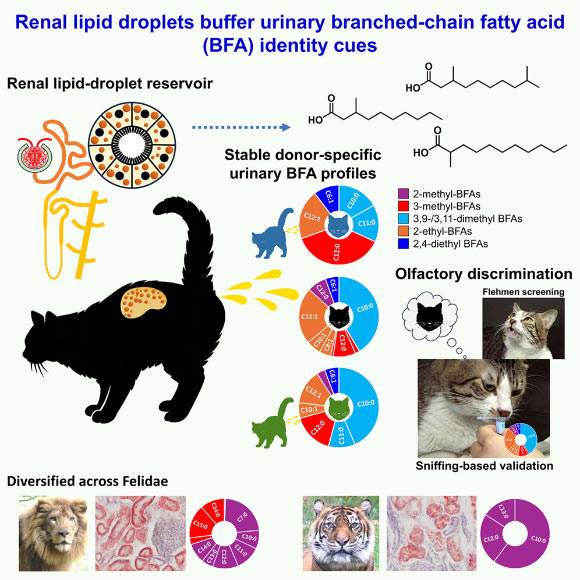
For nearly 110 years, scientists have wondered why domestic cats have unusually large numbers of fat-storage structures, known as lipid droplets, in their kidneys. A new study led by Professor Masao Miyazaki of Iwate University suggests that these kidney lipid droplets may serve as a chemical reservoir. They could help cats maintain a stable individual “scent signature” in their urine, even as other odor molecules change over time.
Animals often use scent to communicate identity, but odor molecules can change over time. Ichizawa et al. show that domestic cats maintain a durable chemical identity through a reservoir system based on branched-chain fatty acids. Image credit: Ichizawa et al., doi: 10.1016/j.cub.2026.07.045.
Animals that use scent to mark territory face a major chemical challenge. Odor molecules can evaporate, degrade, or change after being released into the environment, meaning that a scent signal may become less reliable over time.
Domestic cats appear to solve this problem using a group of 13 branched-chain fatty acids (BFAs). These compounds had not previously been documented in mammalian urine or other body secretions.
The new research shows that each cat has a distinctive combination and ratio of these fatty acids. Unlike many volatile compounds in urine, the BFA profile changes relatively little over time, evaporates slowly, and remains detectable for at least 24 hours after urine is deposited.
“Although it has been known for more than a century that cats have lipid droplets in their kidneys, it has remained a mystery why cats have so many lipid droplets,” says Professor Miyazaki.
“Our findings suggest that one of their functions may be to support stable chemical signatures in urine.”
“How BFAs stored in renal lipids are ultimately released into the urine is an important question for future research.”
To investigate whether cats can detect this chemical identity, the researchers observed the animals’ Flehmen response—the characteristic open-mouthed expression cats make when drawing scents toward a specialized organ in the roof of the mouth.
Cats displayed the Flehmen response more frequently when exposed to unfamiliar cat urine than to their own urine. The reaction declined after repeated exposure to the same sample but returned when urine from a different cat was introduced.
In a follow-up experiment, cats detected differences in fatty acid mixtures even when the researchers kept other urine components constant. This finding indicates that cats can recognize information encoded in these fatty acid profiles.
The branched-chain fatty acids were found almost exclusively in the kidneys, where they were stored in the long-mysterious lipid droplets located in the renal cortex.
Related compounds and kidney lipid droplets have also been identified in other wild cat species, including lions, tigers, leopards, jaguars, and lynx. However, the chemical profiles differ between species.
The discovery could eventually contribute to new ways of managing cat urine odor. Because fatty acid profiles appear to identify individual animals reliably, the findings may also help conservationists monitor elusive wild cats without directly observing them—simply by analyzing their scent.
“These findings identify an organ-level mechanism that stabilizes the small-molecule chemical identity of domestic cats and reveal diverse chemical substrates supported by reservoirs across the feline lineage,” the scientists concluded.
Their paper was published online in Current Biology on August 19, 2026.
_____
Shota Ichizawa et al. The characteristics of branched-chain fatty acids derived from renal stores give domestic cats a stable chemical identity. Current Biology, published online August 19, 2026. doi: 10.1016/j.cub.2026.07.045
Source: www.sci.news