


518-Million-Year-Old Fossil Reveals a Tentacled Ancestor of Starfish
A 518-million-year-old fossil discovered in China suggests that the common ancestor of starfish and their relatives was not a burrowing, worm-like animal. Instead, it may have been a tentacled creature that fed on particles suspended in the surrounding water.
What Was the Common Ancestor of Starfish?
Ambulacraria is one of the two major lineages of deuterostomes, a broad group of animals that includes echinoderms and hemichordates. Echinoderms include starfish, while hemichordates include acorn worms.
The two groups have markedly different body forms. Starfish and other echinoderms typically have fivefold radial symmetry, whereas acorn worms and their relatives have bilateral, worm-like bodies. The evolutionary origin of these differences has long remained difficult to explain because early fossil evidence is scarce.
“The five-fold radial symmetry of starfish and their relatives, and the bilaterally symmetrical worm-like bodies of acorn worms and their relatives, have until now been something of a mystery,” said co-author Dr. Giovanni Mussini, a palaeontologist at the University of Cambridge.
A New Cambrian Fossil from China
Researchers discovered several previously unknown specimens in the Maotianshan Shale of China’s Yunnan province. The site is known for preserving soft-bodied animals from the Cambrian explosion, a period of rapid evolutionary diversification when many major animal groups first appeared in the fossil record.
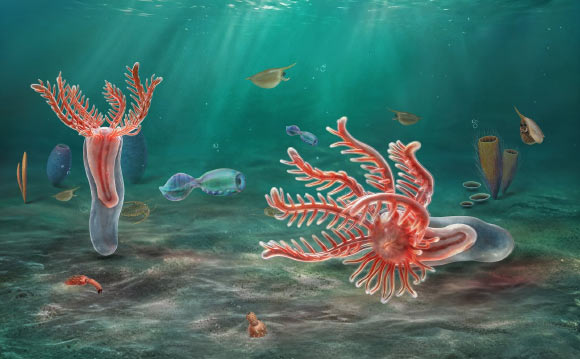
The new species, named Yujingia glutenotunica, was small, measuring between 8 and 22 mm in length. Its body was bottle-shaped and soft, with feathery tentacles at the top that likely captured food particles from the water.
A second appendage probably anchored the animal to the ocean floor, although it may have been capable of limited movement. This combination of tentacles and an anchored body gives the fossil an appearance unlike the burrowing ancestor traditionally envisioned for Ambulacraria.
Evidence for a Tentacled Ambulacrarian Ancestor
By analyzing anatomical characteristics across 100 living and extinct species, the researchers placed Yujingia glutenotunica close to the last common ancestor of Ambulacraria.
“We tend to think that the last common ancestor of ambulacrarians looked a lot like worms that lived in burrows on the ocean floor and filtered food from the water,” Mussini said.
“If anything, this new fossil suggests that the common ancestor of ambulacrarians may actually have had tentacles and may have been more similar to starfish and their relatives.”
The finding highlights how ecology can direct different evolutionary lineages along very different paths, producing major differences in body shape and behavior.
“Chordates became dependent on locomotion to find food, streamlining their bodies and developing brains, while members of the starfish lineage remained relatively anchored to the ocean floor and specialized in this particle-feeding lifestyle,” Mussini added.
Linking Cambrian Animals to Modern Starfish and Acorn Worms
“How the major deuterostome groups diverged during the Cambrian explosion is one of the central questions in animal evolution,” said lead author Dr. Degan Hsu, a paleontologist at Northwest University.
“Yujingia glutenotunica helps link primitive tentacled animals living on the ocean floor with modern echinoderms and hemichordates.”
The researchers said the fossil provides a new way to understand the deep evolutionary transition from bilateral symmetry to the fivefold radial body shape seen in echinoderms. It also fills an important gap in the early animal tree of life.
The study was published in the October 19 issue of Current Biology.
_____
Kaiyue He et al. 2026. Cambrian fossils reveal a common ancestor of the ambulacrarians. Current Biology 36 (20): 5180–5190. doi: 10.1016/j.cub.2026.08.053.
Source: www.sci.news