


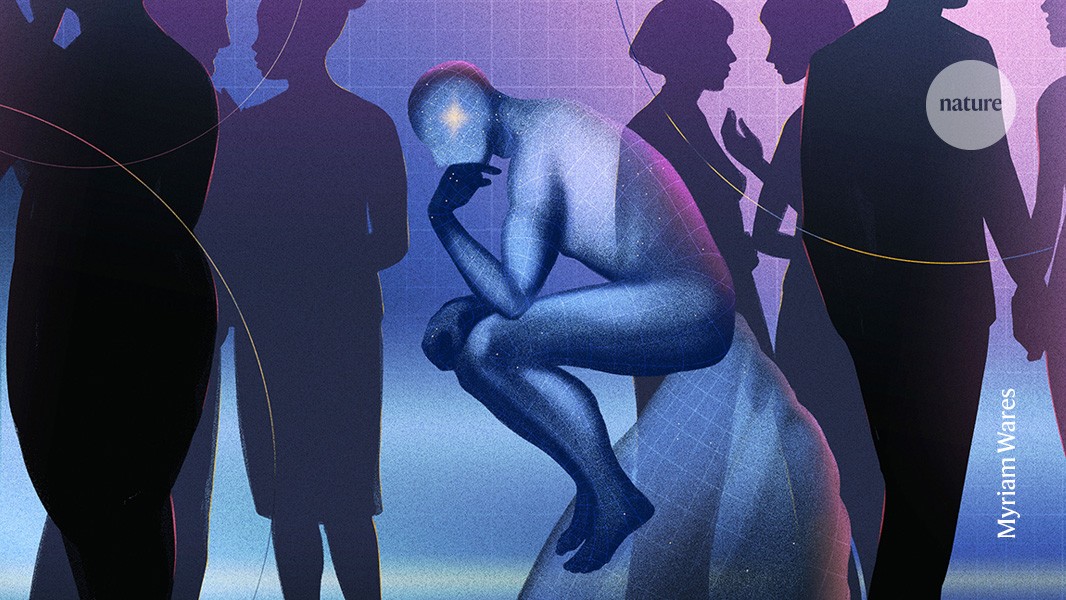
Intertwined Creatures: An Embodied Cognitive Science of the Self and Others Anthony Chemero Columbia University Press (2026)
Consciousness research is having an AI moment. Will the hype help this sector?
What does it mean for a machine to be intelligent, sentient or conscious? Can artificial intelligence systems meaningfully claim legal rights? Questions that once belonged largely to academic research are now being debated in public. Yet these discussions often assume that human cognition, intelligence and consciousness are already fully understood. They are not.
In Intertwined Creatures, cognitive scientist Anthony Chemero examines how debates about consciousness in artificial intelligence are shaped by reductive ideas about the human mind. He argues that many claims about machine consciousness rely on incomplete theories of cognition—and, in some cases, fundamental misunderstandings of how human beings think, perceive and act.
Western philosophy and psychology have traditionally based theories of mind and scientific practice on the image of a disembodied, solitary thinker observing the world from a detached and objective perspective. In this model, the mind is static, separate from the body, hidden from view and accessible primarily through introspection. These assumptions support the idea that behavior is governed by specialized brain processes and that cognition is an abstract intellectual activity involving the manipulation of internal representations according to rules.
Chemero presents a very different account of the mind. Drawing on ecological psychology, enactivism—the view that cognition emerges through interaction between an organism and its environment—and nonlinear dynamics, he explains how complex behavior develops through ongoing relationships among people, bodies and surroundings. Human cognition, he argues, is embodied, dynamic and social. It is inseparable from the environments and relationships that sustain us, including the people who “give us the warmth, food and love we need to keep us going.”
Perception, experience and thought are therefore embodied activities. The body is not merely a physical object but a living, changing organism situated within a social, cultural and material world. For Chemero, the key issue is not simply how the brain interacts with the body, but how a particular brain and body engage with a particular environment.
Is it possible to understand the consciousness on this side of death?
Chemero writes with unusual clarity in a field often dominated by technical language. He makes abstract theories accessible through familiar examples. Imagine realizing that you are late for work, searching for your keys, becoming distracted by a pile of laundry and remembering that you need to buy detergent. While looking for a book to take with you, you discover an apple core in your bag. Then, after rushing to clean your laptop before leaving, you forget the book you originally planned to bring.
This apparently ordinary chain of thoughts and actions illustrates Chemero’s central point: inner speech is closely connected to our interactions with other people and with the surrounding environment. Thinking is not an isolated process taking place inside a hidden mental realm. It develops through the practical situations in which we find ourselves.
The same applies to imagination and counterfactual thought. When you imagine what might happen if pigs could fly or if a country elected a Black woman as its head of state, those scenarios are not created independently of the world. They are shaped by political institutions, cultural expectations, material conditions and personal encounters with other people.
Imagining a Black woman becoming president, for example, may draw on experiences of Black women in positions of authority, representations in the media, political structures and broader social assumptions about who can hold power. Even fictional possibilities are influenced by perception, culture and embodied experience.
For Chemero, “real” thinking is not separate from the physical world. It unfolds through continuous engagement with people, objects and environments. Imagination and creativity are not hidden mental computations; they emerge through situated behavior and interaction. This account of human cognition—one that does not depend on an invisible, isolated mind—is the foundation of Chemero’s embodied cognitive science.
The human brain is not a computer
Chemero’s theory of embodied cognition has important consequences for debates about consciousness in artificial intelligence. Many arguments about AI sentience rely, either explicitly or implicitly, on simplified comparisons between human thought and computer processing. Chemero challenges these analogies.
Advanced AI systems, including large language models, do not navigate the interpersonal relationships and physical environments required to sustain their own existence. They do not have bodies in the human sense, nor do they possess the capacity to care, depend on others or participate in the social worlds that shape human consciousness.
The world of AI agents requires new ethics
Source: www.nature.com