


Gravity is best known as the force that pulls objects toward Earth, but its influence extends across the entire universe. As the invisible framework of the cosmos, gravity shapes the formation and evolution of galaxies, galaxy clusters, and the largest structures in space.
For decades, however, astronomers have observed cosmic motions that do not appear to match the amount of visible matter present. Stars and galaxies often move faster than their observable mass should allow. This mystery has led cosmologists, including University of Pennsylvania researcher Patricio A. Gallardo, to investigate whether Newton’s and Einstein’s theories of gravity remain accurate on the universe’s largest scales.
“Astrophysics has been plagued by major discrepancies in the cosmic ledger,” Gallardo says. “If you look at how stars orbit within galaxies or how galaxies move within clusters, some appear to be moving too fast for the amount of visible matter they contain.”
According to Gallardo, the discrepancy has two possible explanations. The universe could contain large amounts of invisible dark matter that provides additional gravitational pull. Alternatively, “the fundamental equation of gravity would need to be modified.”
Testing gravity on an unprecedented cosmic scale
Gallardo and his collaborators are conducting a large-scale test of gravity using observations from the Atacama Cosmology Telescope (ACT), a roughly three- to four-story telescope developed primarily by researchers at Penn State and led by Mark Devlin.
The team examined the gravitational effects associated with galaxy clusters hundreds of millions of light-years away, creating one of the largest tests of gravity ever conducted.
The results, published in Physical Review Letters, show that gravity weakens with distance according to the inverse-square law predicted by Newton and incorporated into Einstein’s general theory of relativity.
“It is remarkable that the inverse-square law, proposed by Newton in the 17th century and later incorporated into Einstein’s theory of general relativity, has retained its status in the 21st century,” Gallardo says.
The findings support one of the foundations of modern cosmology. Demonstrating that established theories of gravity continue to work across enormous distances strengthens the standard model of cosmology and places tighter limits on alternatives such as modified Newtonian dynamics, or MOND. MOND attempts to explain unusual cosmic motions by changing the laws of gravity rather than proposing dark matter.
Newton originally developed the inverse-square relationship to describe motion within the solar system. Under this principle, gravitational strength decreases by the square of the distance between two objects. Scientists have now tested the same relationship using masses and distances on a scale that would have been “unthinkable in Newton’s time,” Gallardo says.
Why are galaxies moving so fast?
There are more than 200 billion galaxies in the observable universe, and their motions have long presented major challenges for astronomers.
In a simple Newtonian model, stars farther from a galaxy’s center should orbit more slowly. Observations show the opposite pattern: stars in the outer regions of galaxies move much faster than the visible matter appears capable of supporting through gravity alone.
A similar problem occurs inside galaxy clusters. Entire galaxies travel through these enormous structures at speeds that cannot be explained by the clusters’ visible mass alone.
“That’s the central puzzle,” Gallardo explains. “Either gravity behaves differently on very large scales, or the universe contains additional matter that we can’t see directly.”
Ancient light provides a test of gravity
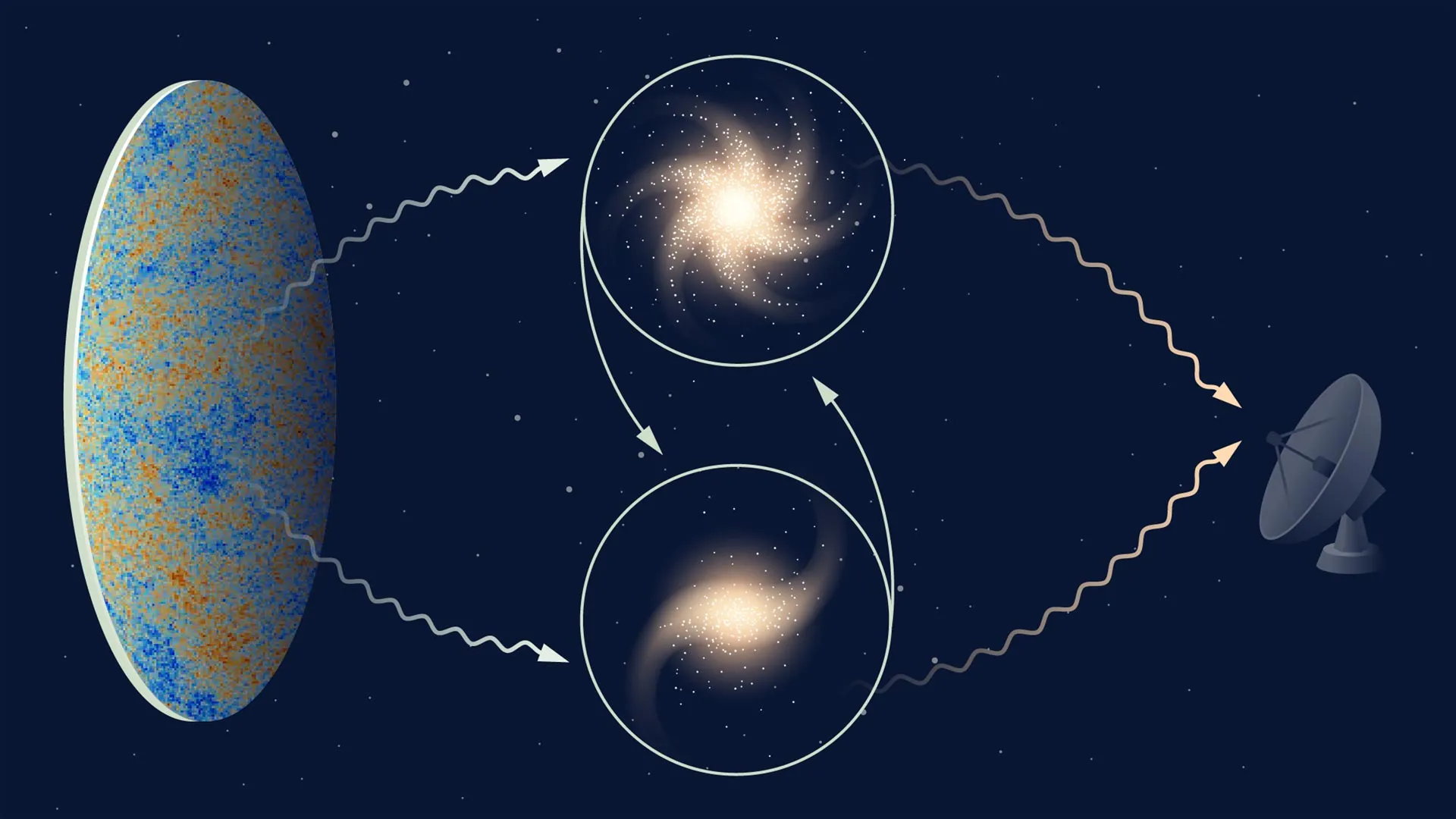
To determine which explanation best fits the evidence, the researchers analyzed observations of the cosmic microwave background (CMB) collected by ACT. This ancient light was released approximately 380,000 years after the Big Bang and has traveled across the universe ever since.
When CMB light passes through massive galaxy clusters, the motion of those clusters produces subtle changes in the light. Astronomers can detect these faint signatures and use them to study the movement of large-scale cosmic structures.
By analyzing these effects across large numbers of galaxy clusters located tens to hundreds of millions of light-years away, the researchers were able to measure how strongly gravity acts across some of the universe’s largest structures.
If a modified-gravity model such as MOND were correct, the observations should have shown gravity decreasing more gradually with distance.
That is not what the team found. Instead, the measurements closely matched the predictions of Newton’s theory and Einstein’s general relativity.
Because gravity behaves as expected, modifying the laws of gravity cannot fully explain the missing mass indicated by these observations. The findings therefore strengthen the case for dark matter as the invisible component providing the additional gravitational force.
The mystery of dark matter remains
Although the study adds to the evidence for dark matter, it does not solve one of the biggest unanswered questions in physics: what dark matter is made of.
“This study strengthens the evidence that the universe contains a component of dark matter,” Gallardo says. “But we still don’t know what those particles are made of.”
Future observations of the cosmic microwave background and increasingly detailed galaxy surveys should enable astronomers and physicists to test gravity with even greater precision.
“Gravity remains one of the most fascinating areas of research because there are so many unanswered questions. It’s a naturally fascinating field,” Gallardo says with a laugh.
Patricio Gallardo is a research associate in the Department of Astronomy and Physics in the College of Arts and Sciences at the University of Pennsylvania.
More than 40 researchers representing institutions in multiple countries participated in this study. Individual investigators received support from a range of fellowships and national funding agencies, including the University of Chicago’s Kavli Institute for Cosmological Physics, the Simons Society of Fellows, the U.S. National Science Foundation through grant AST-2206088, NASA ROSES grant 12-EUCLID12-0004, and Chile’s National Agency for Research and Development (ANID). Additional support came from Fundamental Project FB210003, the South African National Research Foundation, and Natural Sciences and Engineering Research Council of Canada (NSERC) grants RGPIN-2023-05014 and DGECR-2023-00180. Funding was also provided by the Sutton Family Chair in Science, Christianity and Culture in the Faculty of Arts and Sciences at the University of Toronto.
The Atacama Cosmology Telescope (ACT) project is supported primarily by the U.S. National Science Foundation through awards AST-0408698, AST-0965625, AST-1440226, PHY-0355328, PHY-0855887, and PHY-1214379. Additional funding was provided to Princeton University, the University of Pennsylvania, and the University of British Columbia through a Canadian Foundation for Innovation (CFI) award. Development of the ACT multichroic detector and lens was supported by NASA grants NNX13AE56G and NNX14AB58G. Detector research at the National Institute of Standards and Technology (NIST) was supported through the NIST Measurement Science Innovation Program.
Source: www.sciencedaily.com