


James Webb’s ‘Little Red Dots’ May Be Rapidly Growing Black Holes
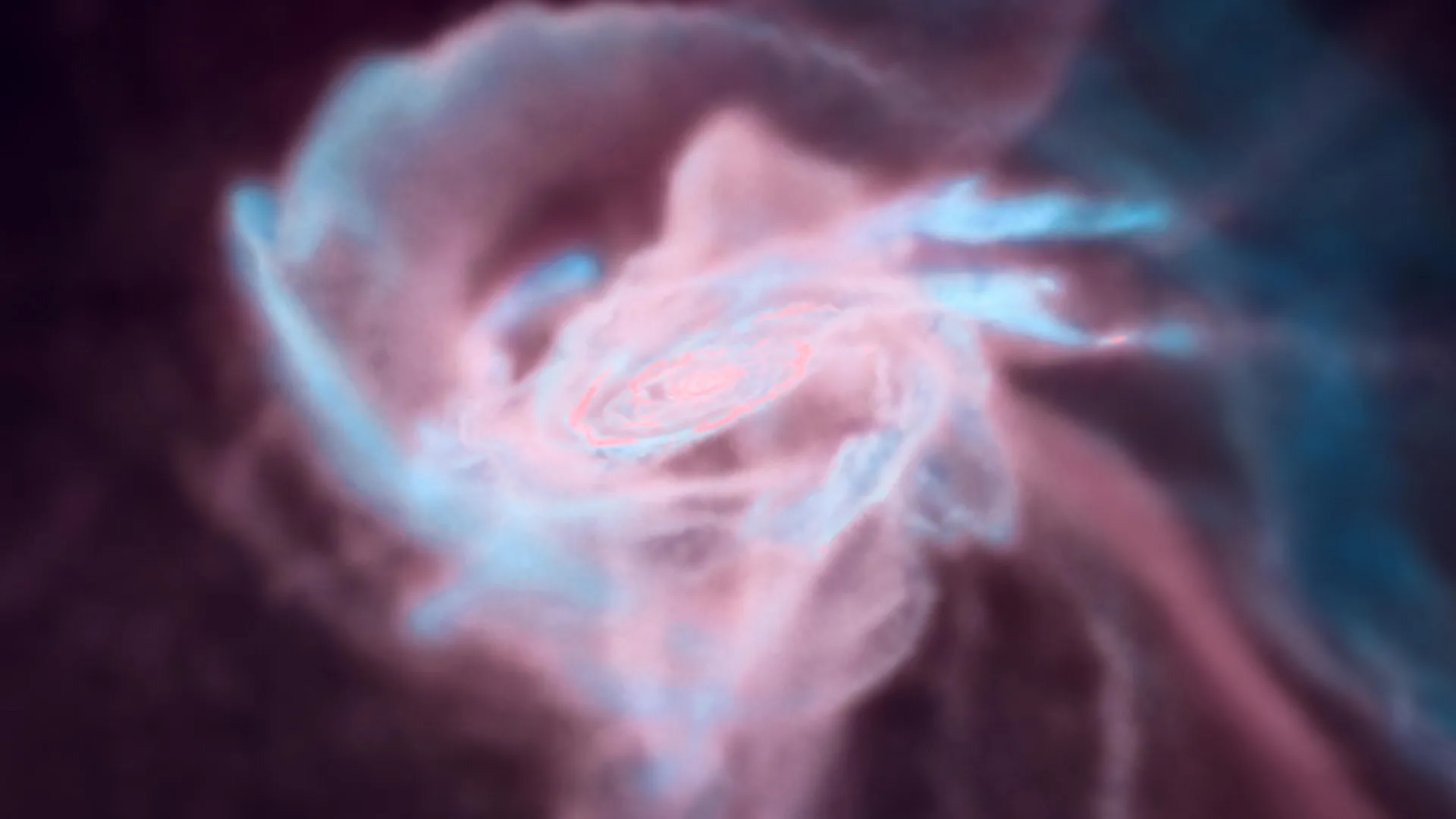
Among the most surprising discoveries made by the James Webb Space Telescope (JWST) are large numbers of small, bright-red objects known as little red dots (LRDs). Their true identities remain unknown. Now, new simulations run on Japan’s ATERUI III supercomputer suggest that these mysterious objects could be rapidly growing black holes, fueled by conditions in the early universe that no longer exist today.
Simulations reveal how little red dots could form
The discovery does not require extraordinary physics or highly unlikely events. Instead, the simulations show that LRDs could arise naturally in the young universe, when black holes may have been able to grow at extraordinary rates.
The research was led by Sunmyon Chon of the Max Planck Institute for Astrophysics. The team used the National Astronomical Observatory of Japan’s ATERUI III supercomputer to run what it describes as the most detailed cosmological simulation of the early universe to date.
The simulations began at the scale of young galaxies before focusing on progressively smaller regions and eventually reaching individual gas clouds. This demanding process required the high-resolution computing power of ATERUI III.
The results suggest that strong far-ultraviolet (FUV) radiation from nearby galaxies could prevent ordinary stars from forming inside some gas clouds. Rather than breaking apart into many smaller stars, the gas could collapse into a single supermassive star.
That massive star could then collapse and create a black hole seed.
How early black holes could grow at extraordinary speeds
According to the simulations, newly formed black hole seeds could be surrounded by a thick disk of dense gas. These gas-rich environments trap radiation, allowing the black holes to consume matter far more efficiently than black holes in the modern universe.
Under these conditions, black holes could grow tens of times faster than they can today.
The properties of the simulated black holes closely resemble those of the little red dots observed by JWST. This similarity suggests that LRDs could represent an early stage of extremely rapid black hole growth.
The mystery of supermassive black holes in the early universe
Astronomers have struggled for years to explain how supermassive black holes appeared so early in cosmic history. Some contain millions or even billions of times the mass of the Sun, yet they already existed less than 600 million years after the Big Bang.
JWST was expected to help solve this mystery by detecting galaxies that were fainter and more distant than previous telescopes could observe.
Because light travels at a finite speed, observing very distant objects also means looking into the past. If a galaxy is 11 billion light-years away, its light takes 11 billion years to reach Earth. Astronomers therefore see that galaxy as it appeared 11 billion years ago. The same principle applies to a galaxy 12 billion light-years away, whose light is 12 billion years old.
By observing farther back in time than previous observatories, JWST gives astronomers an unprecedented view of the young universe.
Could little red dots explain early black hole growth?
Rather than immediately solving the mystery of early black hole formation, JWST revealed something unexpected: large numbers of tiny, extremely red objects that researchers have begun calling little red dots.
A new simulation suggests that these objects could be the missing piece of the puzzle.
In this model, the conditions needed to create and rapidly grow black holes developed naturally in the early universe. No unusual assumptions or rare coincidences were required. The model may also help explain why little red dots appear so frequently in JWST observations.
As JWST continues to discover more LRDs and future telescopes probe deeper into cosmic history, this model could provide astronomers with a valuable framework for understanding how some of the universe’s earliest black holes formed, grew, and helped shape the evolution of the universe.
Source: www.sciencedaily.com