


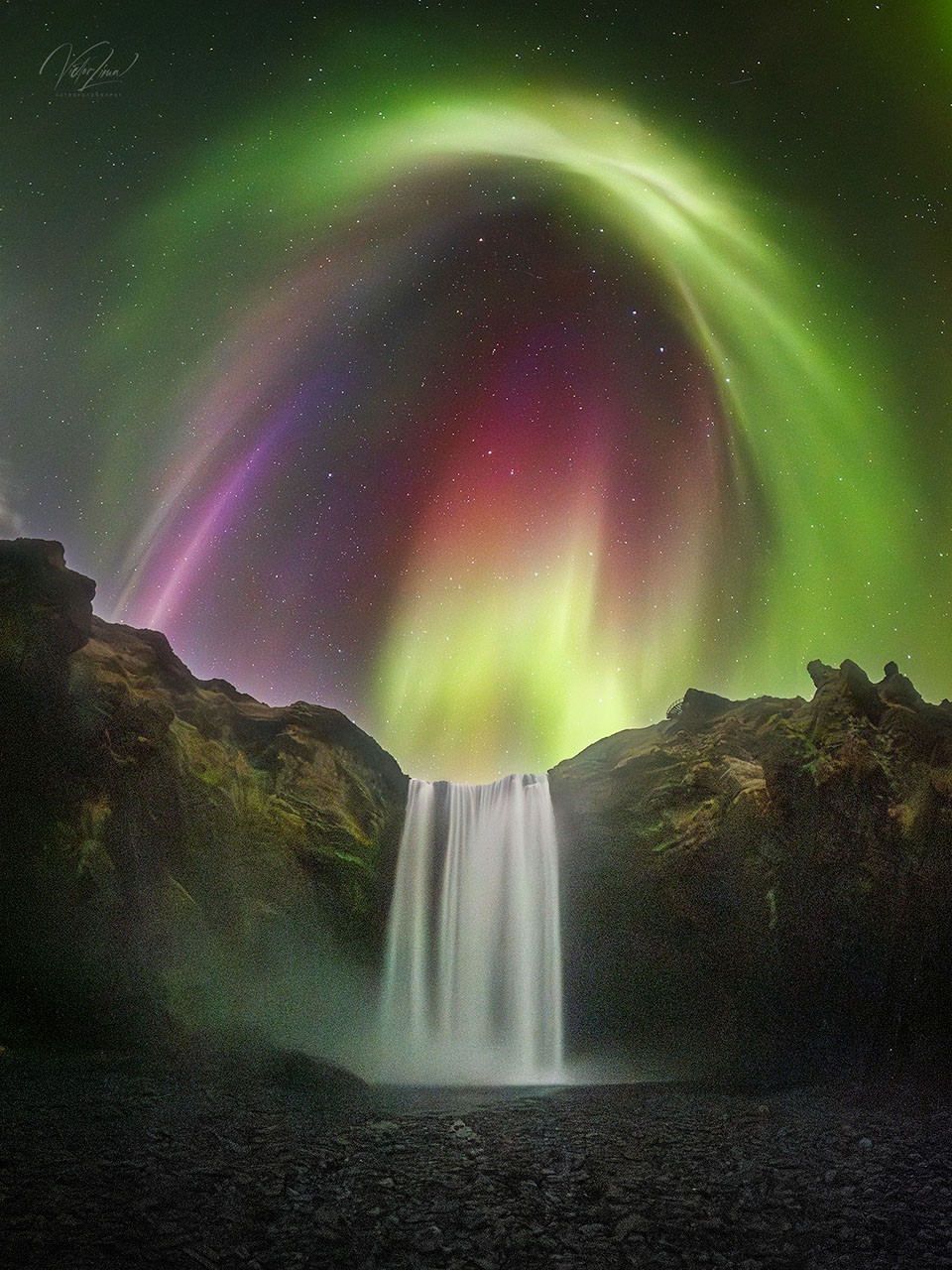
Explanation: Witness the breathtaking Northern Lights over Skógafoss waterfall in Iceland, creating the illusion of colorful rain cascading through the night sky. This stunning aurora photograph was captured with a single 5-second exposure.
Seeing the aurora borealis is on many travelers’ bucket lists, but capturing this natural phenomenon requires the right conditions: strong solar activity, dark and clear skies, and an ideal high-latitude location. The Northern Lights are generally easier to observe than their counterpart, the Southern Lights, partly because there is considerably less land around the Southern Hemisphere, particularly near the Antarctic Circle.
Auroras occur when charged particles carried by the solar wind become trapped in Earth’s magnetosphere. Earth’s magnetic field guides these particles toward regions near the North and South Poles, where they collide with gases in the atmosphere. The resulting colors depend on the gases involved and the altitude of the interaction. Oxygen can produce red and green auroras, while nitrogen can create blue and pink hues.
NASA’s main site for Astronomy Picture of the Day (APOD) is on the move: Visit apod.nasa.gov or go to science.nasa.gov/apod.
Tomorrow’s photo: What’s next?
Source: science.nasa.gov