


Nature Briefing: Wildlife Crime, Lithium Extraction, Smallpox History and Europe’s Wildfires
Hello Nature readers. Would you like to receive the Nature Briefing in your inbox for free every day? Sign up here.
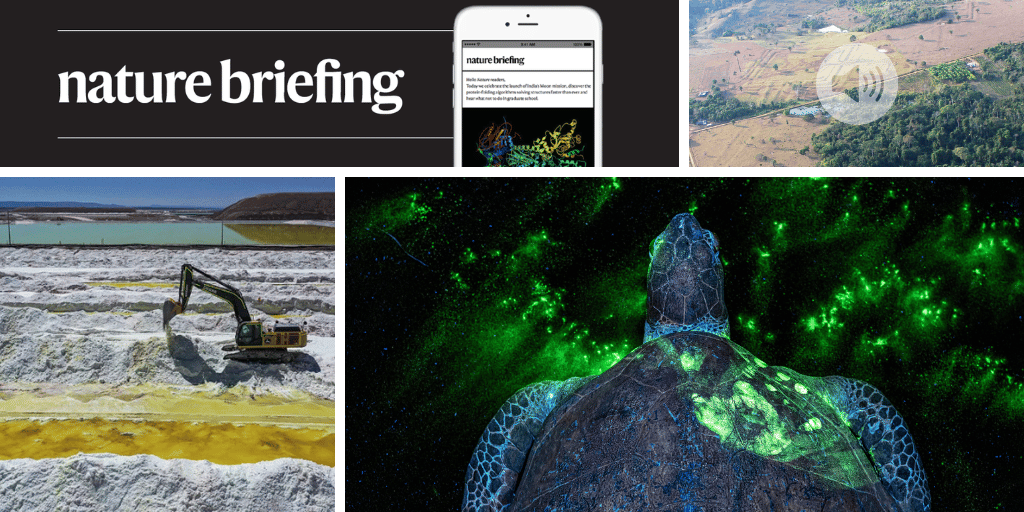
Credit: Britta Jaschinski, Every Crime Leaves a Trace, 2025, Wildlife Crime Lab, Institute of Zoology (IOZ), London, UK. Earth Photo 2026 Award
Photographer Britta Jaschinski works with border forces and wildlife-crime investigators across Europe to document the illegal wildlife trade and poaching. This powerful image shows a handprint on the shell of a green sea turtle (Chelonia mydas) that was confiscated at London Heathrow Airport in the United Kingdom. The photograph was among Jaschinski’s winning entries in the 2026 Earth Photo Awards.
Explore more of the month’s most compelling science photography, selected by the Nature photo team.
Latest science news and research
Greener lithium extraction could reduce environmental damage. Demand for lithium has surged alongside the growth of rechargeable batteries and other clean-energy technologies. Conventional lithium-extraction methods used in Chile and Argentina are inefficient, consume large amounts of water and can damage ecosystems and affect Indigenous communities. New approaches could make lithium production more sustainable by using electrochemical processes or heat to extract the metal from naturally occurring brines. These techniques require less freshwater and could deliver higher yields, although major investment will be needed to scale them up.
Nature | 5 min read
Ancient viral DNA links smallpox to European colonization of the Americas. DNA recovered from the mummified remains of two people in Chile indicates that Orthopoxvirus variola, the virus responsible for smallpox, was brought to the Americas by European colonizers. Researchers identified an previously unknown smallpox variant that appears to have diverged from a European strain around the thirteenth century. The variant contained fewer genes than viruses found in seventh-century Viking settlements, suggesting that smallpox may have lost genes as it adapted to human hosts. Related viruses could be undergoing similar changes today.
Nature | 4 min read
Reference: Science paper
Climate change is intensifying wildfire risk in France and Spain. Wildfires currently burning across France and Spain could signal a major shift in southern Europe’s fire patterns. Researchers say that rising temperatures caused by human-driven climate change are making the region’s fire conditions increasingly similar to those in highly fire-prone areas such as California. Although fire-suppression efforts have reduced Europe’s overall wildfire activity since the 1980s, increasingly hot and dry weather is contributing to larger and more destructive fires, says meteorologist and study co-author Raúl Cordero.
Nature | 5 min read
Reference: Scientific Reports paper

Source: European Forest Fire Information System
Science features and expert opinion
Tick-borne meat allergy is becoming more common. A tick-induced allergy to red meat can cause symptoms ranging from stomach pain and vomiting to potentially fatal anaphylaxis. There is currently no cure or approved treatment. Researchers believe that climate change and growing deer populations, which help ticks thrive, could be contributing to the increase in cases. However, many questions remain unanswered. “We’re still casting in the dark, but it is our responsibility to find something that works for people” who need treatment, says immunologist Benjamin Casterline.
Nature | 6 min read
A museum exhibition explores the emotional impact of climate change and what climate grief feels like in The past is an open can of worms: a stimulated-memory exhibition.
Nature | 6 min read
Andrew Robinson recommends five science books to read this week, including accounts of how Los Angeles improved its air quality and how ignorance can influence knowledge and decision-making.
Nature | 4 min read
Lidar reveals hundreds of hidden structures in the Amazon rainforest. Researchers have identified almost 400 previously unknown earthworks beneath the Amazon’s dense vegetation. The discovery could transform estimates of the size and complexity of the civilization now known as the Aquiry. Based on these newly mapped structures, researchers estimate that the Aquiry population may have reached between 1.25 million and 3 million people around AD 200.
Nature Podcast | 20 min listen
Subscribe to the Nature Podcast on Apple Podcasts, Spotify or YouTube Music, or use the RSS feed.
Today, Leif Penguinson is looking into Boca do Inferno — “mouth of hell” in English — on the coast of Cascais, Portugal. Can you find the penguin?
You’ll have to wait a little longer than usual for the answer. It will appear in the Monday 10 August edition of the Nature Briefing. As always, thanks to Briefing photo editor and penguin wrangler Tom Houghton.
The Nature Briefing is always evolving. Tell us what you think by sending your feedback to [email protected].
Thanks for reading,
Jacob Smith, associate editor, Nature Briefing
• Nature Briefing: Careers — insights, advice and award-winning journalism to help you optimize your working life
• Nature Briefing: Microbiology — the microorganisms that shape health, the environment and food systems
• Nature Briefing: Anthropocene — climate change, biodiversity, sustainability and geoengineering
• Nature Briefing: AI & Robotics — 100% written by humans, of course
• Nature Briefing: Cancer — a weekly newsletter created for cancer researchers
• Nature Briefing: Translational Research — biotechnology, drug discovery and pharmaceutical research
Source: www.nature.com