


The Helix Nebula (NGC 7293) is one of the closest and brightest planetary nebulae, making it an important natural laboratory for studying how the final outflows from dying stars interact with their surroundings. Using the Gaia EDR3/DR3 astrometric solution for its central white dwarf, WD 2226-210, we adopt a distance of d = 198.6 (+1.6/−1.8) pc (ref. 10).
Previous observations show that the Helix Nebula has a highly complex structure. Its bright central region consists of an inner disc surrounded by an outer torus. This system is embedded in a larger shell whose upstream side is truncated, suggesting that expanding asymptotic giant branch (AGB) material is interacting with the surrounding interstellar medium (ISM)11,12,13.
The ionized gas is threaded by thousands of dense cometary knots and associated molecular material. This indicates that a substantial fraction of the stellar ejecta remains clumpy and only partially processed11,14. Deep imaging and spectroscopy have also identified a bow shock in the faint outer halo, aligned with the motion of the nebula through the local ISM12,15. These characteristics make the Helix Nebula an exceptional target for investigating how fragmented stellar ejecta are dispersed, disrupted and mixed into the ISM—a key stage in the galactic recycling of gas, dust and newly synthesized elements4,9.
The Helix Nebula was observed in Hα, [N ii] and [O iii] using the partially completed Modular Optical Telephoto Hyperspectral Robotic Array (MOTHRA). Located at the El Sauce Observatory in Chile, MOTHRA combines high-end telephoto lenses with tiltable ultra-narrow interference filters. Its design builds on the Dragonfly Spectral Line Mapper at New Mexico Skies Observatory16,17. Once complete, MOTHRA will contain 1,140 lenses distributed across 30 mounts, providing the optical equivalent of a 4.8 m f/0.08 refractor. The observations presented here correspond to approximately 20 minutes of on-source exposure with the completed array.
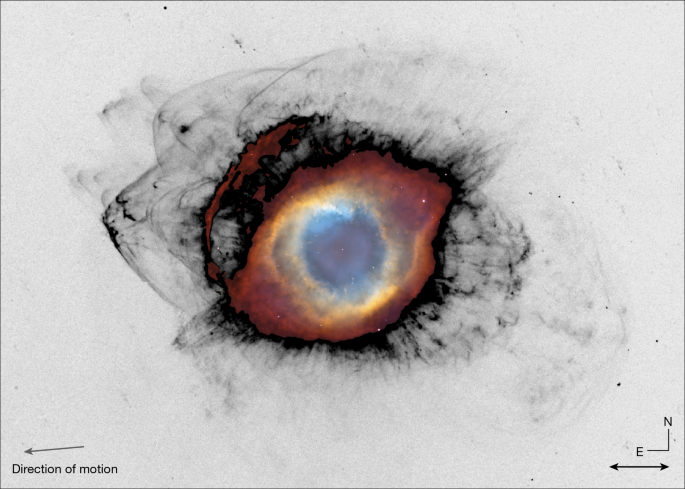
The MOTHRA Hα image of the Helix Nebula is shown in Fig. 1. It reveals several features that have not previously been observed in ionized gas, including extensions of the northwestern and southeastern plumes11,13 and turbulent, complex Hα emission with low surface brightness in the southwest13.
The most prominent discovery is a forest of arcs and partial arcs on the eastern side of the nebula. We identify at least 22 such structures, labelled 1–22 in Fig. 3 according to their increasing distance from the central white dwarf. Although most appear to be newly detected, several were visible in earlier GALEX and Hα observations. These include the large, complex feature 14 and arcs 3, 10 and 13, among others11,13,15.
The arcs are not detected in [O iii] and are faint in [N ii]. In the brightest region of arc 14, we measure [N ii]/Hα = 0.06 ± 0.01 and [O iii]/Hα < 0.015 (2σ). We also identify faint arc-like structures on the western side of the Helix at distances from the white dwarf similar to those of the much brighter eastern arcs.
The continuum-subtracted MOTHRA Hα image uses an inverted grey scale to emphasize faint outer emission. A combined Hubble Space Telescope and Kitt Peak 4 m image is overlaid on the bright central region11. The Hubble Space Telescope data were obtained with the Advanced Camera for Surveys F502N ([O iii]) and F658N (Hα) filters. The arrow shows the Gaia-determined direction of motion of the central white dwarf relative to the ambient gas. MOTHRA reveals numerous structures at distances greater than approximately 1 pc from the white dwarf that had not previously been detected in Hα. The most striking features are the eastern bow shocks, produced where AGB ejecta collide with the ambient ISM at supersonic relative velocities. Scale bar, 5′ = 0.29 pc. The colour Hubble Space Telescope/Kitt Peak image is reproduced from NASA, ESA, C. R. O’Dell (Vanderbilt University) and M. Meixner, P. McCullough and G. Bacon (Space Telescope Science Institute).
Following earlier studies, we interpret the eastern arcs as bow shocks created when expanding stellar ejecta encounter the ISM at supersonic speeds13,15. The Helix Nebula moves through the ISM at approximately 36 km s−1 toward 95° east of north in the plane of the sky and approximately 27 km s−1 along the line of sight15,18. The combined relative velocity is therefore vISM ≈ 45 km s−1.
On the eastern side, the shock velocity is approximately the sum of the ISM velocity and the radial expansion velocity of the ejecta: vshock, e ≈ |vISM + vexp|. On the western side, the ejecta interact with a turbulent post-shock wake that has passed through and mixed with the planetary nebula. There, the shock velocity is approximately vshock, w ≈ |vwake − vexp|. The wake is expected to move slowly relative to the systemic velocity of the nebula. In the well-studied AGB star Mira, processed gas leaving the bow shock and entering the downstream tail trails the star by only about 10% (ref. 19). Applying this estimate to the Helix gives vwake = 0−10 km s−1.
Using the MAPPINGS V code20, we estimate eastern shock velocities of vshock, e = 80−90 km s−1 from the [O ii]/Hα and [N ii]/Hα line ratios (Methods). Removing the approximately 45 km s−1 ISM velocity yields an ejecta expansion velocity of vexp = 35−45 km s−1, consistent with earlier Hα measurements near the brightest bow shock15.
The resulting velocity field is shown in Fig. 2. Along the approximate east–west axis, shock velocities are about 80 km s−1 in the east and 35 km s−1 in the west. Shock models predict that Hα emission at these velocities should be 1–2 orders of magnitude fainter in the west than in the east, matching the observed difference in brightness (Methods).

Schematic velocity field around the Helix for a bulk nebular velocity relative to the ISM of vISM = 45 km s−1 eastward, a post-shock wake velocity of vwake = 5 km s−1 and a radial ejecta expansion velocity of vexp = 40 km s−1. The greatest relative velocities occur on the eastern side, where the strongest bow shocks are observed.
An expansion velocity of vexp = 35–45 km s−1 implies a dynamical age of approximately 20,000–30,000 years for clumps located at r ≈ 1 pc. This predates the formation of the planetary nebula, estimated to have occurred roughly 12,000 years ago21. The clumps therefore most likely originated in an older circumstellar envelope expelled during the late AGB phase before fragmenting into numerous dense structures.
This interpretation is supported by the fact that the bow shocks lie at approximately the same radius as the roughly 40′ outer WISE 12-μm halo, which has been linked to dust from an AGB wind13. Fast winds and outflows, sometimes exceeding the canonical 5−20 km s−1 velocities associated with the main AGB phase, are frequently observed during the late-AGB and early post-AGB stages22,23,24. These outflows are often bipolar rather than isotropic25, potentially explaining the preferred axis that connects the strong eastern and northeastern bows with weaker western and southwestern features.
We modelled the bow-shock morphologies using parabolas, hyperbolas, ellipses and Wilkinoids26. Parabolic fits were selected as the fiducial model because they describe the observations reasonably well and retain the same functional form under projection27. Many structures are incomplete, while others are broader and less sharply defined than ideal thin-shell bow shocks. Consequently, the selected fit family is not assigned a direct dynamical interpretation. Instead, the fits provide geometric measurements—particularly the characteristic curvature scale—and the differences between models are used to estimate systematic uncertainty.
The fitting procedure is described in the Methods, and the results are presented in Fig. 3. Most of the 22 bow shocks are adequately described by parabolas, although their wings are often more closely approximated by hyperbolas27. The brightest feature, bow 14, is more sharply peaked than the fitted curve. Examination of its apex reveals a complex network of smaller shocks.

The Hα image contains 22 complete or partial bow shocks, each fitted with a parabola shown by a red line (Methods). Red dots mark the parabolic foci, which indicate the approximate locations of the objects producing the shocks. The absence of Hα emission near most foci suggests that these objects are largely neutral. The bows are numbered by the distance from their apex to the central white dwarf. Two previously identified structures, the NE Object and the NE Arc11, are also shown.
The red dots in Fig. 3 mark the foci of the parabolic fits. These positions provide approximate locations for the shell fragments generating the shocks, although the true positions depend on the three-dimensional orientation and geometry of each bow27. In most cases, no corresponding emission is detected in Hα, [O iii] or [N ii]. The absence of bright emission supports the conclusion that the fragments are predominantly neutral. Rather than detecting the fragments through their own radiation, these observations identify them through the shocks they create as they move through the ISM.
The bow shocks also change systematically with distance from the central white dwarf. Structures closer to the star are generally large, thin and sharply defined, while those in the outer regions are smaller, broader and more diffuse. To measure this trend without assuming a particular steady-state bow-shock model, we use the radius of curvature at each apex, Rc, derived from the best-fitting parabola.
Figure 4 shows the relationship between Rc and the distance from the white dwarf, r. The characteristic bow-shock size decreases by approximately two orders of magnitude between 0.4 pc ≲ r ≲ 1.4 pc. A log-linear fit gives log Rc = 0.34−1.59r, corresponding to an e-folding length of 0.27 pc.

Left, radius of curvature Rc from parabolic fits plotted against distance r from the central white dwarf. Grey points mark shock apexes, while black points mark the foci, or approximate locations of the objects generating the shocks. Yellow numbers identify the bows in order of increasing apex distance. Outer shocks are substantially smaller than inner shocks. The red line shows a fit of log Rc = 0.34−1.59r, corresponding to an e-folding length of 0.27 pc. Right, representative morphologies at r ≈ 0.8 pc (top) and r ≈ 1.3 pc (bottom). With increasing distance, large, thin and well-defined shocks evolve into small, broad structures, consistent with progressive shell-fragment disruption.
Because Rc is a geometric measurement, it does not independently determine the detailed momentum balance within the flow. It does show, however, that the coherent obstacle responsible for each bow shock becomes much smaller farther from the white dwarf. This reduction in size is accompanied by a clear morphological transformation: inner bows are narrow and sharply bounded, whereas outer structures are broader, irregular and increasingly clumpy.
Together, these observations point to the progressive stripping and fragmentation of dense AGB-shell remnants as they interact with the surrounding ISM. Material is ablated from the fragments and incorporated into the ambient flow, leaving behind smaller, more porous dense heads. A growing proportion of the Hα emission may therefore arise from fragment-associated, mass-loaded mixed gas rather than from a geometrically thin, well-defined forward shock8,28,29.
In this scenario, the bow shocks both reveal the shell fragments and contribute to their destruction. Their emission is powered by the relative kinetic energy of the fragments and the ambient gas, demonstrating that momentum transfer, ablation and mixing are ongoing8,28. If the radial positions of the bows, ri, are treated as an evolutionary sequence with ti ≈ ri/vexp, the observed Rc–r relation provides an estimate of the timescale over which coherent bow structures disappear.
For an ejecta expansion velocity of vexp ≈ 40 km s−1, the curvature scale declines with an e-folding time of τRc ≈ 7 × 10³ years. We therefore infer that the bow-forming AGB-shell fragments are disrupted over a timescale of approximately 104 years. This should be understood as the survival time of a coherent dense fragment and its bow shock, rather than as a direct measurement of a specific mass-loss rate or momentum-transfer rate.
Classical AGB–ISM bow shocks, such as the structure surrounding Mira, trace a single wind-driven stand-off interaction centred on the mass-losing star6. Far-infrared surveys show that these large-scale wind–ISM interactions are common around evolved stars7. Such long-lived structures, which may persist for roughly 105 years6, identify where the stellar wind meets the ISM but do not directly reveal how fragmented ejecta are eventually assimilated.
The Helix outer halo provides a different view. Its numerous compact bow shocks have no luminous source at their foci, indicating that the original AGB–ISM interaction has broken into dense, line-dark obstacles. These fragments are being gradually ablated and entrained by the ambient flow. The inferred disruption time of roughly 104 years may therefore represent the relevant timescale for recycling late-AGB ejecta into the ISM.
More generally, stellar mass loss returns gas, metals and dust to the ISM and is a major driver of galactic chemical recycling30. However, the duration and efficiency of the final fragment-driven stage of AGB–ISM mixing remain poorly constrained observationally6,31. Galaxy-formation simulations consequently use subgrid turbulence and diffusion prescriptions to model unresolved transport32,33,34. The empirically derived disruption timescale of approximately 104 years suggests that once AGB ejecta fragment and become exposed to diffuse gas, they rapidly lose their coherent identity. This provides a valuable benchmark for simulations of stellar feedback, gas recycling and chemical enrichment.
Future observations can test and extend these results. Because the Helix is a relatively typical planetary nebula, similar fragment-driven bow shocks may exist in the outer regions of other planetary nebulae. The strong dependence of Hα luminosity on shock velocity means that these structures should be easiest to detect when the nebula moves through the ISM at speeds greater than approximately 40 km s−1. A larger sample will allow researchers to determine whether fragment-mixing timescales vary with shock velocity. Such surveys should become practical with the completed MOTHRA array.
The molecular cometary knots already observed in the Helix provide an additional opportunity for follow-up studies14,35,36,37. The Hα-dark clumps inferred from their bow shocks may be detectable through CO rotational transitions and, especially, the H2 1–0 S(1) line at 2.12 μm. These observations could directly connect the neutral fragments seen through shock emission with the molecular material responsible for recycling stellar ejecta into the interstellar medium.
Source: www.nature.com