


How Megalodon and Other Giant Predatory Sharks Evolved
From cannibalism in the womb to avoiding giant marine predators, several evolutionary advantages helped megalodon and other prehistoric sharks reach enormous sizes far beyond any shark alive today.
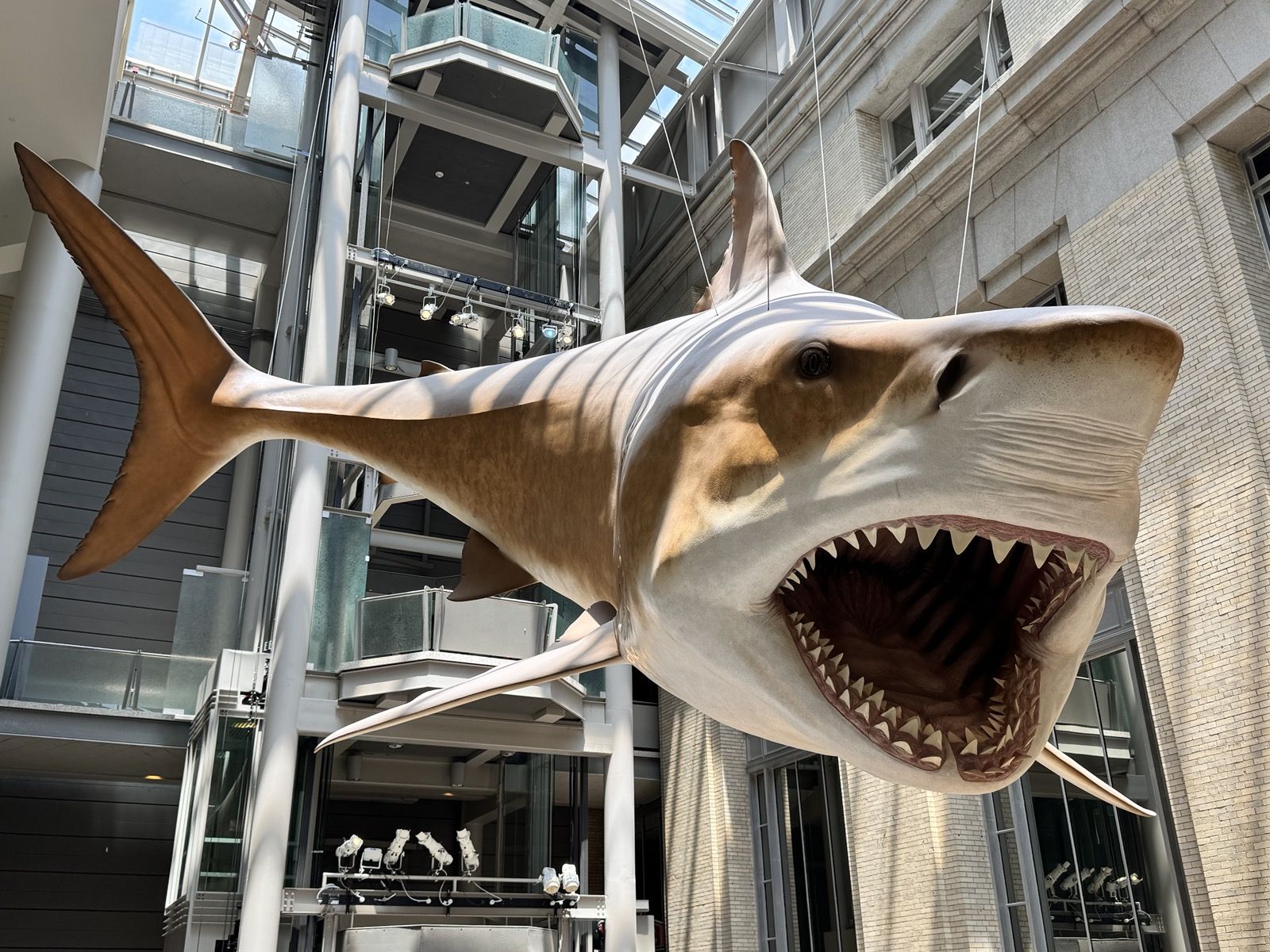
:focal(800x602:801x603)/https://tf-cmsv2-smithsonianmag-media.s3.amazonaws.com/filer_public/3e/c2/3ec2180a-a238-4b81-8841-2285409305be/img_2825.jpg)
Riley Black
For more than 100 million years, giant sharks have dominated parts of Earth’s oceans. Some enormous species were gentle filter-feeders, including today’s whale, basking and megamouth sharks. Others were powerful predators equipped with rows of cutting teeth, from the modern great white shark to the extinct megalodon.
Sharks with bodies longer than 20 feet did not evolve only once. Since at least the middle of the Cretaceous Period, large predatory sharks have emerged repeatedly from different branches of the shark family tree. Early examples such as Cardabiodon reached approximately great-white-shark size and had smooth-edged teeth adapted for catching fish. The “Ginsu shark,” formally known as Cretoxyrhina, lived about 75 million years ago and grew to roughly 24 feet long in seas filled with ammonites and mosasaurs.
The most famous giant sharks were the megatooth sharks. Beginning about 65 million years ago with the roughly 30-foot-long Otodus obliquus, this lineage repeatedly produced larger predators. Its most famous member, O. megalodon, probably exceeded 50 feet in length and lived in oceans around the world for more than 20 million years.
Did megalodon grow even longer than scientists thought?
Recent research suggests that O. megalodon may have had a slimmer, longer body than previously estimated. If it had proportions similar to modern mako or lemon sharks instead of great white sharks, some individuals may have reached approximately 80 feet long.
Paleontologists are developing a clearer picture of how megalodon and other giant predatory sharks evolved. Their enormous size was not simply the result of eating more than other sharks. A combination of reproductive strategies, abundant prey, changing ocean ecosystems and competition from other marine carnivores helped these sharks become some of the largest predators in Earth’s history.
Here are the major evolutionary factors that helped produce the world’s biggest carnivorous sharks.
Marine reptiles created opportunities for giant sharks
/https://tf-cmsv2-smithsonianmag-media.s3.amazonaws.com/filer_public/57/05/5705b9b2-c9de-4b78-a9a1-fd0f3fe9576d/oldest-modern-shark-mega-predator.webp)
Pollyanna von Knorring, Swedish Museum of Natural History
The first sharks to reach truly impressive sizes appeared during the age of dinosaurs. Cretaceous seas supported a wide variety of fish as well as marine reptiles, including tuna-shaped ichthyosaurs, long-necked plesiosaurs and heavily built pliosaurs.
Pliosaurs were among the oceans’ top predators, hunting other reptiles and large fish. However, they were not present in every marine habitat. Giant predatory sharks may have first evolved in areas where pliosaurs were absent. Evidence published in 2025 comes from the approximately 115-million-year-old Darwin Formation in northern Australia, where researchers discovered large, disk-shaped vertebrae from some of the earliest giant predatory sharks.
The fossils occurred alongside medium-size marine reptiles but not the largest pliosaurs. These coastal environments offered abundant prey while reducing the risk of attack from rival apex predators. Large Cretaceous sharks also hunted and scavenged marine reptiles, meaning the abundance of ocean-dwelling reptiles helped support the evolution of larger sharks.
Because shark skeletons are mostly made of cartilage, complete fossil skeletons are rare. Teeth are much more durable and commonly preserved, while some shark vertebrae became ossified, or reinforced with bone-like tissue. By comparing fossil teeth and vertebrae with more complete remains from modern sharks, paleontologists can estimate the size and body proportions of extinct species.
The early shark vertebrae from Australia’s Darwin Formation belonged to relatives of the sharp-toothed Cardabiodon. These sharks may have reached approximately 26 feet in length and weighed more than three tons.
Marine mammals supplied energy-rich prey
/https://tf-cmsv2-smithsonianmag-media.s3.amazonaws.com/filer_public/c1/d3/c1d34729-dea3-4643-b2c1-ef771c17eb4f/arctocephalus_pusillus_cape_fur_seals.jpg)
Hans Hillewaert via Wikimedia Commons under CC BY-SA 4.0
About 50 million years ago, the first cetaceans—the ancestors of modern whales—began returning to the water. Although these animals initially walked on land, they evolved into a remarkable variety of fully aquatic species within roughly 10 million years. Some prehistoric whales grew more than 60 feet long, and all developed insulating blubber to survive in cold ocean environments.
About 25 million years ago, another group of mammals began adapting to marine life. These weasel-like ancestors eventually gave rise to modern seals and sea lions. Around the same time, O. megalodon appeared.
Megalodon evolved within a lineage that developed alongside marine mammals. When early whales began spreading through the oceans, the approximately 30-foot-long O. obliquus was already widespread. As seals became increasingly aquatic and ancient whales diversified into filter-feeding and toothed forms, the megatooth lineage included the 31-foot-long O. auriculatus and the larger O. angustidens.
The final and largest member of this lineage, O. megalodon, may have been twice as long as some of its predecessors. Whales and seals provided an abundant supply of calorie-rich blubber, giving giant predatory sharks a dependable food source across many marine environments.
Megalodon did not necessarily target the largest whales. Fossil bones of the relatively small whale Piscobalaena found in Peru show tooth marks from giant sharks, and similar marks appear on pinnipeds comparable in size to modern seals and sea lions. Zinc isotopes in O. megalodon teeth indicate that the predator fed at several levels of the food web. Its enormous size may therefore have been supported by the abundance of fatty prey, rather than by a diet consisting only of gigantic animals.
Large bodies helped megalodon travel and hunt
/https://tf-cmsv2-smithsonianmag-media.s3.amazonaws.com/filer_public/95/97/9597c04a-49ac-43f0-b13f-0cfa67d2f1cd/gettyimages-1791580758.jpg)
Mark Kostich via Getty Images
The enormous size of O. megalodon and other Cenozoic sharks was not simply the result of abundant marine mammals. Once sharks evolved larger bodies, their size provided additional advantages that helped them survive and spread through the world’s oceans.
O. megalodon was a transoceanic predator whose fossils have been found across the globe, from Australia to the coastal wetlands of the United States. Powerful muscles allowed the shark to maintain a cruising speed of approximately three miles per hour. Its huge body could carry it farther each day, increasing the chances of encountering prey compared with smaller sharks.
Researchers estimate that an adult O. megalodon needed approximately 98,175 calories per day. That is equivalent to about 45 pounds of whale blubber or 40 pounds of shark liver. For a shark that may have weighed roughly 67 tons, the daily energy requirement was surprisingly modest. Even feeding on large prey such as orcas—which the shark may have consumed in as few as five bites—would not necessarily have depleted prey populations. This efficient relationship with abundant food allowed megalodon to occupy a wide geographic range.
Competition from other predators favored rapid growth
/https://tf-cmsv2-smithsonianmag-media.s3.amazonaws.com/filer_public/93/9d/939d466f-4760-46d1-ba12-9d43bfa29725/livyatan_melvillei_skull.jpg)
Ghedoghedo via Wikimedia Commons under CC BY-SA 4.0
Even apex predators can become prey, particularly when they are young. Megalodon lived alongside other giant sharks, toothed predatory whales and marine animals that may have attacked its juveniles. Growing rapidly to a large size would have reduced the time young O. megalodon spent vulnerable to other large predators.
Newborn megalodon may have been about the size of an adult human. Although that is large for a newborn shark, young megalodon living in coastal nursery habitats were still smaller than adult ancient great whites and other Otodus species.
Juvenile megalodon also faced threats from marine mammals. Large dolphins with scissor-like teeth, early killer whales and the enormous sperm whale Livyatan shared the oceans with them. These predators may have made rapid growth essential for survival.
Young O. megalodon needed years to accumulate enough mass to outgrow many competitors and predators, even though the species may have lived as long as 100 years. The fossil record contains many more large adult teeth than the heart-shaped teeth associated with young megalodon, suggesting that life was especially difficult during the juvenile stage.
Sibling cannibalism helped megalodon pups grow before birth
/https://tf-cmsv2-smithsonianmag-media.s3.amazonaws.com/filer_public/88/91/8891117d-f89e-45eb-b5b9-d4c879bb9948/img_5838.jpg)
Riley Black
A newborn O. megalodon may have been about six feet long—larger than many adult sharks alive today. Reaching that size before birth required substantial nutrition. The young sharks likely received it through intrauterine cannibalism, consuming their developing siblings inside the womb.
Sharks reproduce in several different ways. Some lay egg cases, while others give birth to live young nourished by a placenta-like yolk sac. Megalodon likely used a reproductive strategy in which fertilized eggs remained inside the mother until the pups were born alive.
Some living sharks that use this method produce large litters. However, paleontologists believe that O. megalodon may have given birth to only one or two pups at a time. The unusually large size of megalodon embryos suggests that perhaps only one pup could occupy each of the mother’s two uteri. A similar reproductive pattern occurs in distantly related modern sand tiger sharks.
In modern lamniform sharks—the group that included O. megalodon—the first embryos to develop teeth begin feeding on the eggs and other embryos around them. This behavior, known as intrauterine cannibalism or oophagy, gives the earliest-developing embryos an important nutritional advantage. They grow faster, become better equipped to hunt and eventually consume their potential siblings.
By the time baby O. megalodon entered coastal nursery habitats, they were already large, well-nourished predators. Cannibalism in the womb helped produce powerful newborns—and may have been one of the evolutionary traits that allowed megalodon to become the largest predatory shark ever known.
Source: www.smithsonianmag.com