


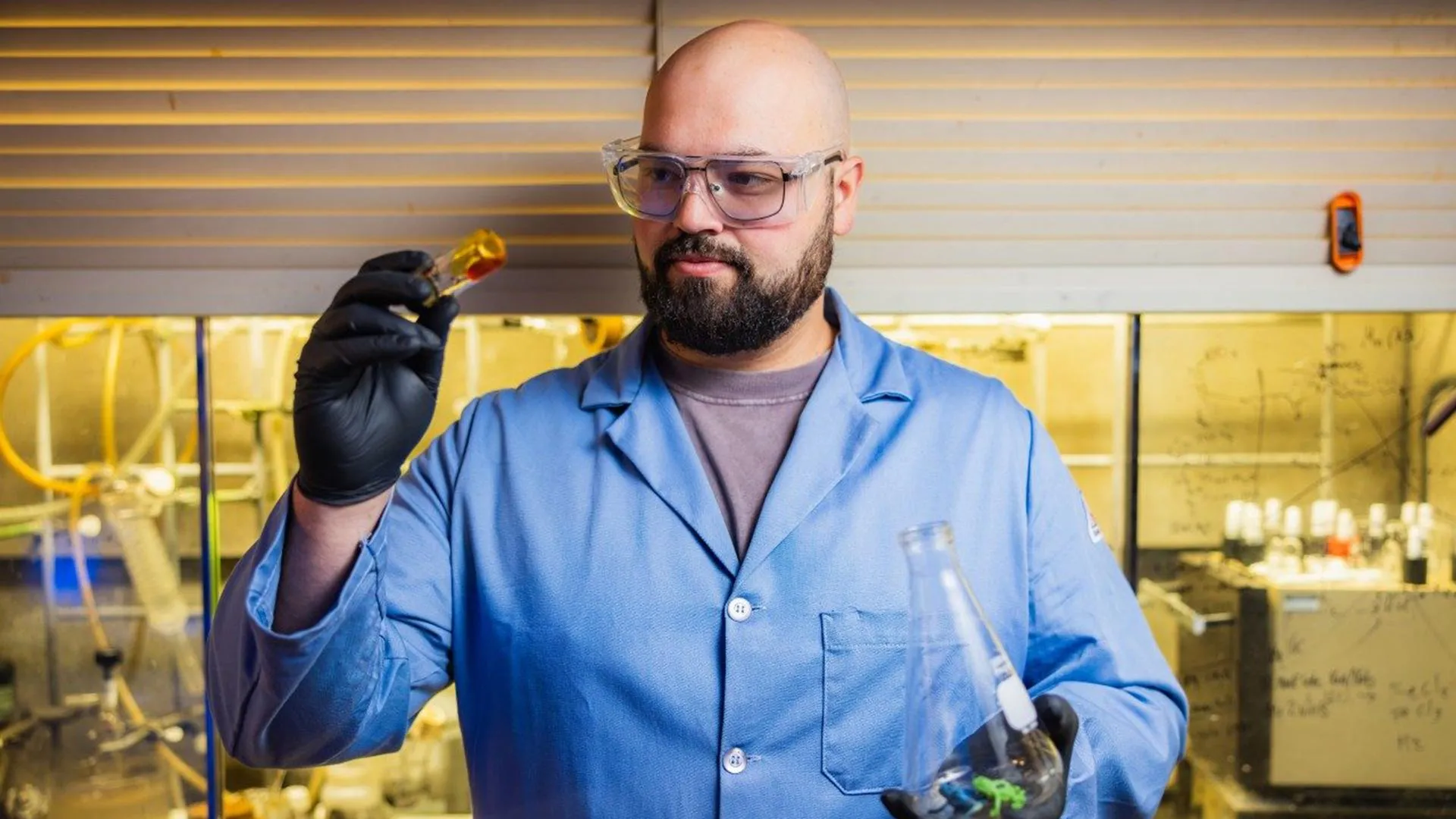
Virginia Tech chemist and chemical engineer Guoliang “Greg” Liu and his research team have developed an innovative method for converting polyvinyl chloride (PVC) waste into polyalphaolefins (PAOs), high-performance ingredients used in lubricants such as engine oil.
Published in Nature on August 5, the study presents a potential solution to two major environmental challenges: the difficulty of recycling PVC and the need to manufacture industrial lubricants more sustainably.
PVC is one of the most challenging plastics to recycle because it contains chlorine and may include a variety of additives, depending on how it is manufactured. As a result, large quantities of PVC waste are sent to landfills each year.
At the same time, global demand for lubricants, including engine oil, continues to grow. Producing these materials can have significant environmental impacts. Converting discarded PVC into valuable lubricant ingredients could therefore reduce plastic waste while supporting the production of more sustainable industrial products.
Converting PVC waste into high-performance lubricants
Lubricants are essential to modern machinery, even though they often go unnoticed. Engine oil is used in equipment ranging from lawn mowers and passenger vehicles to aircraft engines. The lubricant industry therefore depends on a reliable supply of the materials needed to produce these products.
Liu’s laboratory has developed a chemical recycling process that gives PVC waste a useful new purpose while helping address the growing problem of plastic pollution.
The process begins with PVC, the same type of plastic commonly used in plumbing, window frames, construction materials, and credit cards. Researchers dissolve the PVC in a solvent and add aluminum trichloride and alpha olefins. The mixture is then heated to 158 degrees Fahrenheit for three hours. After processing, the researchers extract a relatively thick oil that can function as a lubricant.
“First, we have demonstrated that it is possible to use plastic waste to produce high-performance lubricants. Second, these lubricants are environmentally friendly and can meet the growing sustainability needs of the market,” Liu said.
Building on earlier plastic upcycling research
The project builds on earlier research from Liu’s team, published in Science and Nature Sustainability. In those studies, the researchers developed methods for converting other plastic wastes into surfactants used in products such as soaps and detergents.
After successfully upcycling those materials, Liu and his colleagues began exploring whether PVC could also be transformed into a useful product.
“We want to contribute to improving PVC recycling and upcycling,” Liu said.
Liu assembled a team of graduate researchers to advance the project. Eric Munyaneza Nwayo, a final-year doctoral student, was selected to lead the research.
Connor S. Thompson, a graduate student in the Department of Chemistry, was initially working on a different project. When Liu proposed taking on the PVC recycling challenge, Thompson agreed to join the effort.
The team also included first-year graduate student Abby Siviero, who quickly made important contributions to the study.
“I used to call them the Three Musketeers,” Liu said.
Unexpected results lead to a new approach
At first, the researchers investigated ways to chemically transform PVC molecules into different materials.
“The idea was simple: PVC is one of the most activated forms of polyethylene and should be easily converted into other molecules by replacing the chlorine atoms with different groups,” Liu said.
However, the initial results were not promising. The material remained soft and somewhat sticky, and it did not deliver the performance the researchers had expected.
“One day, I realized: If this polymer is so sticky and soft, why don’t we just keep breaking the polymer chains into smaller segments?” Liu said.
This change in strategy became a turning point. As the team continued breaking down PVC, generating new molecules, and testing the resulting materials, Liu recognized that the researchers may have produced something more valuable than conventional recycled plastic products.
Testing the PVC-derived lubricant
To determine the performance and potential applications of the new oil, Liu contacted researchers with specialized expertise.
Samples were sent to Ali Erdemir at Texas A&M University, where researchers evaluated the final material. Liu also collaborated with William Goddard of the California Institute of Technology on chemical calculations.
Virginia Tech colleague Xi Chen contributed economic and production analyses, as well as a model examining how the PVC-derived oil could eventually be manufactured at commercial scale.
The researchers now aim to make the lubricant production process even more sustainable and expand access to the resulting product.
“Lubricants are the silent heroes of our world. We often don’t notice their existence, but they work quietly all around us. We want to produce this oil on a larger scale so it can reach more people around the world,” Liu said.
Source: www.sciencedaily.com