


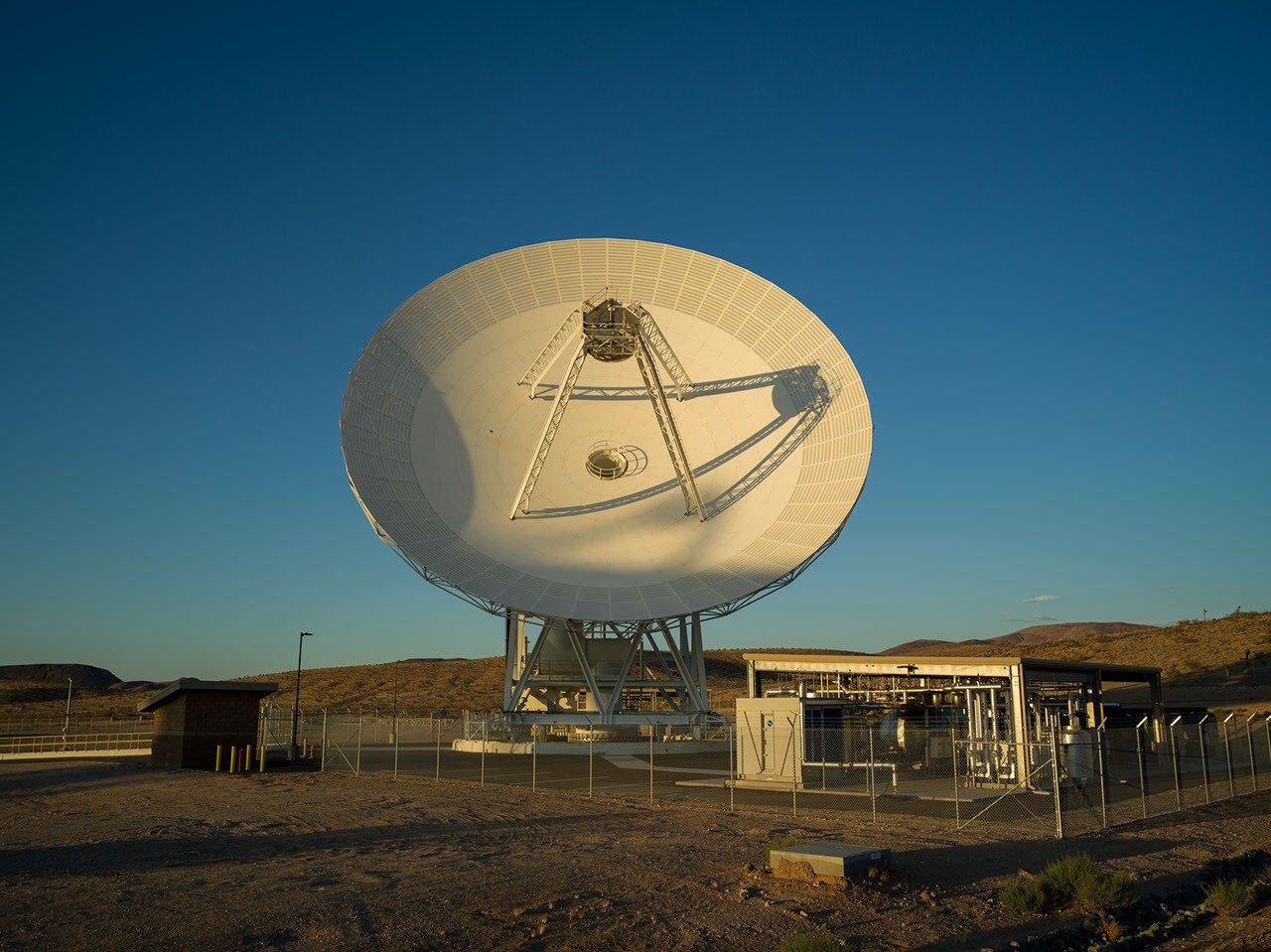
A long shadow from the newly completed Deep Space Station 23 (DSS-23) stretches across the Deep Space Network’s Goldstone complex near Barstow, California, in August 2026. The 34-meter (114-foot) multifrequency beam waveguide antenna will expand the NASA Deep Space Network (DSN) and strengthen deep space communications for decades to come.
On August 25, 2026, NASA leaders, staff, and senior officials gathered at the completed DSS-23 antenna for a ceremonial ribbon-cutting ceremony. The antenna is the latest addition to the Deep Space Network Aperture Enhancement Project, which began in 2009 to upgrade and expand the network with six new 34-meter antennas.
As a multifrequency beam waveguide antenna, DSS-23 can support missions operating across multiple radio frequencies. This flexibility helps NASA communicate with a wide range of spacecraft exploring the Moon, Mars, and destinations throughout the solar system.
The Deep Space Network tracks spacecraft across vast distances, sends commands, and receives scientific data from robotic missions. NASA’s Jet Propulsion Laboratory, a division of the California Institute of Technology in Southern California, manages the DSN for NASA’s Space Communications and Navigation (SCaN) Program. SCaN is part of NASA’s Space Operations Mission Directorate at NASA Headquarters.
For more information about the NASA Deep Space Network, visit:
Source: science.nasa.gov