


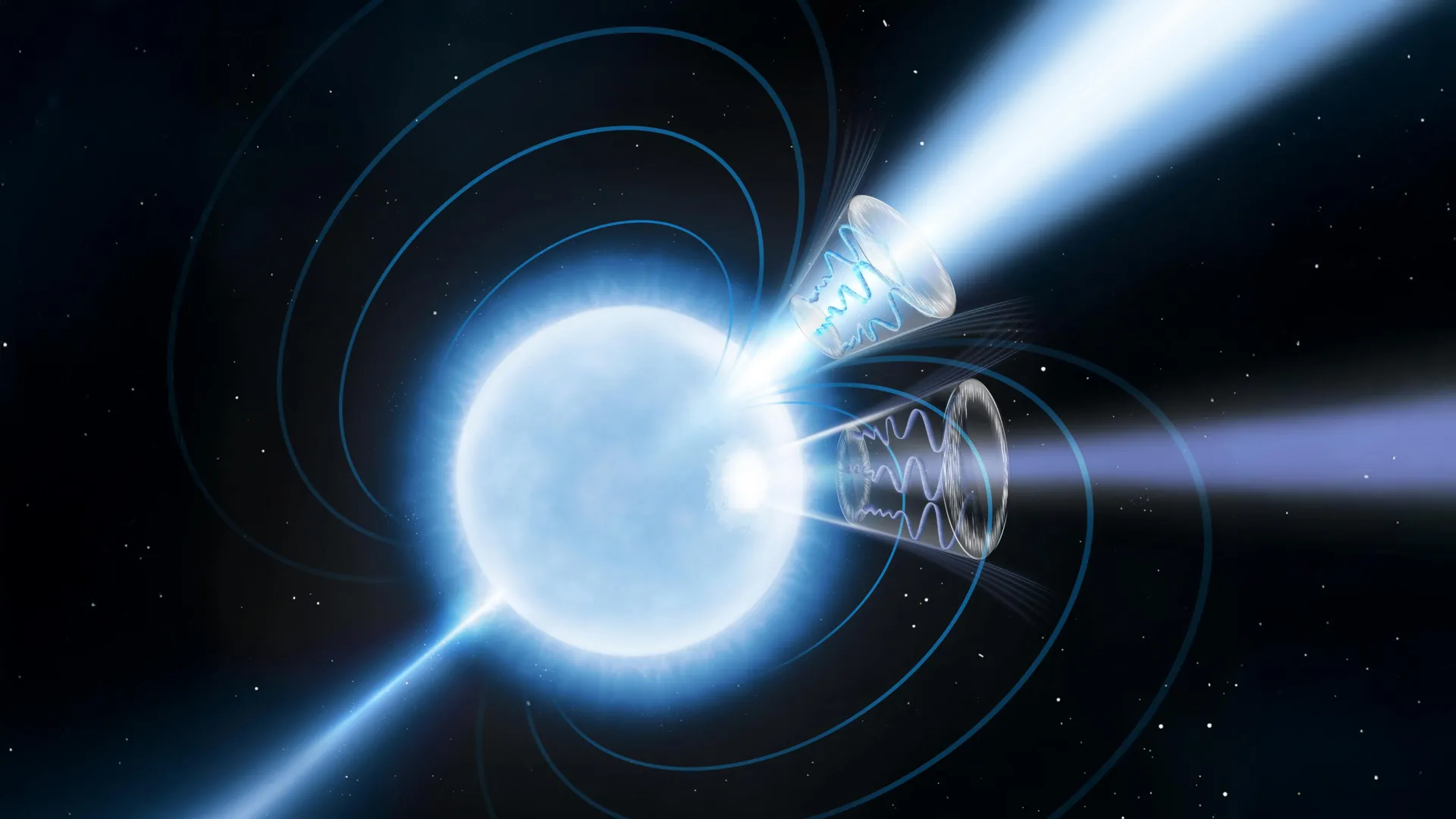
Astronomers may have found some of the strongest evidence yet for vacuum birefringence, one of the most unusual predictions of quantum mechanics. The discovery suggests that seemingly empty space can influence how light travels through it.
Vacuum birefringence was predicted nearly 90 years ago by Werner Heisenberg, one of the founders of quantum mechanics. The theory states that a perfect vacuum is not truly empty. Instead, it contains a quantum “sea” of virtual particles that can briefly appear and disappear.
Researchers, including Dr. Marcus Lower of Swinburne University of Technology, investigated this long-standing quantum mystery by studying magnetars. These rare neutron stars possess the strongest magnetic fields known in the universe.
The observations may represent the first detection of vacuum birefringence occurring inside a magnetar’s extreme magnetic field. If confirmed, the finding could provide scientists with a powerful new way to study quantum physics under the most extreme conditions. The research results were recently published in Nature.
How extreme magnetic fields change light
According to quantum theory, an extraordinarily strong magnetic field can influence the virtual particles associated with empty space. These particles may alter the way light travels, causing it to split or refract according to its polarization. This predicted effect is known as vacuum birefringence.
Magnetars provide a rare natural laboratory for observing this phenomenon because their magnetic fields are powerful enough to produce measurable quantum effects.
Dr. Lower was part of an international research team that used NASA’s Imaging X-ray Polarimetry Explorer (IXPE) to study the magnetar 1E 1547.0-5408, commonly known as 1E1547. The observations were supported by the NICER X-ray telescope aboard the International Space Station and CSIRO’s Murriyang radio telescope at Parkes, Australia’s national radio astronomy facility.
Radio observations collected by Dr. Lower using Murriyang, combined with analysis performed on Swinburne’s Ngarrgu Tindebeek supercomputer, helped researchers investigate what could be the first direct detection of this previously theoretical quantum phenomenon.
Vacuum birefringence was first predicted in the 1930s, but scientists have not yet definitively observed it, Dr. Lower said.
“To detect vacuum birefringence, we need a magnetic field more than 100 million times stronger than anything we have ever created on Earth. Fortunately, nature has provided us with magnetars, which are ideal space laboratories for studying this effect,” Dr. Lower said.
A magnetar with the ideal viewing angle
The researchers carefully studied how radio waves from the magnetar changed polarization as the star rotated. Their measurements showed that the magnetic and rotational axes of 1E1547 were closely aligned, allowing astronomers to observe the magnetar from near its magnetic poles.
Together, these features created highly favorable conditions for detecting vacuum birefringence in 1E1547.
The research team identified two important signs of quantum effects. First, the X-rays detected by IXPE displayed an exceptionally high degree of polarization. Second, the direction of the X-ray polarization remained aligned with the magnetar’s magnetic field, matching the pattern observed in radio waves.
“Because of the magnetic field’s strength, Heisenberg’s virtual particles align with the direction of the field,” Dr. Lower said.
“By tracking how the radio waves and X-rays oscillate as the magnetar rotates, we found that the arrangement of 1E1547’s magnetic and rotational poles is ideal for detecting vacuum birefringence.”
Solving a 90-year-old quantum mystery
If confirmed, the interpretation could help physicists test established theories of quantum physics under the most extreme conditions in the universe.
Dr. Lower said additional observations and more advanced computer simulations are needed to determine whether the signal truly comes from vacuum birefringence. These improvements could help researchers distinguish the predicted quantum signature from other physical processes taking place around the magnetar.
“With future data and modern simulations, we may finally be able to complete the quest Heisenberg began nearly 90 years ago.”
The study, titled “Vacuum birefringence and polarized X-ray emission in radio magnetars,” was published in Nature.
Source: www.sciencedaily.com