


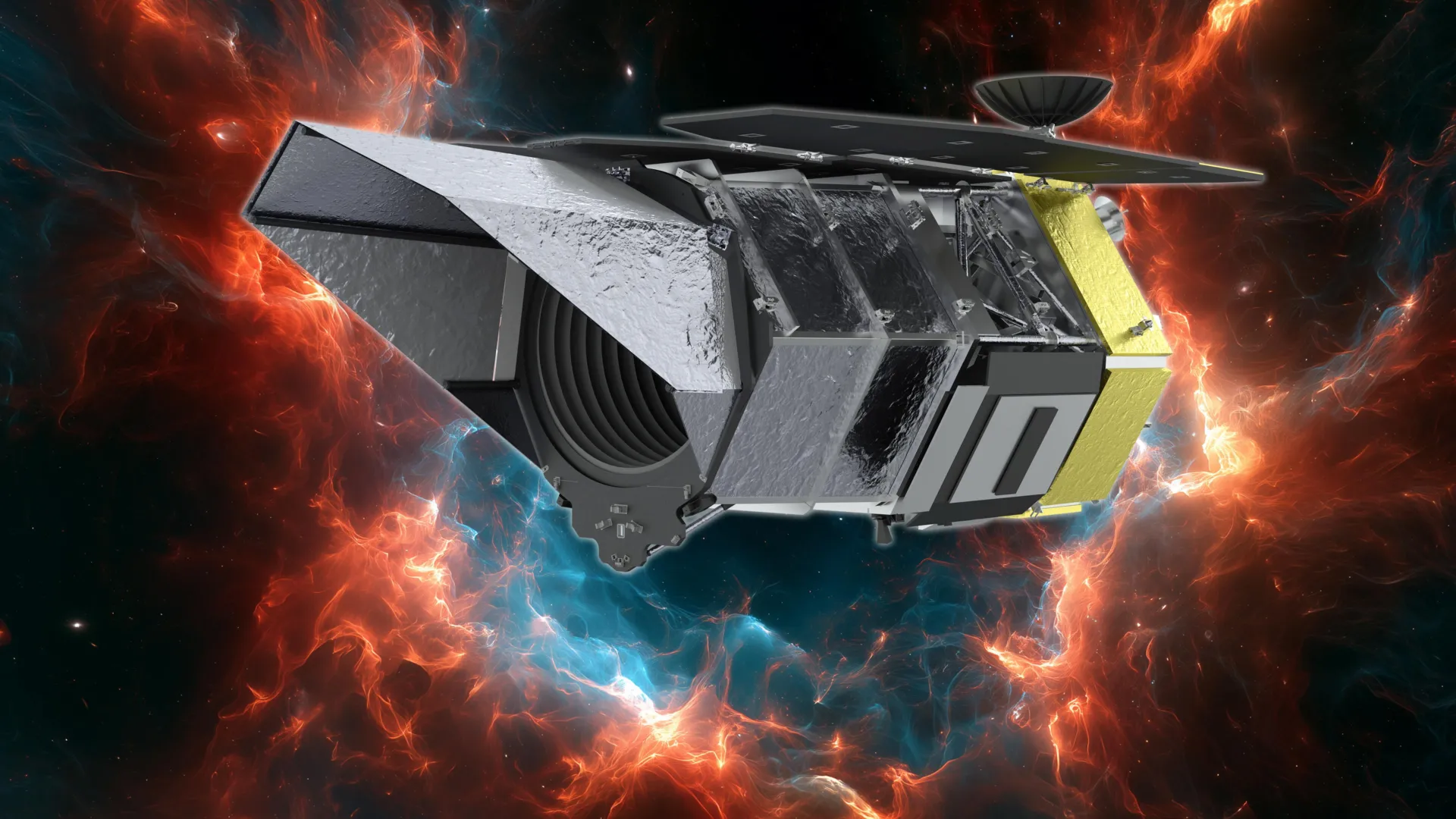
NASA’s Nancy Grace Roman Space Telescope has completed a major prelaunch milestone and is moving closer to its journey into space.
NASA mission leaders, the Nancy Grace Roman Space Telescope team, and SpaceX met Friday at Kennedy Space Center in Florida for a flight readiness review. During the formal assessment, experts evaluated the spacecraft, Falcon Heavy rocket, launch complex, and overall mission preparations to determine whether the mission was ready to enter its final launch phase.
Nancy Grace Roman Space Telescope cleared for final launch preparations
Following the review, NASA mission managers confirmed that the Roman Space Telescope was ready to proceed with the remaining steps before liftoff.
NASA and SpaceX are targeting a launch no earlier than 7:26 a.m. ET on Sunday, August 30. The space telescope will launch aboard a SpaceX Falcon Heavy rocket from Launch Complex 39A at NASA’s Kennedy Space Center in Florida.
Falcon Heavy is one of SpaceX’s most powerful launch vehicles. Its three connected booster cores generate the immense thrust required to send large spacecraft, including NASA’s Roman observatory, into orbit.
Preparing the Roman Space Telescope for its Falcon Heavy launch
In the coming days, technicians will move the Roman observatory to SpaceX’s hangar at Launch Complex 39A. The telescope is already enclosed inside Falcon Heavy’s protective payload fairing, a shell designed to shield the spacecraft from aerodynamic forces and the atmosphere during launch.
Technicians will connect the encapsulated observatory to the Falcon Heavy rocket before transporting the fully assembled vehicle to the launch pad. Once at the pad, teams will complete the final inspections and preparations ahead of liftoff.
NASA’s new space telescope will explore the universe
NASA’s Nancy Grace Roman Space Telescope is designed to provide astronomers with a wide-field view of the universe. Its observations will help scientists investigate some of the most important unanswered questions in modern astronomy.
Researchers will use Roman to study how the universe has evolved, explore the forces driving its expansion, and search for exoplanets orbiting stars beyond our solar system.
By surveying broad regions of the sky, the Roman Space Telescope will offer new insights into the history and structure of the cosmos while expanding scientists’ understanding of distant planetary systems.
Source: www.sciencedaily.com