


New Silica Map Reveals the Chemical Composition of the Moon and Mercury
German planetary researchers have produced the most detailed map yet of silica (SiO2) across the Moon and developed the first orbital estimates of silica abundance on Mercury. The study uses a newly refined laboratory calibration based on the Christiansen feature (CF), a mid-infrared spectral signature that varies predictably with the silica content of planetary surface materials.
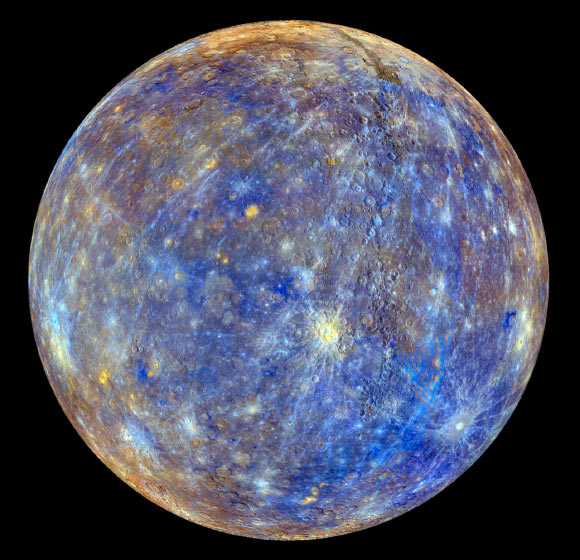
This colorful view of Mercury was created using images from MESSENGER’s color base map imaging campaign during its primary mission. The colors do not represent how Mercury appears to the human eye; instead, they highlight chemical, mineralogical, and physical differences between rocks on the planet’s surface. Image credit: NASA / Johns Hopkins University Applied Physics Laboratory / Carnegie Institution of Washington.
“Silica concentrations in planetary surface materials are a fundamental geochemical indicator used to understand the nature and evolution of planetary crusts,” said Dr. Christian Lengli of the Max Planck Institute for Solar System Research and his colleagues.
Silica is a key measure of rock composition and lithofacies. It is also linked to major mineral groups and can be used as a proxy for mineralogy and the degree of magmatic differentiation.
However, measuring silica concentrations remotely on the Moon and Mercury has been challenging. To improve these estimates, the researchers created seven types of synthetic glass covering an exceptionally broad composition range, from 0.5% to 97.6% silica.
The team used the glass samples to refine the mathematical relationship between the position of the Christiansen feature and silica abundance.
“Glass beads perform a similar function to a calibration weight on a scale,” explained Dr. Iris Weber of the University of Münster. “Because we know exactly how much silica they contain, we can interpret their infrared properties accurately.”
Using the new calibration with global observations from NASA’s Lunar Reconnaissance Orbiter Diviner instrument, the scientists created a high-resolution silica map of the Moon. Their results show that the lunar surface is broadly divided into silica-poor basaltic regions, containing an average of less than 46% silica, and silica-rich highland areas with an average concentration of about 51%.
The analysis also identified exceptionally silica-rich volcanic features. The Gruithuisen Dome, Hansteen Alpha, and Russell Massif contain silica concentrations of up to approximately 76%. Scientists have long suspected that these formations resemble rhyolite domes on Earth, but their composition had not previously been quantified so precisely using orbital data.
The researchers compared their results with lunar soil and rock samples returned by the Apollo, Luna, and Chang’e missions. The new orbital estimates showed strong overall agreement with the laboratory measurements of these samples.
Mercury May Have Less Silica Than Previously Estimated
The new calibration may also improve our understanding of Mercury. When the researchers applied it to decades-old, Earth-based infrared observations of the planet, they estimated that Mercury’s surface contains only about 37% silica.
This value is significantly lower than earlier estimates based on data from NASA’s MESSENGER spacecraft. The finding suggests that some of Mercury’s silicon may occur in unusual metallic or carbide compounds rather than in conventional silicate minerals.
“The Moon is a kind of touchstone for us and an important conceptual stepping stone on the way to Mercury,” Dr. Lengli said. “Our findings suggest that Mercury’s volcanic rocks formed from mantle material that underwent melting at greater depths than previously thought.”
The researchers say their calibration will be especially valuable for data from the European Space Agency and Japan Aerospace Exploration Agency’s BepiColombo mission. The mission’s MERTIS instrument is expected to make detailed infrared observations of Mercury during its science phase, helping scientists test whether the planet’s surface truly has a low silicon dioxide content.
The technique could also support future studies of rocky exoplanets. Infrared observations from NASA, ESA, and CSA’s James Webb Space Telescope may eventually provide information about the surface compositions of distant terrestrial worlds.
“We now hope to use data from ESA’s BepiColombo mission to confirm that Mercury’s surface has a low silicon dioxide content,” the scientists said.
The research results were featured in this month’s issue of Planetary Research.
_____
Christian Lengli et al. 2026. Silica Abundance on the Surfaces of the Moon and Mercury. Planetary Research 1(1); doi: 10.53480/bf74-m226
Source: www.sci.news