


Roman Military Camp in Spain Reveals Weapons and Soldiers’ Hobnails From the Cantabrian Wars
Archaeologists excavating a Roman military camp in northern Spain have uncovered fragments of weapons and iron studs from soldiers’ shoes. The camp was used during Emperor Augustus’ campaign to conquer the Cantabrian region in the 1st century BC.
Roman fort stood near an Iron Age settlement
According to a translated statement from the University of León, the fortified camp includes an earthwork approximately 39 feet (12 meters) wide, surrounded by a stone perimeter wall about 5 feet (1.5 meters) thick.
The site, discovered during excavations earlier this year, lies about a third of a mile (500 meters) from an Iron Age settlement once inhabited by the Kantaburi, a Celtic people who lived in the Cantabrian Mountains in what is now northern Spain.
The Cantabrians resisted Roman rule for a decade before Roman-led forces conquered them in 19 BC. The Cantabrian Wars ended local control of the region and brought the Iberian Peninsula under the authority of the Roman Empire.
Archaeologists are working on the site of a Roman fort.
Image provided by the University of León.
Military sandals and weapon fragments found at the camp
“It is not easy to find a camp associated with a hill fort in this condition,” Eduardo González Gómez de Agüero, an archaeologist from the University of León who co-led the excavation project, said in a statement.
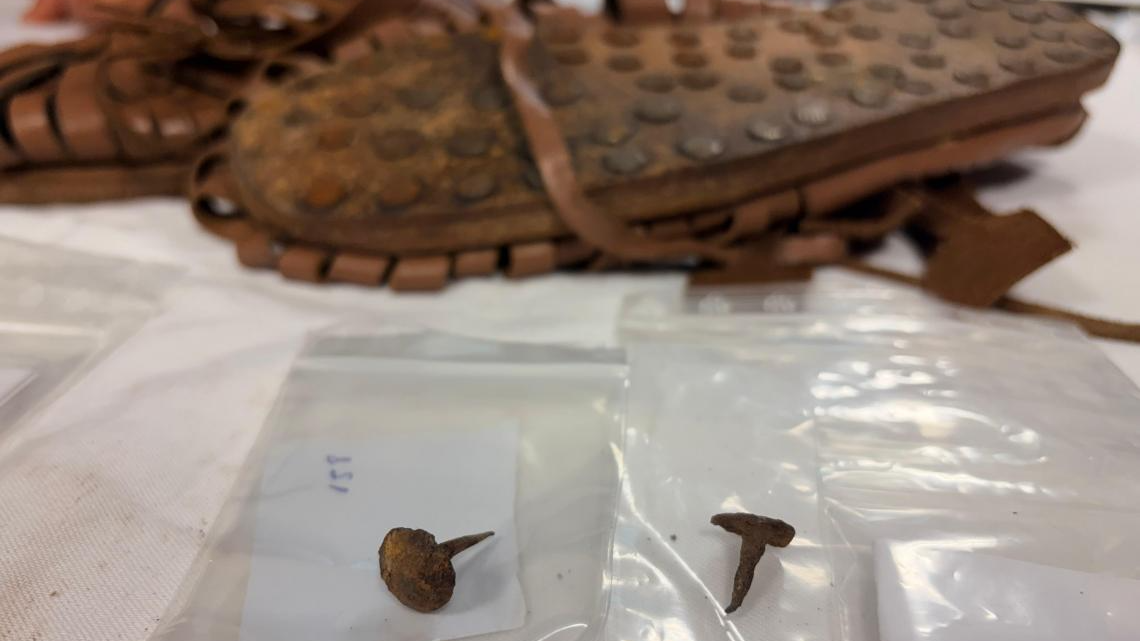
The well-preserved Roman camp also contained fragments of metal weapons and small iron studs known as hobnails. These studs were driven into the soles of Roman soldiers’ leather military sandals to provide traction on rocky and muddy terrain.
The discoveries suggest that Roman forces were prepared to attack and conquer Iron Age communities in the region.
Fire may have destroyed two Iron Age temples
Archaeologists also found evidence of a large fire that destroyed much of the pre-Roman settlement, including two temples. González Gómez de Agüero suggested that Roman forces may have intentionally set the fires during their conquest.
“It’s not just about defeating the enemy, it’s about humiliating them, erasing their identity and severing their connection to the land,” he said in a statement.
Researchers are tracing the final Roman attack
Researchers are working to establish the date of the last Roman attack on the Kantaburi settlement. They hope to determine whether the community was destroyed in a single event or over a longer period.
Another research team previously discovered 66 Roman encampments, highlighting the scale of the imperial campaign against the Cantabrians in northern Spain.
These latest findings are helping researchers understand the scale and location of Rome’s battle for control of the Iberian Peninsula.
“This is an important step in understanding how conquest took place on the slopes of León’s Cantabrian peninsula, an area that needed to link Roman camps and Iron Age settlements,” Carlos Fernández Rodríguez, an archaeologist from the University of León, said in a statement.
Can you identify these historical weapons and war objects? Test your knowledge with our World Weapons Quiz.
Source: www.livescience.com