


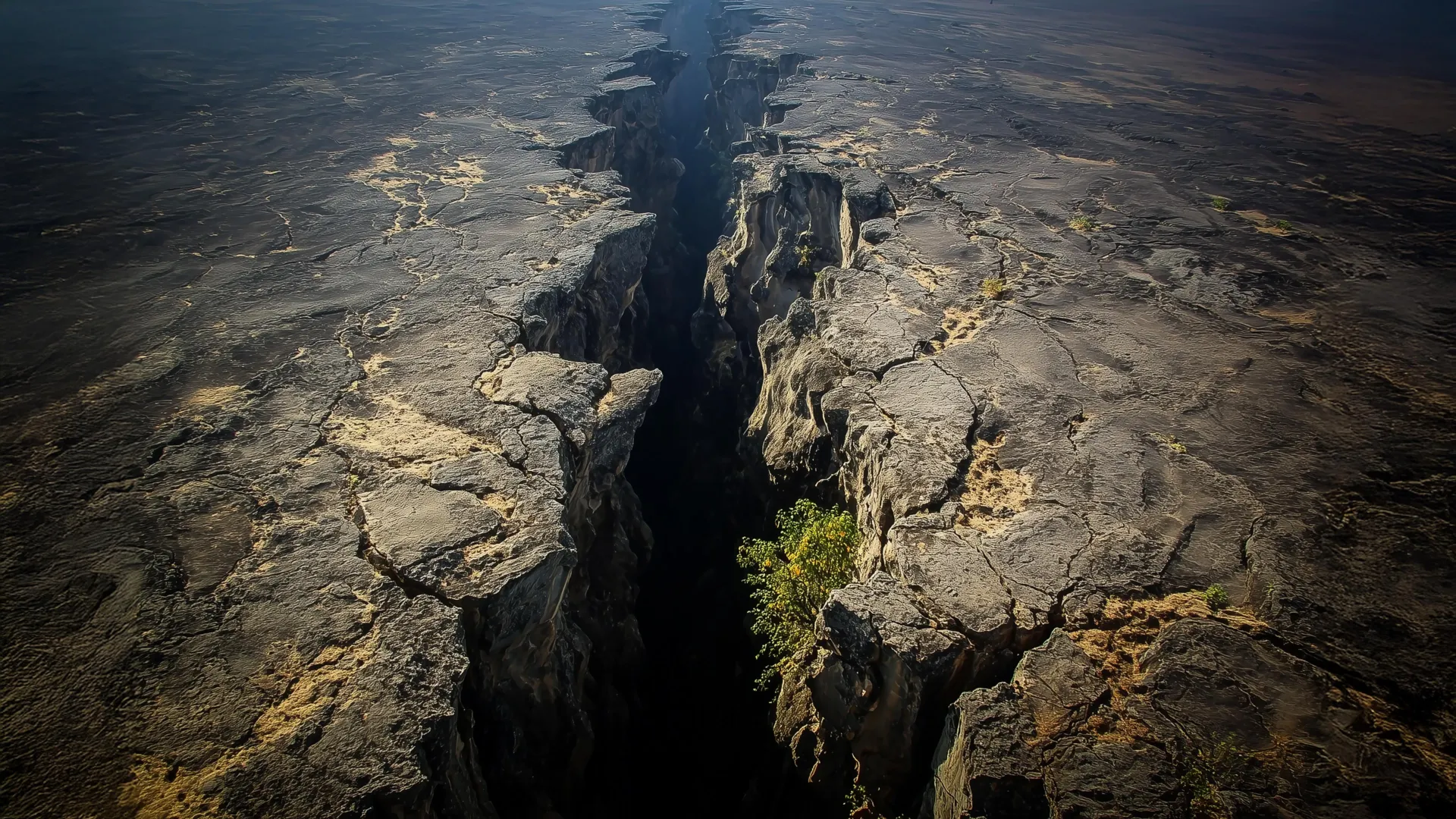
Computer models are helping scientists explain unusual deformation beneath the East African Rift Valley. New research suggests that the African Superplume—a vast upwelling of hot mantle material deep inside Earth—is driving northward movement parallel to the rift. The modeled deformation also matches seismic-wave patterns observed in the rocks beneath the region, offering new insight into how continental rifting begins.
Continental rifting occurs when Earth’s rigid outer layer begins to stretch, thin, and fracture. This outer layer, known as the lithosphere, includes the crust and the uppermost part of the mantle.
When the lithosphere is pulled apart, it can respond differently depending on how quickly and where stress is applied. Near the surface, rocks may crack and form faults, triggering earthquakes. At greater depths, hotter rocks can deform gradually over longer periods.
Geophysicist D. Sarah Stamps compares these different behaviors to Silly Putty.
“If you hit Silly Putty with a hammer, it can actually crack and break,” says Stamps, an associate professor in Virginia Tech’s Department of Earth Sciences in the College of Science. “But when you pull it apart slowly, the Silly Putty stretches. So on different time scales, Earth’s lithosphere behaves differently.”
In many continental rifts, deformation follows a predictable pattern. The strongest movement usually occurs perpendicular to the rift, in the direction the crust is being pulled apart.
The East African Rift System, the largest continental rift system on Earth, shows this expected extension. However, after analyzing more than 12 years of GPS measurements, Stamps discovered another form of movement: parts of the region were also deforming parallel to the rift.
This unexpected rift-parallel motion became a central mystery for researchers at the Institute of Geodesy and Crustal Physics.
A massive mantle plume beneath Africa
In a study published in Geophysical Research Letters, researchers used a three-dimensional thermomechanical model to investigate the cause of the unusual deformation.
The model was developed by lead author Tahirih Rajaonarisson, who was a postdoctoral fellow at the New Mexico Institute of Mining and Technology and earned a Ph.D. while working in Stamps’ laboratory at Virginia Tech.
The simulations indicate that the rift-parallel motion is linked to northward mantle flow associated with the African Superplume.
The African Superplume is a huge region of rising mantle material that begins deep beneath southwestern Africa and extends northeastward beneath the continent. The mantle flow becomes progressively shallower toward the north.
The modeling suggests that this deep mantle movement may be responsible for deformation that does not fit the simple pattern expected from continental stretching.
Two forces may be driving the East African Rift
The findings add new evidence to the long-running debate over what drives the East African Rift System.
Scientists have generally focused on two possible mechanisms: lithospheric buoyancy, mantle traction, or a combination of both.
Lithospheric buoyancy acts relatively close to Earth’s surface and is influenced by differences in elevation and density within the lithosphere. One of East Africa’s most important geological features is the African Superswell, a broad region of unusually high elevation.
Mantle traction occurs deeper inside Earth. It results from the movement of mantle material beneath the lithosphere and the forces that flowing mantle exerts on the rigid plate above it.
Stamps first documented the anomalous rift-parallel motion while working as a postdoctoral researcher. She used a GPS station that received signals from more than 30 satellites orbiting Earth approximately 25,000 kilometers above the surface.
These measurements were precise enough to detect surface movement at the millimeter scale.
Her observations complicated existing models. Shallow buoyancy forces could explain much of the expected motion across the rift, but they could not account for movement along the rift.
Earlier models pointed to a combination of forces
In a 2021 study, the research team used three-dimensional computational simulations to examine how the two forces interact.
The models suggested that both mechanisms may be important.
Lithospheric buoyancy appeared to explain the more familiar deformation perpendicular to the rift. However, the models could not reproduce the unusual parallel movement measured by GPS.
This result led the researchers to investigate additional mechanisms.
In the new study, Rajaonarisson again used three-dimensional thermomechanical modeling, this time focusing specifically on the unexplained deformation parallel to the rift.
The model showed that northward mantle flow connected to the African Superplume could produce the observed surface movement.
The simulations also reproduced another important feature beneath the rift: rift-parallel seismic anisotropy.
What seismic anisotropy reveals
Seismic anisotropy occurs when seismic waves travel through rock at different speeds or in different ways depending on their direction of movement.
This behavior can develop when minerals and rock structures become aligned. Such alignment may be caused by mantle flow, pockets of molten rock, or older structures preserved within the lithosphere.
In this study, the orientation of the rocks matched the direction of northward mantle flow associated with the African Superplume.
This agreement provides additional evidence that deep mantle movement is influencing the unusual deformation detected at Earth’s surface.
“We’re saying that rather than driving some of the deformation east-west, perpendicular to the rift, the mantle flow may be causing anomalous northward deformation parallel to the rift,” Rajaonarisson said. “We confirmed previous ideas that lithospheric buoyancy is driving the cracking, but provide new insight that unusual deformation can occur in East Africa.”
A more complex picture of continental breakup
Together, the studies suggest that no single force explains everything happening within the East African Rift System.
Shallow lithospheric buoyancy appears to play a major role in typical rift extension. At the same time, deeper mantle flow associated with the African Superplume may be responsible for the anomalous northward deformation and the related seismic patterns beneath the rift.
The East African Rift Valley is a natural laboratory for studying how continents begin to break apart. Understanding how shallow and deep Earth processes interact can help scientists better explain the formation of rifts, faults, and earthquakes.
Researchers have spent decades investigating the chain of processes involved in continental rifting, from movement deep within the mantle to the development of surface fractures and seismic activity.
“We are excited about this result from Dr. Rajaonarisson’s numerical modeling because it provides new information about the complex processes that form Earth’s surface through continental cracks,” Stamps said.
Source: www.sciencedaily.com