


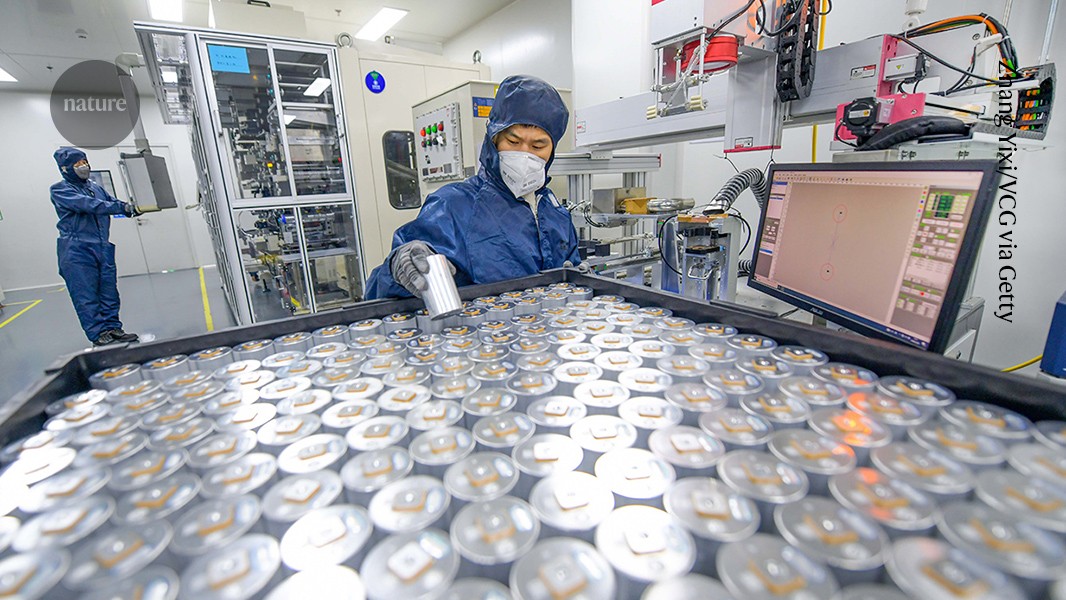
Lithium-ion batteries are the cornerstone of today’s technology, powering over 8 billion mobile phones, hundreds of millions of laptops, and a rapidly expanding number of electric vehicles and energy storage systems. However, new contenders are entering the battery landscape.
Sodium-based batteries are projected to be less costly, safer, and significantly more environmentally friendly than their lithium-ion counterparts. This year may signal the dawn of the sodium era in battery technology.
In April, CATL, the world’s largest battery manufacturer, announced plans for mass production of sodium-ion batteries by the end of 2026. The Ningde-based company also revealed agreements to supply batteries to both automakers and energy storage providers for the grid.
Initially developed in the 1980s alongside lithium-ion technology, sodium-ion batteries faced significant limitations in energy capacity and durability. Consequently, decades of research have prioritized lithium-ion development. However, in the past five years, investments and interest in sodium-ion technology have surged. Chinese manufacturers have already launched motorcycles and compact cars featuring sodium batteries, while production facilities are being established. CATL’s mass production efforts are anticipated to enhance the widespread adoption of this technology. Analysts indicate that Shenzhen-based BYD, a leading global electric vehicle manufacturer, is also investing heavily in sodium-ion batteries.
CATL’s sodium-ion batteries are utilized in electric vehicles (left) and energy storage systems (right).Credit: CATL
The swift advancement in sodium-ion technology surprised many experts. Auke Hoekstra, an energy analyst at Eindhoven University of Technology, expressed his astonishment at the rapid progress, stating, “Honestly, I didn’t expect things to happen so quickly, and I’m usually considered an optimist.”
Known for his accurate predictions in renewable energy, Hoekstra is optimistic about sodium-ion technology as a game-changer that could further lower battery prices and accelerate the electrification of the global economy. “This will be truly transformational for the future of energy,” he asserts.
Battery Prices: A Decline on the Horizon
The optimism surrounding sodium-ion technology’s potential to lower battery costs stems from the fact that its raw materials are more affordable and abundant compared to lithium-ion batteries.
Since 2010, battery cell prices have plummeted by over 90%, primarily due to enhanced efficiency in industrial processes and increased production rates. Consequently, the raw materials in cells now represent a larger portion of the total cost than they did previously.

Source: Adapted from Our World in Data/BloombergNEF
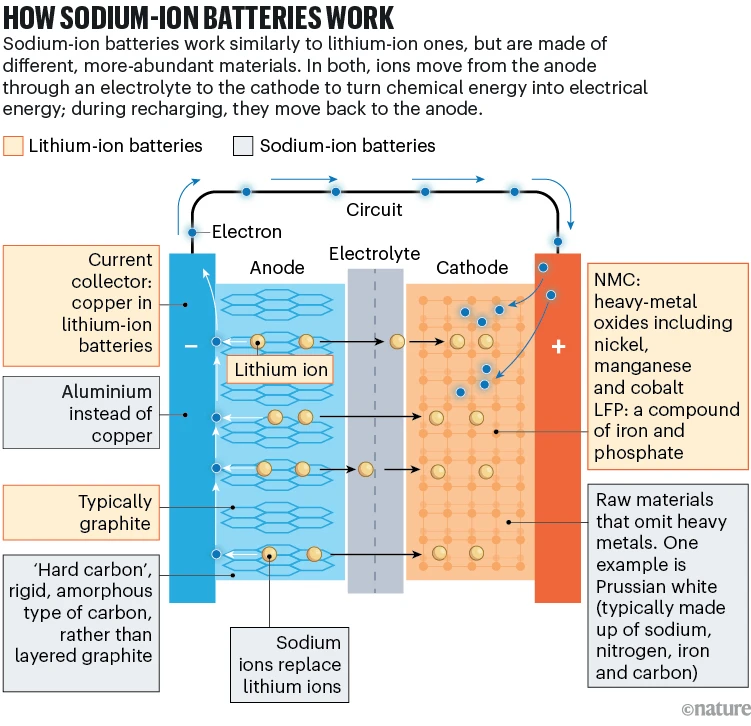
For lithium-ion batteries, the primary materials include lithium ions stored within a graphite and copper electrode (anode). The cathode draws in lithium ions during discharge. To enhance energy capacity, materials scientists have developed batteries incorporating nickel, manganese, and cobalt (NMC) to form microscopic crystals of “layered oxide,” enabling high energy storage. Advanced NMC cells have achieved capacity records exceeding 300 watt-hours per kilogram (Wh kg−1), allowing certain high-end electric vehicles to travel over 800 kilometers on a single charge.
Despite the advantages, the high costs and scarcity of some cathode materials are causing NMC prices to stabilize. In recent years, many manufacturers, especially in China, have shifted toward less expensive layered oxide cathodes that combine lithium with iron and phosphates (known as LFP). Although LFP cells offer about two-thirds the energy capacity of advanced NMC cells, they are sufficient for most electric vehicles, particularly in urban settings. Additionally, LFP batteries dominate the market for large-scale storage of excess renewable energy.

Source: BNEF (Global View)/IEA Global EV Outlook 2026 (Electric Vehicles)
Thanks to the rise of LFP, lithium-ion battery prices are in a continual downward trajectory, with raw materials now representing a significant portion of total costs.
Sodium on the Rise
During the pandemic, the lithium market faced volatility, confirming the limited nature of lithium’s supply chain amidst soaring electric vehicle demand. While adequate lithium reserves exist globally, price fluctuations and uncertainties regarding supply chain expansion have led to heightened investments in sodium technology by Chinese firms. “They aim for a reliable supply chain,” remarked Yun Chao, a researcher at Imperial College London.
Sodium, easily extracted from abundant industrial chemicals like soda ash, is significantly more plentiful than lithium, estimated to be over 1,000 times more abundant in the earth’s crust and up to 60,000 times more abundant in oceans. As of last month, the cost of industrial sodium carbonate ranged from $200 to $280 per ton, whereas battery-grade lithium carbonate was priced between $20,000 and $25,000 per ton, according to Zhang Yizhi, a CATL spokesperson.
Sodium-ion batteries also employ different materials for their layered oxide cathode. Like LFP batteries, sodium-ion batteries typically avoid the toxic heavy metals found in NMC cells. CATL has chosen Prussian white—a compound of sodium, nitrogen, iron, and carbon— for its initial mass-manufactured batteries.
Source: Quoted from: G. Harper et al. nature 575 75–86 (2019) and G. Offer et al. nature 582 485–487 (2020).
Using affordable aluminum for the negative electrode and carbon-based materials for sodium ion storage enhances sodium-ion battery efficiency. China, which has been criticized for the environmental impact of graphite mining, currently holds a monopoly on graphite supply.
According to CATL, sodium-based batteries are less flammable than their lithium counterparts (especially NMC types) and function effectively at lower temperatures down to -40 °C.
Price Competition
However, sodium-ion batteries still lag behind NMC lithium-ion batteries regarding energy capacity and range. CATL claims its mass-market sodium-ion product offers an energy density of 175 Wh kg−1, expected to rise to 200 Wh kg−1. This positions sodium-ion batteries on par with LFP, but they still only achieve two-thirds of advanced lithium-ion energy density.
Consequently, competition is primarily with LFP. CATL projects that sodium-ion battery costs will align with LFP by the end of 2026, although some analysts predict this may take longer. Many research firms state that sodium-ion batteries are currently pricier than the most affordable lithium-ion batteries, leading to uncertainty about production rates and cost reductions. Research firm Wood Mackenzie suggests parity with LFP won’t be reached until 2035.
“This is a new technology and it’s not widely available, so there’s a significant margin of error in estimates,” stated Evelina Stoikow, head of battery technology analysts at BloombergNEF.
As the sodium-ion industry emerges, comparing lithium and sodium-based battery costs becomes challenging. Analysts must also make assumptions regarding lithium prices and LFP production costs, which are still declining. The crux is that due to inexpensive raw materials, “sodium-ion batteries will be cheaper than LFPs when produced at scale,” predicts Mukesh Chattar, CEO of sodium battery startup Alsim.
Automotive and Energy Storage Applications
Currently, it remains uncertain whether sodium-ion vehicles will succeed in Western markets. Most electric vehicles in the U.S. and the EU rely on high-capacity lithium-ion batteries, while low-capacity LFP options dominate in China and developing regions. Sodium-ion-equipped vehicles could initially mirror this trend.
Another potential concern is that while sodium-ion batteries are recyclable like lithium-ion batteries, their affordability might render recycling unfeasible without government incentives.
Experts like Hoekstra believe sodium-ion technology could substantially reduce costs for large-scale stationary batteries. The growing success of LFP has demonstrated that compact energy storage isn’t as critical in this context. Hoekstra affirms that sodium-ion batteries are well-suited for energy storage in power grids primarily fueled by solar and wind energy.
Source: www.nature.com