


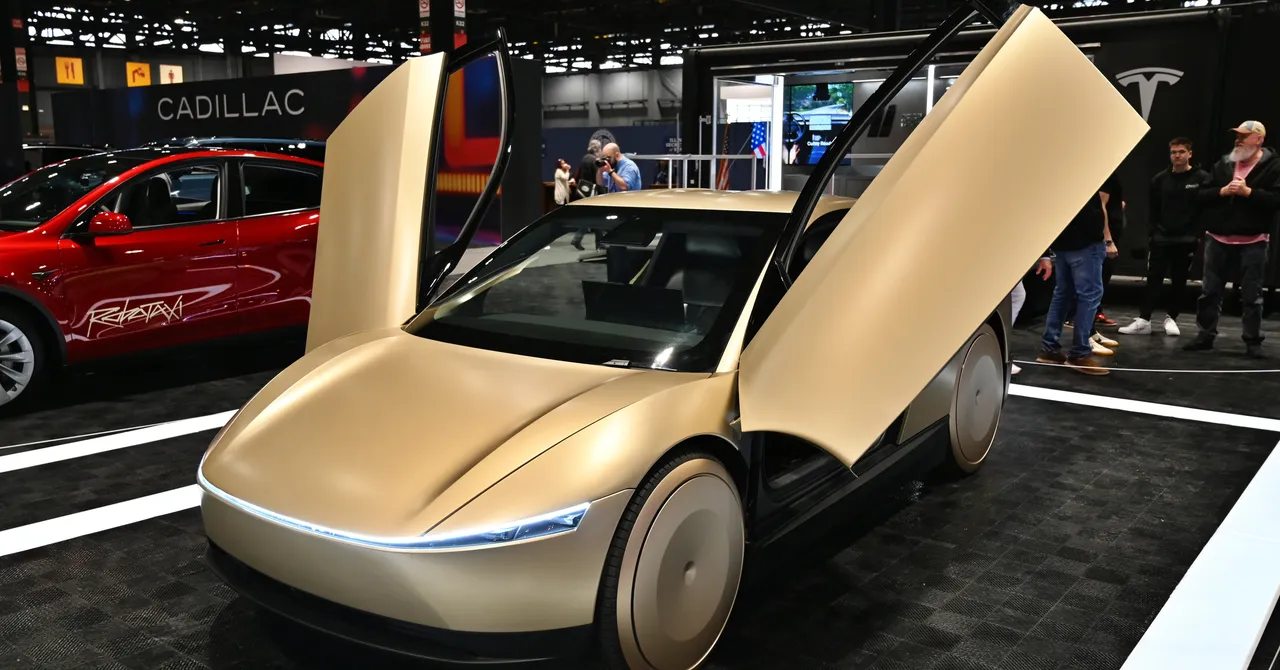
Matte gold and steering-wheel-free, Tesla’s CyberCab is designed to turn heads as the automaker moves closer to launching a dedicated robotaxi service. Tesla plans to unveil the autonomous electric vehicle at an event Thursday at its headquarters in Austin, Texas.
Tesla first revealed the CyberCab prototype in 2024 during a high-profile event on the Warner Bros. lot. This week’s presentation is expected to mark the official introduction of Tesla’s small-scale ride-hailing service. The company has operated a pilot program in Austin since last summer and has expanded testing to several other cities in Texas and Florida. Tesla has also received permission to launch the service in Arizona and Nevada. In the San Francisco Bay Area, Tesla’s robotaxi service is not legally permitted to operate without a safety driver. Before the Austin event, Tesla added 51 CyberCabs to its registered Texas fleet, along with 263 registered Model Ys.
“The streets will never be the same again,” said Ashok Elswamy, Tesla’s head of AI software, in a post on X last month. When an X user asked whether CyberCabs would “flood Austin,” Tesla CEO Elon Musk responded with his trademark hyperbole. His answer on X was simply: “Yes.”
Important details about the Tesla CyberCab event remain unclear, including the vehicle’s long-term business model. Tesla has not confirmed whether the CyberCab will be used exclusively for robotaxi operations or eventually sold to individual consumers. Regulations for self-driving vehicles vary by state, with some jurisdictions imposing strict requirements for permits, safety oversight and data collection. Musk has nevertheless said Tesla plans to sell the CyberCab directly to consumers by the end of 2026.
Regardless of how Tesla commercializes it, the CyberCab expected to be unveiled in Austin could represent a significant step in the company’s ambitious shift from traditional automaking toward autonomous vehicles, artificial intelligence and robotics. Manufacturing a vehicle is challenging, but operating a reliable self-driving service and developing the software behind it may be even more difficult. Tesla has yet to demonstrate that it can deliver either capability at scale.
“Longer term, the software is the most important component,” said Seth Goldstein, a senior equity analyst at Morningstar who follows Tesla. “This is a very important step toward mass production of the CyberCab, but ultimately, the only thing that matters is whether the software makes the vehicle safe to drive.”
For nearly a decade, Musk has promised that Tesla vehicles sold to consumers would gain driverless capabilities through a software update. That promise has not yet been fulfilled, and Musk acknowledged earlier this year that some vehicles may need hardware upgrades to support full autonomy. Tesla’s central argument is that it can deploy self-driving robotaxis more affordably than competitors because its vehicles rely primarily on cameras to navigate complex public roads. Waymo, the leading U.S. autonomous driving company, directly challenged that strategy in a recent blog post, writing: “Cameras are great, but they’re not enough.” Waymo’s more expensive autonomous driving system combines cameras with lidar and radar.
Tesla’s Full Self-Driving (Supervised) system, available to customers for $99 per month, can perform tasks such as changing lanes and stopping at red lights. However, Tesla’s owner manual warns that drivers must remain attentive and prepared to take control at any time. The National Highway Traffic Safety Administration (NHTSA), the nation’s top auto safety regulator, opened an investigation in 2024 into crashes involving Tesla’s FSD system after concerns that it could behave unpredictably in low-visibility conditions. That investigation remains ongoing.
Source: www.wired.com