


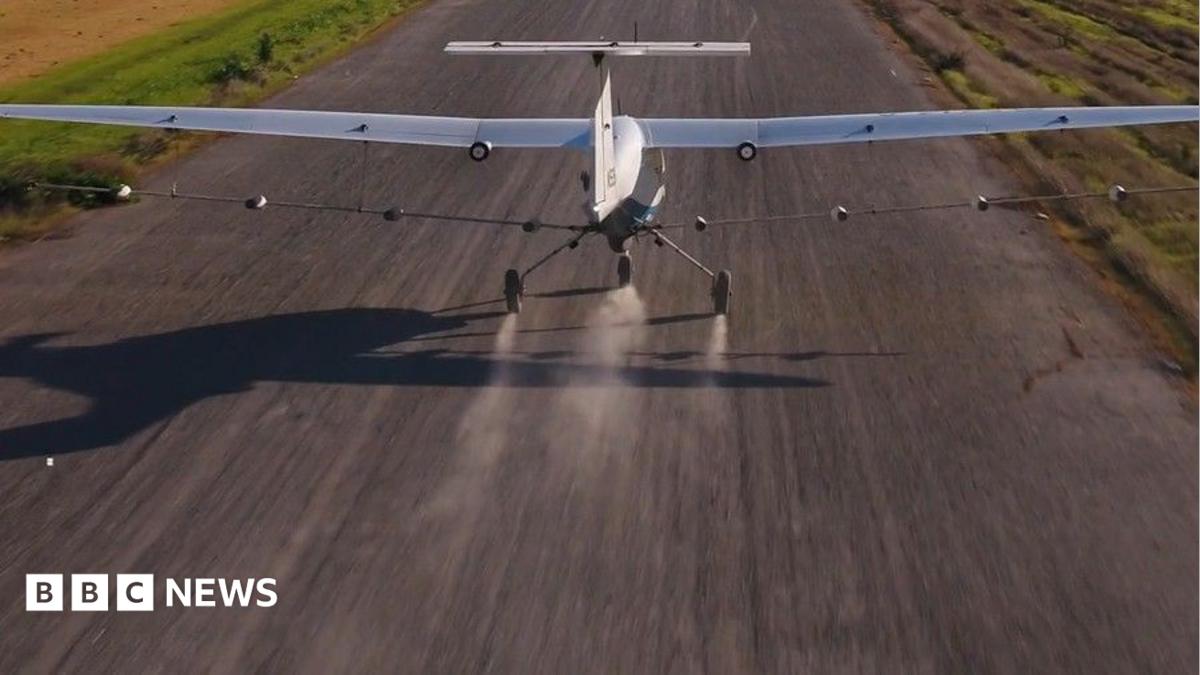
Pyka and Windracers are designing autonomous aircraft from the ground up. According to the companies, this approach allows them to integrate flight autonomy from the beginning and tailor each aircraft to specific missions.
Other companies are taking a different approach by converting existing large aircraft into autonomous cargo planes.
Backed by Boeing’s investment arm, US-based Reliable Robotics is testing its autonomous flight system on a Cessna 208B Grand Caravan. The single-pilot cargo aircraft can carry approximately 1,360 kilograms of payload across hundreds of kilometers.
Robert Rose, co-founder and CEO of Reliable Robotics, says modifying certified aircraft could eliminate the need to seek approval for an entirely new airframe. This would allow the company to focus primarily on demonstrating the safety and reliability of its autonomous aviation systems.
US-based Merlin Research is pursuing another strategy: adapting its autonomy technology for increasingly larger aircraft. The company is currently applying its system to a two-pilot Lockheed Martin C-130J military transport aircraft before moving on to a civilian multi-crew cargo plane.
“This is a common autonomy brain that can move between different aircraft,” explains Merlin founder and CEO Matt George.
The two companies also take contrasting approaches to artificial intelligence in autonomous flight.
Reliable Robotics largely avoids AI, arguing that conventional, rules-based systems can simplify the aircraft certification process.
Merlin, by contrast, is taking a more AI-focused approach to aircraft autonomy.
The difference is particularly clear in their respective detect-and-avoid systems.
One of the biggest challenges in autonomous aviation is replicating a pilot’s ability to identify and safely avoid other aircraft, obstacles, and changing conditions. The margin for error is extremely small.
Because no single detection system is perfect, companies are combining multiple sensors or adding redundant versions of existing aircraft systems to improve safety and reliability.
Reliable Robotics has installed a forward-facing air-to-air radar capable of detecting other aircraft more than eight kilometers away. Its software then uses predefined rules to determine how the aircraft should respond.
“It’s better than a pilot’s eyeball,” Rose says.
Merlin, meanwhile, uses AI-powered cameras to detect and classify objects in the aircraft’s flight path.
Since its founding, Pyka has used LIDAR to identify trees, vehicles, large birds, and terrain. However, because LIDAR has a limited detection range, the company is also planning to add an AI-equipped camera. This would be Pyka’s first full-scale AI installation.
“In many cases, you don’t need to use AI, but it’s the perfect tool for determining whether those six pixels in the distance are an airplane or some other object,” Norcia says.
The debate over AI also extends to communication with air traffic control.
When operating in shared airspace, autonomous aircraft must be able to receive, interpret, and respond to radio instructions, typically from air traffic controllers.
Reliable Robotics initially plans to use highly trained remote pilots on the ground to manage communications and make safety-critical decisions.
Merlin plans to use generative AI trained on thousands of hours of recorded communications to interpret air traffic control instructions and respond independently.
“Our problem is even more difficult—but we want to move beyond remote control,” George says.
Merlin intends to gradually reduce the number of pilots from two to one and eventually to zero.
Pyka is content to “pave the way” for other companies seeking the best methods for operating autonomous aircraft in shared airspace, Norcia says.
Although fully autonomous passenger flights remain some way off, many industry observers believe the technology developed for autonomous cargo aircraft could eventually influence commercial aviation and make piloted flights safer.
The Air Line Pilots Association, International (ALPA), says these safety advancements would be a welcome development.
Source: www.bbc.co.uk