


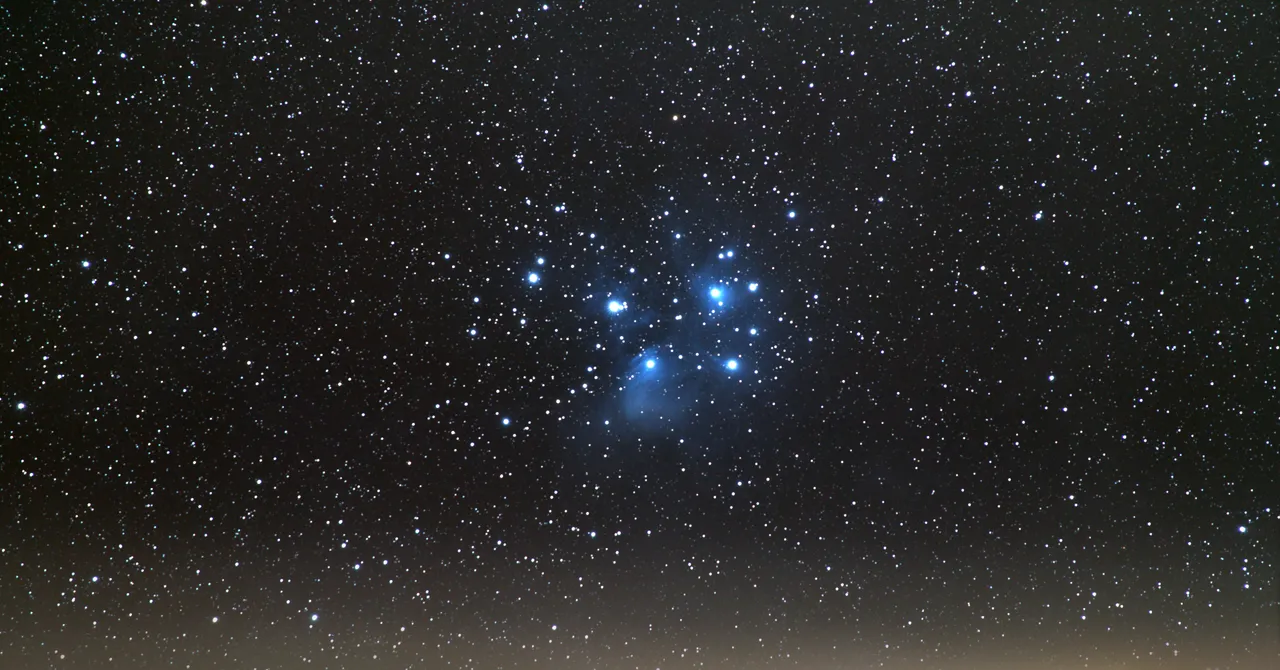
As the Moon enters its waning phase, skywatchers may have a good opportunity to spot this celestial pairing. To the naked eye, the objects appear as a cluster of bright points beside the Moon, resembling a small group of diamonds. Binoculars can reveal even more detail. The Moon and the nearby objects will meet again on September 30, when they will be separated by only about one degree.
A Low-Activity Meteor Shower Peaks on September 9 and 10
September brings a lesser-known meteor shower to the night sky. The Epsilon Perseids are expected to peak on September 9 and 10, producing as many as eight meteors per hour under ideal viewing conditions.
Although the Epsilon Perseids are less active than the famous Perseid meteor shower in August, they offer a key advantage for stargazers. Their peak arrives just two days before the new Moon, creating darker skies and better conditions for spotting meteors.
Viewing conditions should be particularly favorable in the Northern Hemisphere. For the best chance of seeing shooting stars, choose a clear location far from city lights and other sources of light pollution.
Venus Reaches Its Greatest Brightness on September 22
Venus is already one of the easiest planets to see, but it will appear especially bright toward the end of September. Its apparent magnitude is expected to reach approximately -4.8. For comparison, the full Moon has a magnitude of -12.7, while Sirius—the brightest star in the night sky—has a magnitude of about -1.46.
Look toward the western horizon shortly after sunset to find Venus. Observers in the Southern Hemisphere are expected to have the best viewing conditions.
September Equinox Arrives on September 23
Unlike the other astronomical events in this guide, the September equinox is not something that can be observed as a single visual event. Instead, it marks a precise moment in Earth’s orbit and the seasonal transition between summer and fall or winter and spring.
The September equinox occurs on September 23, when the Sun crosses the celestial equator while moving south. It marks the beginning of astronomical fall in the Northern Hemisphere and astronomical spring in the Southern Hemisphere.
Neptune Reaches Opposition on September 26
Finding Neptune is much more challenging than spotting the brighter planets. The most distant planet in the solar system—excluding dwarf planet Pluto—is expected to reach opposition on September 26. At opposition, Earth passes approximately between Neptune and the Sun.
This alignment keeps Neptune visible for much of the night and places it at its closest point to Earth for the year. As a result, September offers one of the best opportunities to observe Neptune in 2026, although a telescope will be needed to locate the faint blue planet.
Source: www.wired.com