


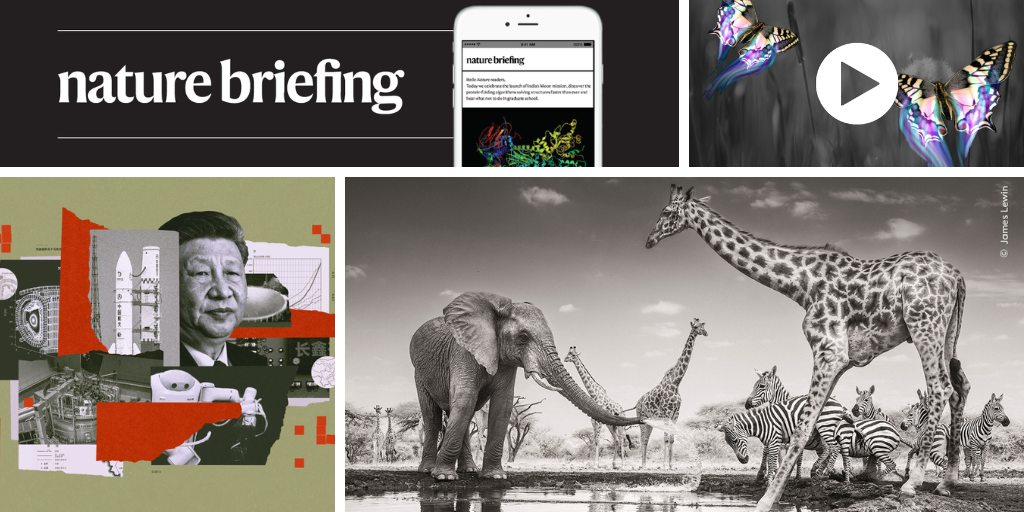
Nature Briefing: China’s scientific rise, AI talent and the world’s oldest shipwreck claim
Hello Nature readers. Would you like to receive this briefing free in your inbox every day? Sign up here.
Illustration: Jasiek Krzysztofiak. Photo: Qilai Shen/Bloomberg/Getty; Sean Hsu/EPA/Bloomberg/Getty; AFP via Getty; Institute of Plasma Physics Science of Hefei Institute of Physics, Chinese Academy of Sciences; SL Chen et al./Scientific Reports (CC BY 4.0); VCG(2) via Getty.
China’s scientific rise comes with major challenges
In fewer than 50 years, China has grown from having little scientific presence on the world stage to becoming a scientific powerhouse on track to lead the world in research and development.
Before that happens, however, China will need to address several systemic concerns. These include widespread scientific misconduct, regulatory and ethical questions in cutting-edge biomedical research, and an academic culture that researchers say makes it difficult to pursue long-term, curiosity-driven projects.
Nature | 14 min read
China’s AI graduates are staying home
An increasing number of Chinese artificial-intelligence graduates are choosing to remain in the country instead of pursuing opportunities overseas. The shift could help China close the gap with the United States in AI research.
China-based researchers currently dominate global AI publications, while companies such as DeepSeek and MoonshotAI are demonstrating the potential of Chinese AI models. Competition for jobs is fierce and pressure to publish is intense. If China can retain its talented workforce, it could become the world leader in AI by the end of this decade.
Nature | 11 min read
News
Could GLP-1 drugs help treat addiction and Parkinson’s disease?
The success of GLP-1 obesity drugs has prompted several pharmaceutical companies to investigate similar compounds for brain diseases.
Eli Lilly has announced results from an early clinical trial of a compound related to tirzepatide for treating alcohol use disorder. Biotechnology company Kariya Pharmaceutical has conducted similar research on GLP-1-like compounds for Parkinson’s disease.
It remains unclear exactly how GLP-1 drugs might inhibit addiction, and previous attempts to treat Parkinson’s disease with GLP-1 drugs have failed.
Nature | 6 min read
Could this be the oldest shipwreck ever discovered?
Archaeologists say amphorae and other artefacts found off Türkiye’s Mediterranean coast could belong to the oldest shipwreck ever discovered. Based on the pottery, the research team says the vessel sailed during the Early Bronze Age, between 4,700 and 4,400 years ago.
Some material was still inside one of the pots. “I looked inside and almost fainted,” archaeologist Karin Sowada said. “It could be olive oil, it could be wine, it could be tree resin.”
References: Maritime Archaeology Journal paper and Maritime Archaeology Journal paper.
This week’s image: an elephant sprays a zebra

Photographer James Lewin used an infrared camera to transform the harsh sunlight at a Kenyan watering hole into a dreamy black-and-white scene.
The image was developed and produced by Wildlife Photographer of the Year in the Animals in the Environment category. Visit the Natural History Museum in London.
BBC | 10 min read (James Lewin/Wildlife Photographer of the Year)
Features and insights
Can researchers restore birds’ lost songs?
Birds transported for conservation or kept in captivity may not have the opportunity to learn songs from older members of their species. New research suggests it might be possible to teach them songs that have been lost.
In Argentina, researchers taught Rufous-collared sparrows (Zonotrichia capensis) songs based on handwritten annotations created in the 1960s. Physicist Gabriel Mindlin, a co-author of the sparrow study, says recordings made by hobbyist birdwatchers could one day help restore lost auditory diversity.
“One day you’ll be grateful to have all these records,” he says.
Reference: Physics D: Nonlinear Phenomena paper and scientific report.
Why university whistleblowers need stronger protections
Astrophysicist N. Wynne Evans argues that university whistleblowers who report misconduct need stronger protection against retaliation. Evans says investigations should be handled by independent experts.
“Challenging an organization can cost you personally, professionally and financially for years,” writes Evans, who experienced such consequences. The account concerns the Institute of Astronomy at the University of Cambridge.
Nature | 5 min read
Butterfly patterns may confuse predators
The bright, intricate patterns on butterflies may create visual illusions that confuse birds, helping the insects avoid capture.
After analysing slow-motion videos of butterflies taking flight, researchers found that the insects’ markings can make them appear to move in one direction while they are actually moving in the opposite direction.
Nature | 10 min video
Perseverance breaks the Mars driving record
Today, I tip my hat to NASA’s Mars rover, Perseverance, which has broken the Mars distance record.
The rover has travelled 45.22 kilometres (28 miles) in fewer than six years — farther than Opportunity travelled in nearly 15 years. “The original mission covered less than 19.4 miles,” said project manager Stephen Lee. “We’ve gone far beyond that,” with more driving still to come.
Let us know about your favourite long drives, bike rides and hikes, or send other feedback about this newsletter to [email protected].
Thank you for reading,
Flora Graham
Nature Briefing Editor-in-Chief
Contributed by Jacob Smith
Explore more Nature Briefings
- Nature Briefing: Careers — insights, advice and award-winning journalism to help you optimise your work life.
- Nature Briefing: Microbiology — microorganisms, the most abundant life forms on Earth, and their roles in health, the environment and our food system.
- Nature Briefing: The Anthropocene — climate change, biodiversity, sustainability and geoengineering.
- Nature Briefing: AI and Robotics — 100% written by humans, of course.
- Nature Briefing: Cancer — a weekly newsletter written with cancer researchers in mind.
- Nature Briefing: Translational Research — biotechnology, drug discovery and pharmaceuticals.
Source: www.nature.com