


driving force One of the greatest mysteries in astronomy is the cause of the universe’s accelerating expansion. Scientists call this mysterious force dark energy. Although it appears to permeate the cosmos, researchers still know very little about its nature.
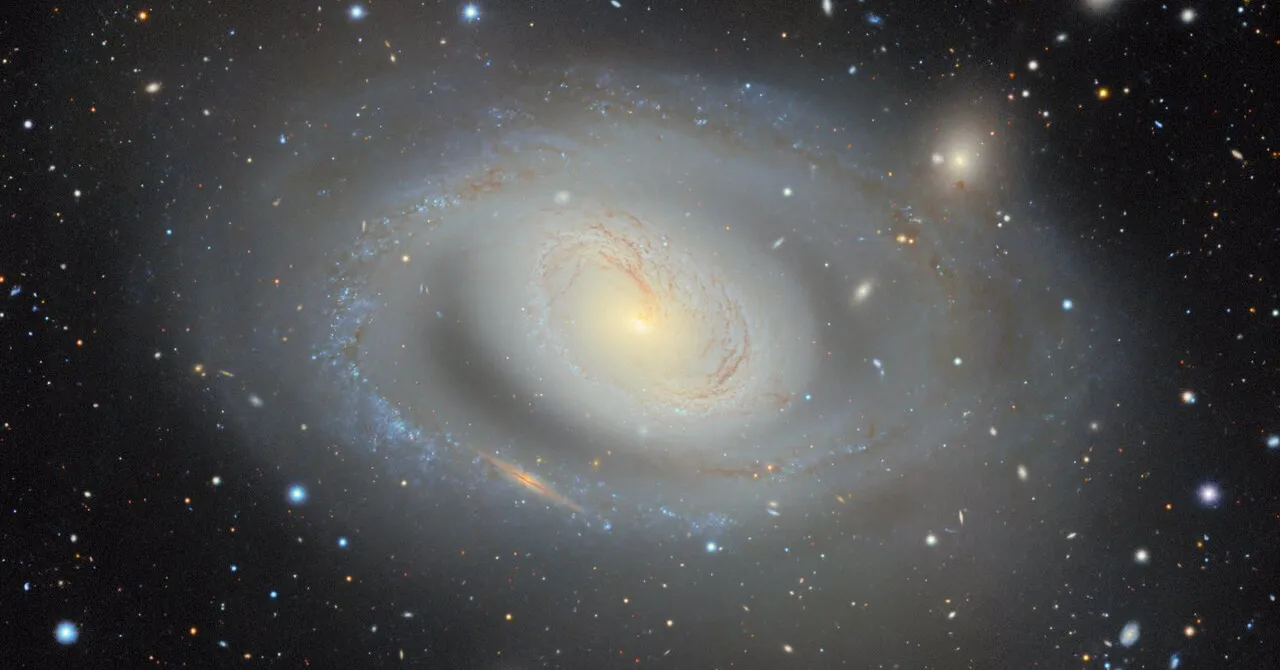
The Dark Energy Spectroscopic Instrument (DESI), located on a remote mountain in Arizona’s Sonoran Desert, has spent the past five years mapping the universe to help solve this mystery. The project has produced the largest three-dimensional map of the universe ever created. Its newest release, the DESI Legacy Image Survey, is a free online tool that lets anyone explore an enormous collection of astronomical images.
The updated map contains an extraordinary amount of data: approximately 4 billion celestial objects, including stars, galaxies, black holes, and asteroids, spread across 5.6 trillion pixels. It covers about 75 percent of the sky and includes observations in both visible and near-infrared wavelengths.
Some regions remain difficult to observe because stars, cosmic dust, and other material in the Milky Way block our view. This creates a major challenge for astronomical research, particularly for ground-based observatories. The Milky Way is shaped somewhat like a fried egg, with its dense disk appearing as a bright band of stars across the night sky. Researchers hope to point DESI’s 5,000 robotic fiber-positioning systems toward the regions above and below the galactic plane, capturing some of the clearest images yet of the distant universe.
The five-year survey builds on 13 additional years of preparation and groundwork. More than 160 scientists contributed to the data collection, and researchers have already published over 1,800 scientific papers that reference the project’s findings.
“It’s now part of the fabric of astronomical research,” says David Schlegel, a researcher at Lawrence Berkeley National Laboratory and co-leader of the Legacy Surveys. In a press release, Schlegel added, “Today, when I work with astronomical objects, I start by firing up Legacy Imaging Viewer and seeing what I’m looking at.”
Earlier this year, DESI researchers released another major map showing the distances of 47 million galaxies and quasars. The data reconstructs 11 billion years of cosmic history and examines the influence of dark energy. Scientists believe dark energy drives the universe’s expansion. Although the force itself remains undetected, astronomers can study its effects by measuring how quickly distant celestial objects appear to be moving away from Earth.
Source: www.wired.com