


Size is not everything when it comes to insect vision. A new study published in Proceedings of the National Academy of Sciences found that some of the smallest bees have photoreceptors capable of detecting fine details as effectively as those of much larger honey bee drones.
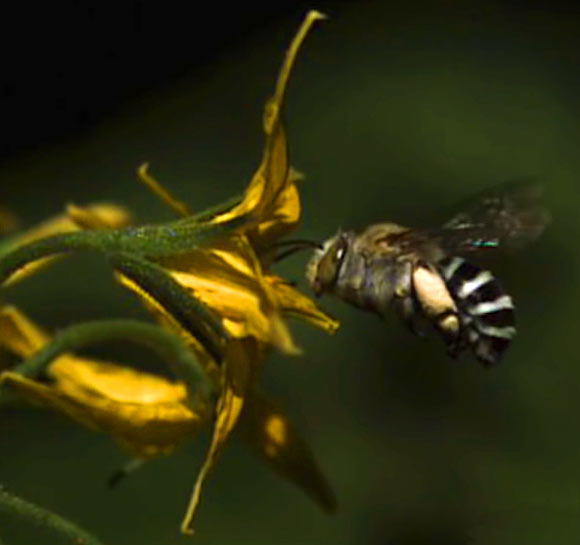
Blue-banded bee Amegilla murrayensis. Image credit: Callin Switzer.
“The western honey bee, one of approximately 20,000 bee species worldwide, has played a central role in research on insect vision,” said lead author Dr. Elisa Ligosi of Lund University and her colleagues.
“Because bees are among the most extensively studied insects, much of what scientists know about how bees see the world is based on research involving honey bees.”
To investigate how visual performance varies among bee species, Dr. Ligosi and researchers from Lund University and the University of Adelaide used intracellular recording to measure the electrical responses of individual photoreceptors—the light-sensitive cells in insect eyes.
The team examined four bee species and both sexes, including the buff-tailed bumblebee, two closely related species from the Anthophorini group, and the solitary wool carder bee (Anthidium manicatum).
The researchers then compared their findings with previously published measurements from western honey bees.
All of the bee groups tested demonstrated sharper visual acuity than female honey bee foragers.
The most surprising result came from the blue-banded bee (Amegilla murrayensis), a small solitary bee native to Australia.
Despite having relatively small eyes, this species matched the ability of honey bee drones to detect small, dark objects. Honey bee drones have particularly strong visual systems because they must track queens during fast aerial mating flights.
The findings show that bee species can evolve high-performance vision through different anatomical and physiological strategies.
Male bees that actively patrol and defend territories appear to invest in dense, highly focused visual sampling. However, this adaptation may reduce their ability to detect low-contrast objects.
Honey bee drones, by contrast, rely on large lenses and specialized light-focusing structures that help maximize both visual sharpness and sensitivity.
Blue-banded bees appear to achieve comparable visual performance more efficiently. Their advantage may come from reduced background noise in their photoreceptors rather than from investing heavily in larger visual structures.
“We were particularly surprised that this tiny blue-banded bee could detect objects in a way comparable to male honey bees, despite being much smaller,” Dr. Ligosi said.
Using electron microscopy, the researchers linked these physiological differences to specific anatomical trade-offs in the photoreceptors. Narrower rhabdoms generally provide sharper vision but capture less light, while wider rhabdoms improve light sensitivity at the expense of visual resolution.
“There is no single way to improve vision in bees,” said Professor David O’Carroll of Lund University.
“Different species have evolved different combinations of traits that produce high visual performance.”
“Bee vision is much more diverse than previously thought,” Dr. Ligosi added.
“By studying a wider range of species, we can see that evolution has created multiple solutions for achieving excellent visual performance.”
_____
Elisa Ligosi et al. 2026. Photoreceptor recordings reveal marked visual acuity in small solitary bees compared with larger species. PNAS 123 (36): e2534625123. doi: 10.1073/pnas.2534625123
Source: www.sci.news