


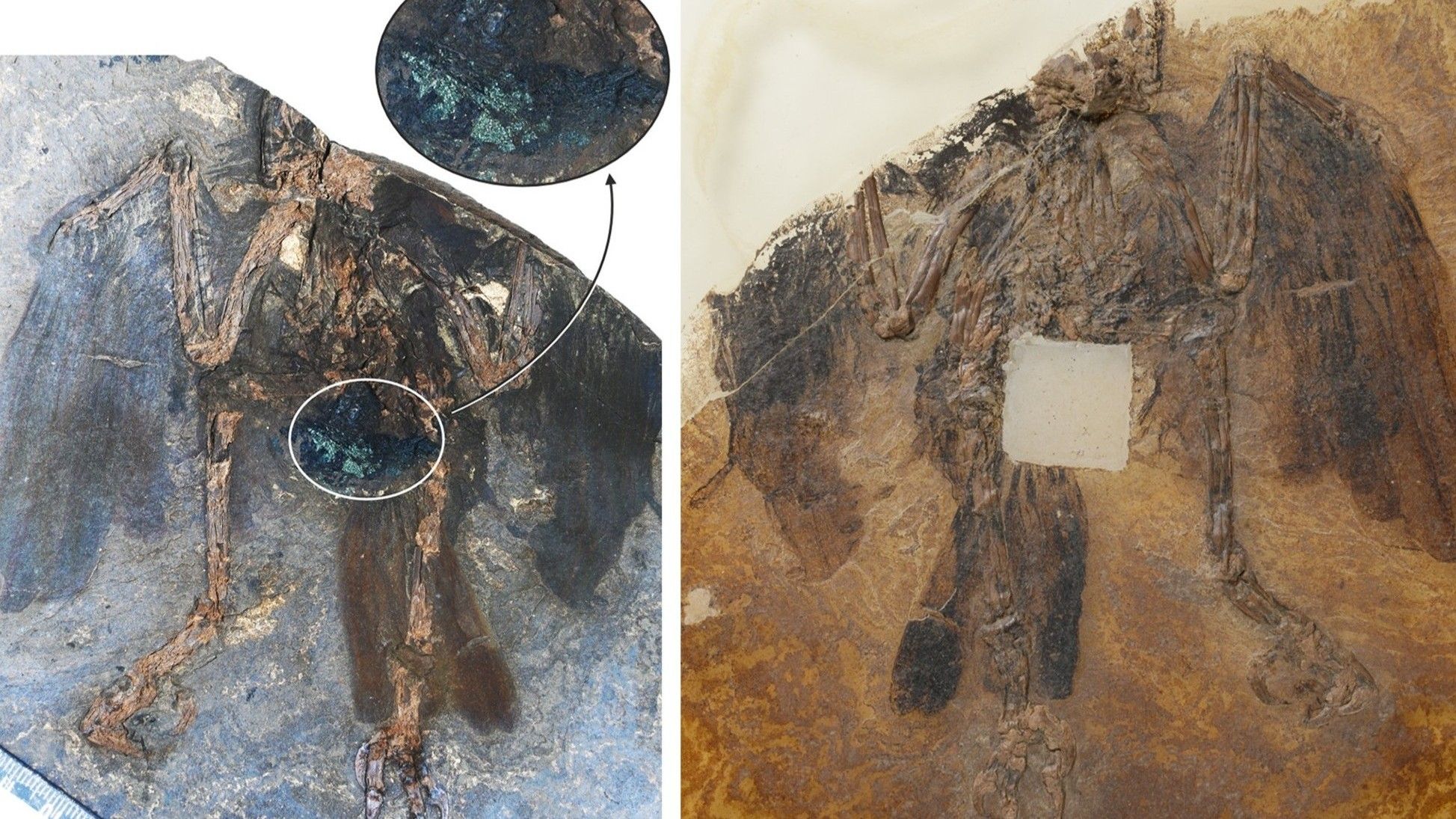
A 47-million-year-old owl fossil discovered in Germany suggests that some early owls were active during the day, offering new clues about when the group evolved its predominantly nocturnal lifestyle. The exceptionally preserved young bird still contains its final meal, a greenish-blue iridescent cockroach, and researchers say several features of the fossil point to a diurnal species.
A fossilized owl and its last meal
The newly described species, Macillastrix brattophaga, was uncovered in 2025 at the Messel Pit, an ancient lake surrounded by forest in what is now Germany. The site is considered the world’s richest fossil locality for understanding life during the Eocene, which lasted from 56 million to 34 million years ago.
Although the owl’s skull was missing, the rest of the fossil was preserved in remarkable detail. Researchers were able to identify a cockroach inside the bird’s stomach. A nearly identical cockroach found in sediment a few feet from the fossil helped the team identify the insect in the owl’s gut, according to the study published in Current Biology.
The insect’s iridescent coloring is one clue that the small owl may have hunted during daylight. Iridescent colors are associated with diurnal animals, although it is possible that the owl caught the cockroach at dawn or dusk. At less than 5 inches (12 centimeters) long, the bird may have been primarily active during the day.
Clues from the owl’s bones and feathers
Other features also support a diurnal lifestyle, including the appearance of some feathers and the shape of the bird’s upper wing bones. Meyer, a paleontologist and head of ornithology at the Senckenberg Institute and the Frankfurt Museum of Natural History in Germany, said that the shape of the upper wing bone, or humerus, may indicate when an owl was active. More information about the institute’s ornithology department is available from the Senckenberg Institute.
The Messel owl had a relatively stocky humerus, which the researchers interpret as an adaptation associated with daytime flight. In daylight, predators are easier to see, so flying silently may provide less of an advantage. Modern nocturnal owls, by contrast, generally have thinner humerus bones and are capable of nearly silent flight.
“There is a consensus that owls must have evolved from a diurnal ancestor,” Meyer told Live Science via email. Some early owl fossils have a rotating head structure similar to that of diurnal raptors, as well as bony ridges above the eye sockets that may have helped shield the eyes from sunlight.
If the interpretation is correct, the Messel owl was probably completely diurnal rather than active both during the day and at night, as some owls are today. The fossil suggests that some ancestors of modern owls had already evolved nocturnal traits, however.
When did owls become nocturnal?
Under this hypothesis, the oldest known nocturnal owl species dates to the late Eocene, about 35 million years ago. Fossils from that period and later resemble modern owls and have elongated humerus bones, Meyer noted. The oldest owl known in the fossil record is Ozigoptinx Wet Molei, which dates to about 60 million years ago, according to the Smithsonian repository.
This suggests that owls may have become nocturnal sometime between 47 million and 35 million years ago. The researchers described that interval as the best estimate currently available, because the owl fossil record is sparse and many species are known from only a few isolated bones.
“We still know very little about the early evolution of modern birds,” Meyer said, adding that every fossil discovery has the potential to change established ideas in the field.
Why did owls switch to nighttime activity?
The reason owls became nocturnal remains uncertain. Earlier theories have proposed that owls adopted nighttime activity to avoid competition with diurnal raptors or to take advantage of the expansion of nocturnal mammals. Research suggests that both groups expanded around 35 million years ago, or roughly 20 million to 25 million years ago, meaning there was no obvious single advantage that would explain a shift by owls at that time. Relevant research has examined owl evolution and nocturnal behavior and the evolution of nocturnal mammals.
The new findings add to the uncertainty over why owls became nocturnal. “By narrowing down when owls became nocturnal, our research may ultimately help solve this mystery,” Professor Meyer said.
Source: www.livescience.com