


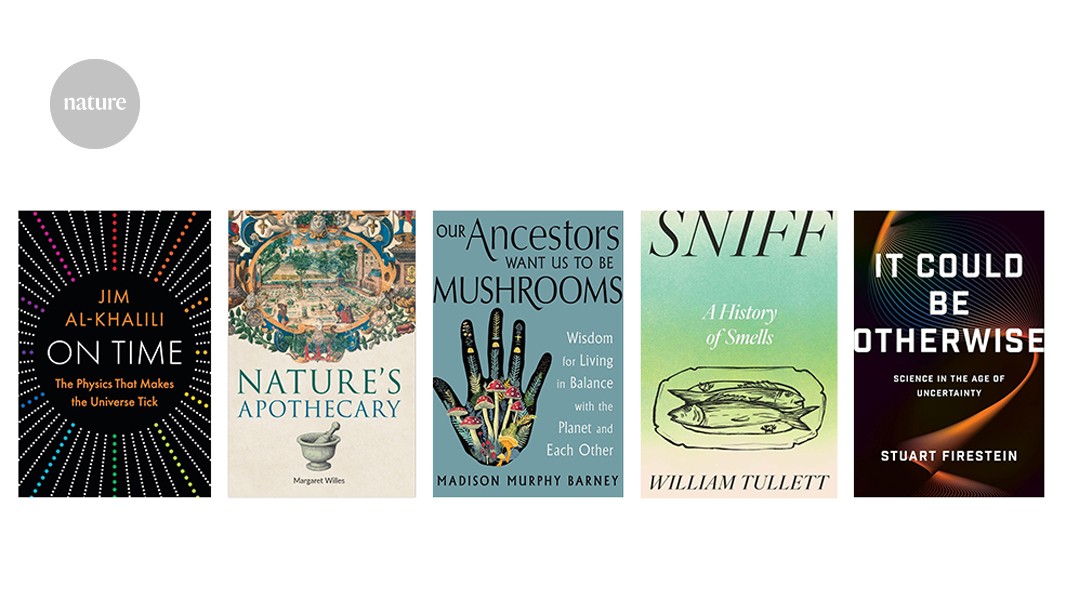
These four 2026 books explore the natural world, human sensory experience, the nature of time and the possibilities of fiction. They range from Margaret Willes’s history of European herbalism and William Tullett’s account of scent across cultures to Jim Al-Khalili’s argument that time has a real, irreversible direction. The selection also includes Stuart Firestein’s Otherwise It Might Be.
Nature’s Apothecary
Margaret Willes, Bodleian Library Publishing (2026)
“Nature itself is the best physician,” according to the ancient Greek medical authority Hippocrates. That idea introduces Margaret Willes’s fascinating history of European herbalism, which spans the Middle Ages to the present day. The book covers plants ranging from alecost (Tanacetum balsamita), a member of the Asteraceae family, to the yew tree (Taxus baccata).
Each plant is illustrated with an exquisite colour drawing taken from John Gerard’s 1597 Herball, or Generall Historie of Plantes.

Smell
William Tullett, Yale University Press (2026)
When automobiles were invented in the late 19th century, their exhaust fumes were initially welcomed because cars replaced the odour of horse dung that had left many city streets in “a state of organic olfactory crisis”, says historian William Tullett.
His immersive history of scent ranges from the smells of ancient Christianity and the perfumes of medieval India to the scents associated with 18th-century slavery and the status of smell in 20th-century China. It explores “the dirty, the savoury, and everything in between”.

On Time
Jim Al-Khalili, Princeton University Press (2026)
Shortly before his death, Albert Einstein said: “The distinction between past, present, and future is but a stubbornly persistent illusion.” In this compelling but intellectually demanding book about the physics of time, physicist and broadcaster Jim Al-Khalili disagrees. He argues that “the irreversible passage of time needs to be incorporated into the laws of physics”.
By comparing the treatment of time in quantum mechanics, general relativity and thermodynamics, Al-Khalili concludes that the arrow of time is real and gives the universe a direction.

Otherwise It Might Be
Stuart Firestein, Basic (2026)
Source: www.nature.com