


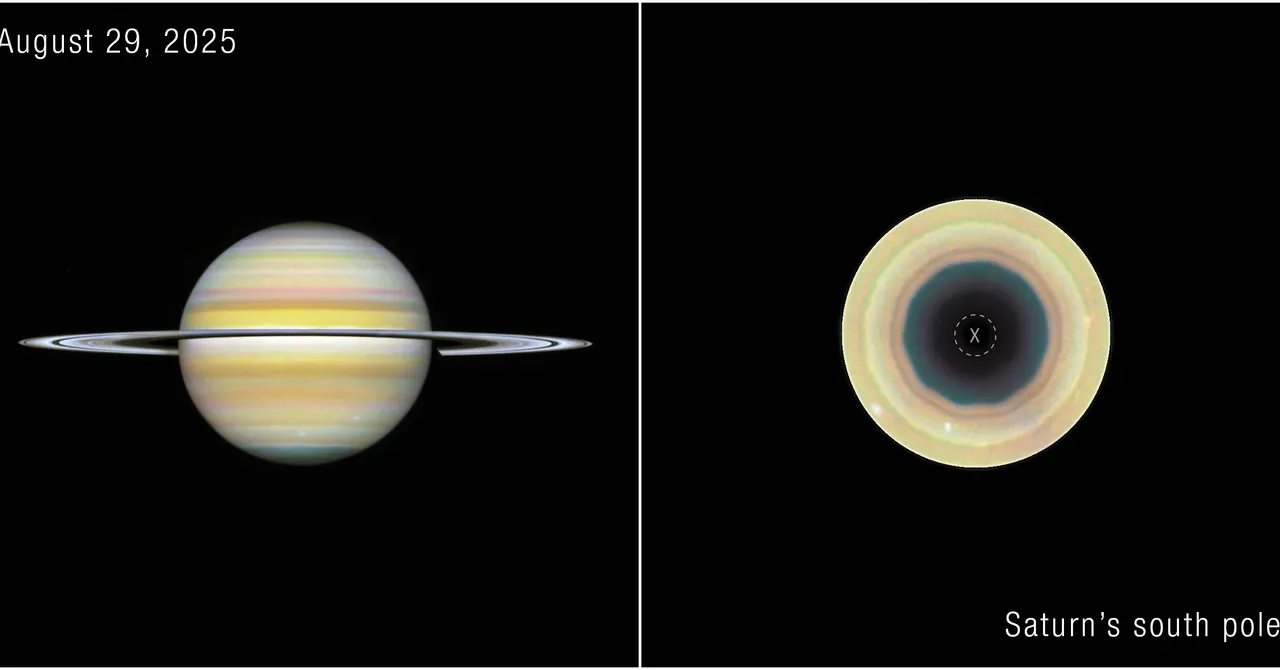
A team of astronomers has discovered a mysterious polygonal atmospheric formation near Saturn’s south pole. The feature, known as the Decagon, resembles Saturn’s famous six-sided jet stream at its north pole, which was first observed 44 years ago. The new image of Saturn’s southern decagon was captured by the Hubble Space Telescope, and the discovery was recently published in Science Advances.
The formations at Saturn’s north and south poles are not solid structures made of rock or ice. Unlike Earth, Saturn does not have a clearly defined solid surface. As an object travels deeper into the gas giant’s atmosphere, pressure and density steadily increase, but there is no conventional ground on which it can land. Instead, astronomers are observing cloud patterns created by powerful atmospheric currents.
Each side of Saturn’s decagon measures approximately 16,800 kilometers long—thousands of miles longer than Earth’s diameter. A nearby jet stream reaches speeds of up to 116 meters per second, or about 260 miles per hour. For comparison, a Category 5 hurricane is defined by sustained winds exceeding 157 knots, or approximately 180 miles per hour. Although the jet stream moves at extraordinary speeds, the decagonal pattern itself shifts much more slowly, at roughly 2.5 meters per second, or less than 6 miles per hour.
The atmospheric formation at Saturn’s south pole appears to have developed relatively recently. For decades, scientists have searched for a southern counterpart to the planet’s well-known northern hexagon. However, spacecraft missions that observed Saturn had not detected a similarly persistent structure in the south. The search was also complicated by Saturn’s axial tilt, which kept the southern hemisphere difficult to observe from Earth for many years.
The first signs of Saturn’s decagon came from ground-based observations made by amateur astronomers. As more images were collected, researchers noticed unusual activity in the planet’s southern cloud belt. Hubble observations allowed scientists to trace the feature back to images captured in 2023. Continued monitoring showed that its 10 vertices had become more clearly defined by 2025, confirming the presence of a new polygonal pattern in Saturn’s atmosphere. Scientists have not yet determined exactly how the decagon formed.
Since Saturn’s northern hexagon was discovered, researchers have proposed several explanations for these unusual atmospheric shapes. One leading theory suggests that the polygons are visible expressions of enormous atmospheric waves trapped within powerful jet streams. These waves can be compared to ocean waves—not as solid objects moving through the water, but as disturbances that travel through a fluid.
The behavior of a wave depends on the environment through which it moves and the boundaries it encounters. On Saturn, waves in the atmosphere may interact with the planet’s high-speed jet stream and become trapped within it. The process is somewhat like an ocean wave interacting with a shoreline, except Saturn’s atmospheric “shoreline” extends around the entire planet.
Source: www.wired.com