


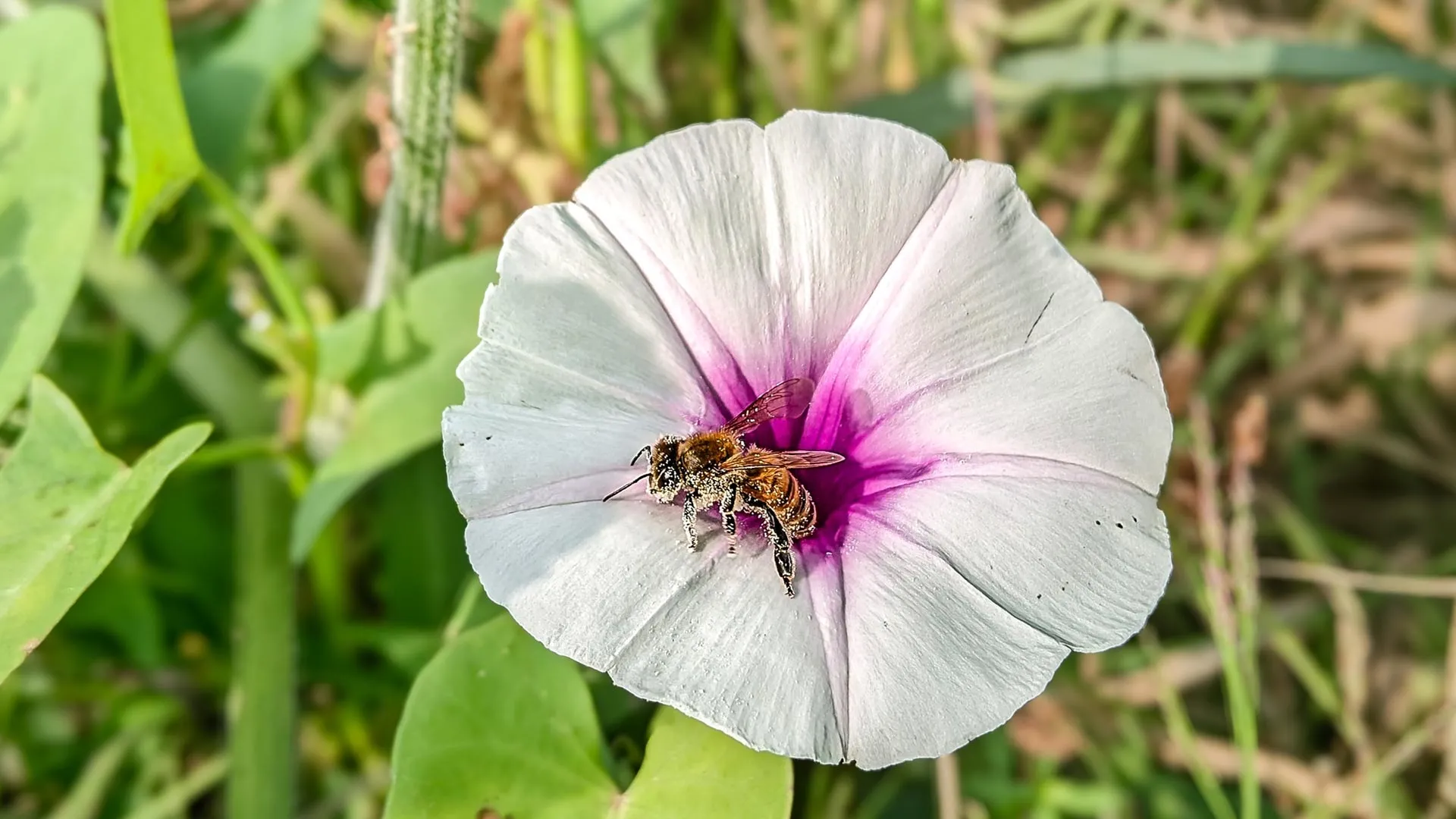
Plants facing climate change and rapidly declining pollinator populations may be pulled in competing evolutionary directions. New research from the University of Michigan suggests that, instead of adapting primarily to rising temperatures and shifting environmental conditions, some plants may be developing traits that improve their ability to attract pollinators.
Researchers found that the evolutionary adaptation rate of a morning glory population declined by 96% over nine years. This rapid slowdown could also have implications for agriculture, since morning glory is widely regarded as a nuisance weed by farmers.
“Pollinator pressure strongly favors larger flowers, so that association can limit how efficiently populations can respond to other selection pressures. It’s hard to predict whether that will ultimately make this weed more or less of a problem for farmers. The unpredictability itself is part of the story,” said Regina Baucom, a professor in the University of Michigan’s Department of Ecology and Evolutionary Biology.
Larger flowers may come at an evolutionary cost
Baucom said the decline in adaptation appears to result from a conflict between two potentially beneficial traits. Larger flowers may improve a plant’s ability to attract pollinators, while earlier flowering can help plants respond to changing climate conditions.
Both traits have become increasingly important in morning glory populations. However, the connection between them may restrict how freely these plants can evolve, with natural selection for larger flowers outweighing the potential advantages of earlier flowering.
Importantly, newer morning glory populations still contain substantial genetic variation. In theory, this genetic diversity should provide the raw material needed for continued adaptation to climate change and other environmental pressures.
“Plants are not running out of evolutionary fuel; they are increasingly locked into a trajectory of attracting pollinators, potentially at the expense of climate adaptation,” Baucom said.
Human-driven environmental changes
The study was led by Sasha Bishop, a recent Ph.D. student, in collaboration with John Stinchcombe, a researcher at the University of Toronto. The team studied morning glories as part of a broader effort to understand how human-caused environmental changes are influencing evolution in wild populations.
Climate warming is only one of the pressures facing plants and animals. Human development has eliminated previously undisturbed habitats, while the widespread use of pesticides and herbicides in agriculture has contributed to significant declines in pollinator populations.
Bishop’s research explores the growing gap between evolutionary theory and observations from nature. Evolutionary theory suggests that organisms may adapt quickly when environmental conditions change rapidly, but many wild plant populations appear unable to keep pace.
“Rather than evolving, there are whole wild populations that are going extinct, declining or experiencing genetic bottlenecks,” Bishop said. “So we’re looking at situations where there’s a lag in what we’re seeing in adaptation rates in wild populations compared to what would be theoretically possible in terms of rapid evolution.”
Testing evolutionary adaptation trade-offs
To investigate this question, the researchers cultivated two batches of morning glory plants from seeds collected from wild populations nine years apart.
They measured several traits influenced by climate conditions and pollinator activity. These traits included the date of the first flower, flower size, nectar sugar content, flowering duration and the distance between the flower’s anther—the pollen-producing structure—and stigma, the pollen-receiving structure.
The team then calculated the plants’ adaptation rate using a statistic known as R. This method estimates how a population is expected to adapt by examining relationships among multiple traits rather than analyzing each trait separately.
This approach helped researchers determine whether one characteristic could “constrain” another. In other words, changes in one trait may limit how much another trait can change.
When traits are linked in this way, they are said to “covary.” During the relatively short nine-year study period, Bishop and Baucom found that flower size and flowering time were correlated in the morning glory populations.
The evolutionary adaptability of plants is declining rapidly.
The researchers estimated that the original morning glory population was adapting at approximately 76% of the rate expected when covariance between traits was not considered.
After nine years, the adaptation rate had fallen to approximately 9% of the expected rate without covariance. The findings indicate that evolutionary constraints increased substantially over a relatively short period.
Flowering time is particularly important because plants can adjust when they flower in response to environmental changes.
“Literally thousands of studies have shown that flowering phenology is a very important adaptive pathway when it comes to climate change, particularly changes in temperature and changes in precipitation. All of these changes are occurring in these wild populations where they are collected,” Bishop said. “What I think is that these plants may be less able to adapt to climate change because of fewer pollinators, or a lack of pollination and a lack of selective drives to attract pollinators.”
Source: www.sciencedaily.com